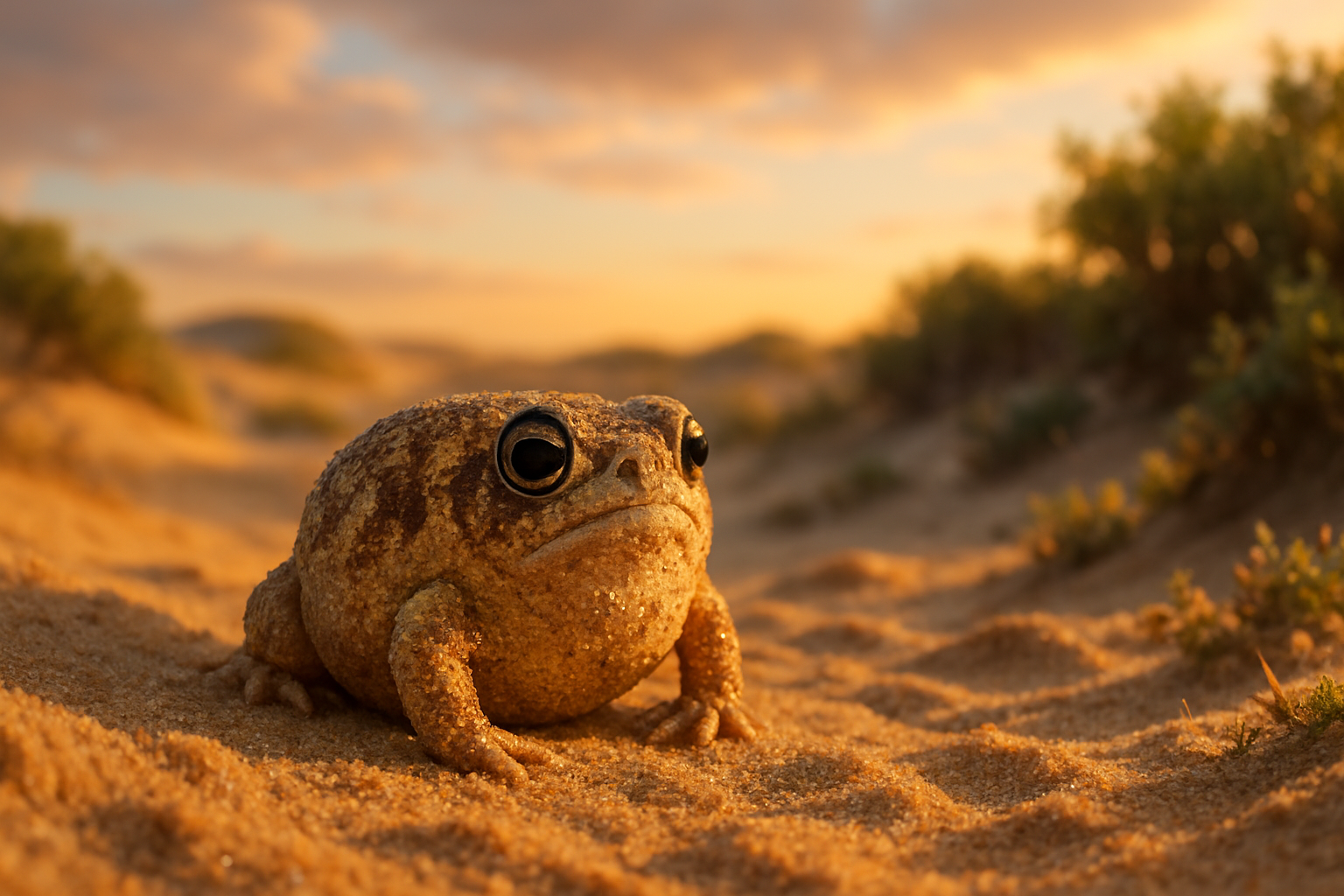
Imagine standing on a cool, fog-draped sand dune along the southwestern coast of Africa in the middle of the night. Out of the darkness comes a high-pitched squeak that sounds surprisingly like a squeezed rubber dog toy. The source of this vocalization is not a lost toy or a bird, but a tiny, round amphibian named Breviceps macrops, commonly known as the desert rain frog [1, 3, 8].
Thriving in an arid region where most amphibians would quickly perish, this creature has abandoned traditional frog behaviors to conquer a life built on sand. From digging backward into damp dunes to absorbing moisture through its belly, it uses an extraordinary array of survival traits to endure one of the world’s most unforgiving coastal environments [2, 5, 7].
A Specialized Realm on the Foggy Coast
A common misconception is that the desert rain frog inhabits vast, waterless inland deserts [2, 4, 6]. In reality, its distribution is strictly limited to a narrow coastal strip in southwestern Namibia and northwestern South Africa [2, 4, 6]. It lives exclusively within 10 to 12 kilometers of the Atlantic coastline, occupying fragile coastal sand dunes and desert shrublands [2, 4, 6].
This narrow range receives an average annual rainfall of only about 60 millimeters, and permanent surface freshwater is entirely absent [2, 4, 6]. Rather than relying on rainfall or streams, Breviceps macrops depends almost completely on dense ocean fogs blowing inland from the Atlantic Ocean [2][5]. These night fogs deposit moisture directly onto the sand dunes, creating a subterranean sanctuary for the small burrowing frog [2][5].
Walking, Running, and Burrowing Backward
Most frogs are known for powerful leaps and agile swimming, but Breviceps macrops possesses a very different physical build. It has a distinctly round, plump body supported by extremely short limbs [2][5]. Because of these anatomical constraints, it is physically incapable of hopping through the air or swimming in water [2, 5, 9].
Instead of leaping, the desert rain frog gets around by walking or running across the surface of shifting sand dunes [2, 5, 9]. When the sun approaches and surface temperatures rise, it retreats underground using specialized digging tools on its feet [2][5].
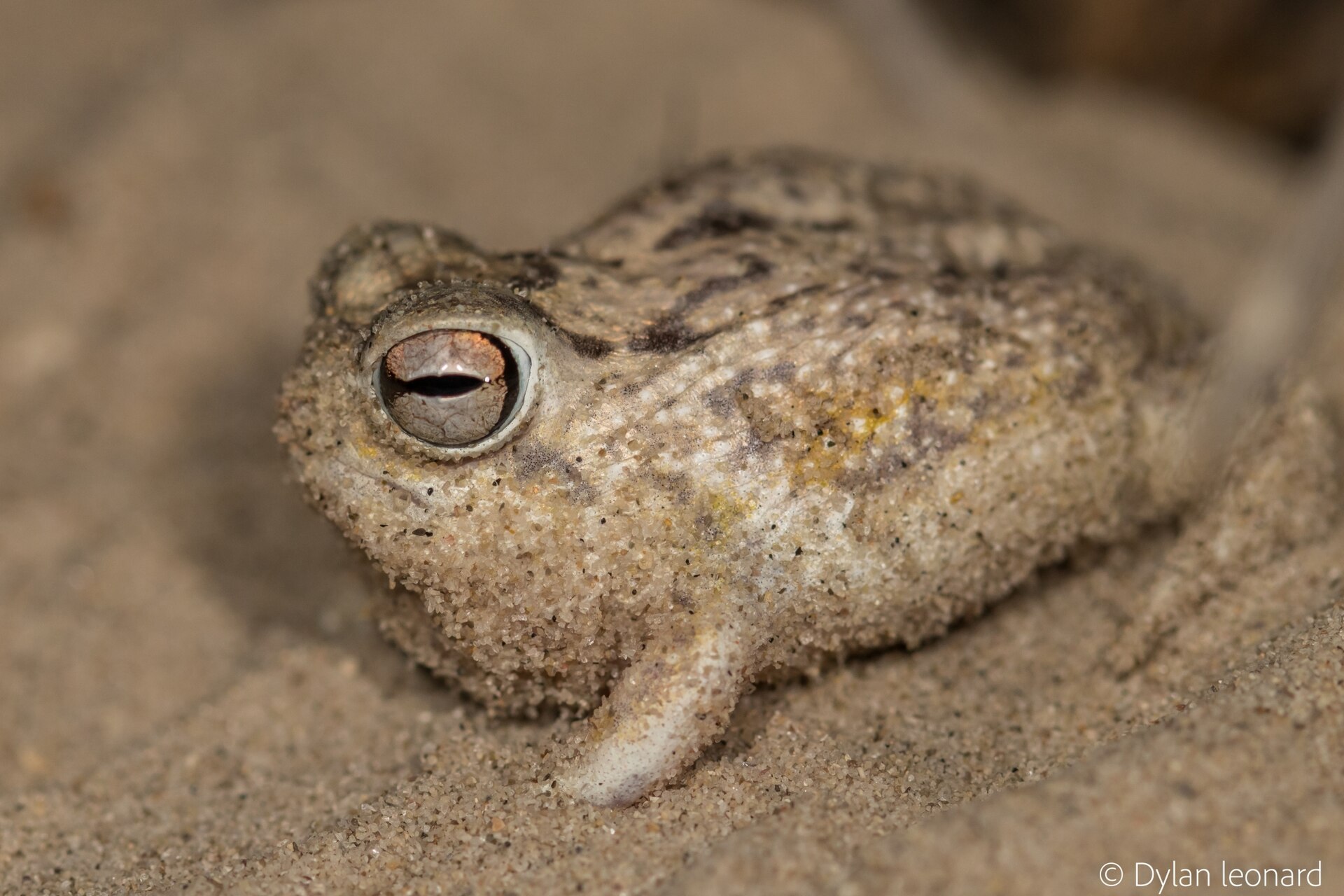
On its hind feet, the frog features shovel-like bony projections, known formally as metatarsal tubercles, along with webbed toes [2][5]. Using these metatarsal tubercles, it digs backward into the sand, scooping away particles until it sinks 10 to 20 centimeters below the surface, reaching depths where fog-borne moisture is preserved [2][5].
To further protect itself while navigating its environment, the frog secretes a sticky fluid from its skin [5][9]. Sand grains adhere to this liquid coating across almost its entire body, leaving only its eyes, mouth, and key patches exposed [5][9]. This sand layer serves a triple purpose: it acts as seamless camouflage, aids in thermal regulation, and helps retain essential bodily moisture [5][9].
Drinking Sand: The Osmotic Belly Patch
Living in a habitat without lakes, ponds, or rivers presents a major biological challenge: how does a tiny amphibian stay hydrated? The desert rain frog does not drink water through its mouth like mammals or birds do [2, 5, 7]. Instead, it extracts liquid directly from the moist sand beneath its body [2, 5, 7].
On the underside of its central abdomen, the frog features a specialized patch of clear, thin skin filled with a dense net of tiny blood vessels, known as capillaries [2, 5, 7]. When fog saturates the top layer of the dunes, the frog settles onto the damp ground [2, 5, 7].
Water moves naturally across a thin membrane from an area of higher water concentration to lower concentration, a process known as osmosis. Through osmosis, moisture passes directly from the damp sand grains, through the capillary-rich abdominal skin, and straight into the frog’s bloodstream [2, 5, 7]. This unique mechanism allows Breviceps macrops to drink directly from the ground without needing a single drop of standing surface water [2, 5, 7].
Bypassing the Tadpole Stage in Sand Nests
In standard amphibian life cycles, adults lay eggs in open bodies of water, which hatch into free-swimming, aquatic larvae known as tadpoles. In an environment completely devoid of standing pools, such a strategy would result in total reproductive failure [2, 5, 9].
To overcome this obstacle, Breviceps macrops reproduces entirely on land through a process where offspring skip the free-swimming larval stage to hatch fully formed, formally known as direct development [2, 5, 9]. Female frogs deposit their eggs inside humid underground sand burrows safe from the scorching surface heat [2, 5, 9].
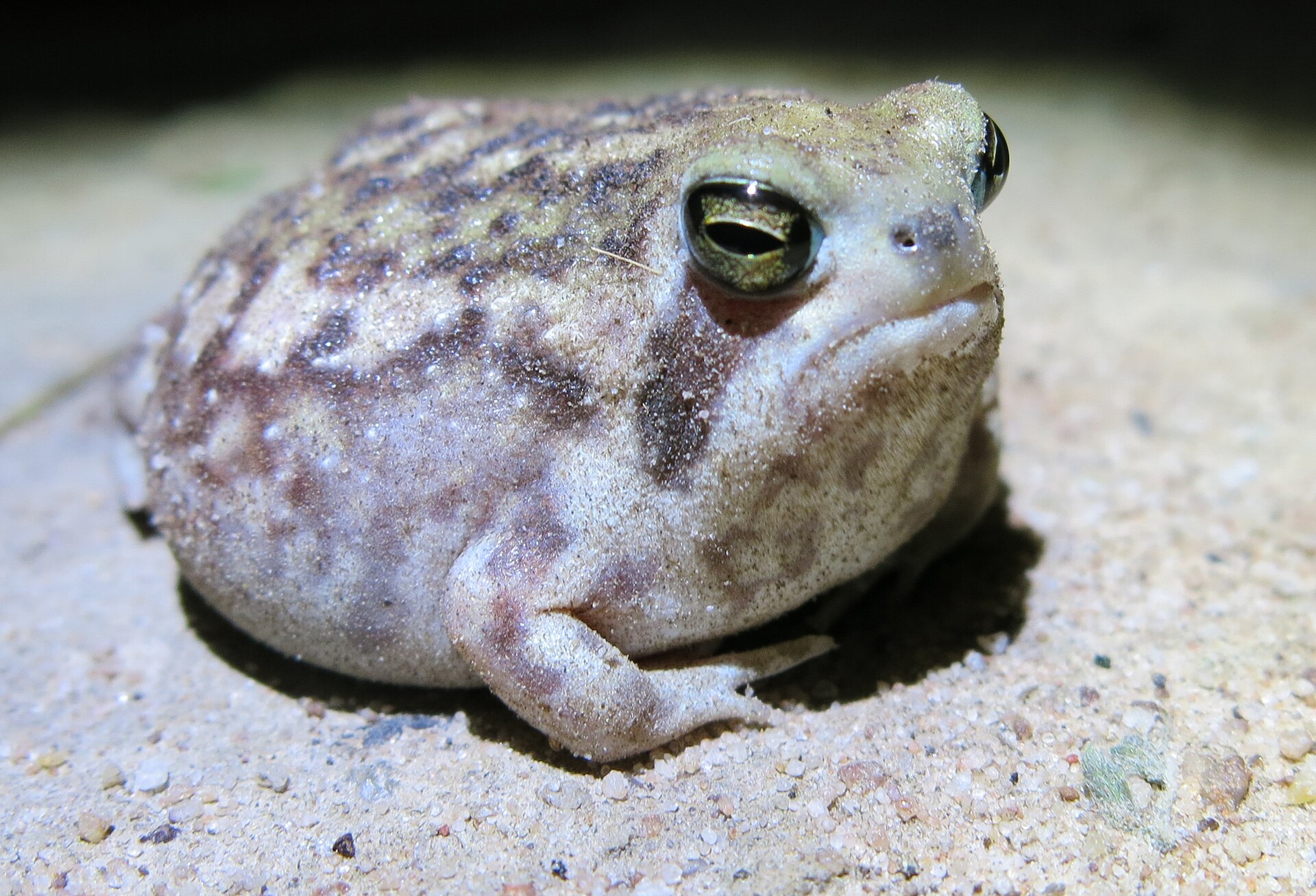
Inside these buried eggs, the embryos undergo their complete growth cycle [2, 5, 9]. Rather than hatching as gill-bearing tadpoles that require water to swim, they emerge directly from the egg capsules as fully formed miniature frogs [2, 5, 9]. From their very first moments of life, these hatchlings are fully equipped to walk and dig in their sandy terrestrial world [2, 5, 9].
The Truth Behind the Famous Defensive Screams
In viral media, videos of the desert rain frog often present its distinct high-pitched sound as a joyful squeak or a cute mating display [1, 3, 8]. However, field observations confirm that this interpretation is a popular misconception [1, 3, 8].
The famous sound is actually a high-pitched threat call and defensive scream produced when the frog feels threatened, cornered, or captured by a predator [1, 3, 8]. When confronted by danger, the frog inflates its round body with air to make itself appear as large as possible to the attacker [1, 3, 8].
Simultaneously, it lets out a loud, shrill warning squeak designed to startle and deter potential threats [1, 3, 8]. While human listeners might find the vocalization charming, for Breviceps macrops, this loud scream is a high-stakes defensive behavior used to survive predator encounters [1, 3, 8].
A Fragile Existence on a Threatened Coastline
Despite its remarkable survival mechanisms, Breviceps macrops faces significant modern pressures. The species is currently listed as Vulnerable (VU) on the IUCN Red List [2, 4, 6]. Because its global presence is restricted to a narrow strip of coastline within 10 to 12 kilometers of the shore, any disturbance to these dunes threatens the species’ long-term survival [2, 4, 6].
Human activities represent the primary drivers of habitat loss across its range [2, 4, 6]. Open-cast diamond mining along the coast strips away stable dune ecosystems, while infrastructure projects—including port expansions and green hydrogen developments—cause severe habitat fragmentation [2, 4, 6]. Additionally, illegal pet trade collection and broader climate change pose ongoing risks to these specialized populations [2, 4, 6].
There is also scientific debate regarding the total population size of this species [2, 4, 6]. Historical modeling and an assessment from 2011 suggested that the total adult population might be under 10,000 individuals due to ongoing habitat fragmentation [2, 4, 6]. However, because Breviceps macrops is a strictly nocturnal creature that spends its daylight hours buried beneath sand, obtaining precise field counts is extraordinarily difficult [2, 4, 6].
While the exact number of wild individuals remains uncertain, researchers agree that habitat degradation is driving a clear decline in overall population trends [2, 4, 6]. Furthermore, long-term studies are still required to understand how potential shifts in the coastal fog belt—caused by global climate change—will affect the moisture availability these frogs depend on for basic survival [2, 4, 6].
Echoes Across the Dunes
The high-pitched squeak echoing across the foggy coastal dunes of southwestern Africa is not a cheerful tune, but a battle cry for survival [1, 3, 8]. Every aspect of Breviceps macrops represents a fine-tuned solution to living without surface water, from absorbing subterranean moisture through its capillary-filled belly patch to digging backward into cool sand with shovel-like hind feet [2, 5, 7].
By bypassing the aquatic tadpole stage entirely and cloaking its round body in protective sand, this tiny amphibian has conquered an environment that seems entirely suited against amphibian life [2, 5, 9]. Protecting the delicate, fog-moistened coastal dunes of Namibia and South Africa will decide whether this small squeaking burrower continues to walk across the sand for generations to come [2, 4, 6].
Featured image credit
Created by TaxonGuru · AI-generated featured explanatory reconstruction · not a documentary photograph · generated 2026-07-28
Sources and editorial policy
This feature is based on publicly available scientific and institutional sources listed below. Read our AI and editorial policy. Report a correction: kjhtime@gmail.com
References
- indianexpress.com — vertexaisearch.cloud.google.com, accessed 2026-07-28
- wikipedia.org — vertexaisearch.cloud.google.com, accessed 2026-07-28
- theguardian.com — vertexaisearch.cloud.google.com, accessed 2026-07-28
- mongabay.com — vertexaisearch.cloud.google.com, accessed 2026-07-28
- critter.science — vertexaisearch.cloud.google.com, accessed 2026-07-28
- researchgate.net — vertexaisearch.cloud.google.com, accessed 2026-07-28
- earth.com — vertexaisearch.cloud.google.com, accessed 2026-07-28
- smithsonianmag.com — vertexaisearch.cloud.google.com, accessed 2026-07-28
- a-z-animals.com — vertexaisearch.cloud.google.com, accessed 2026-07-28