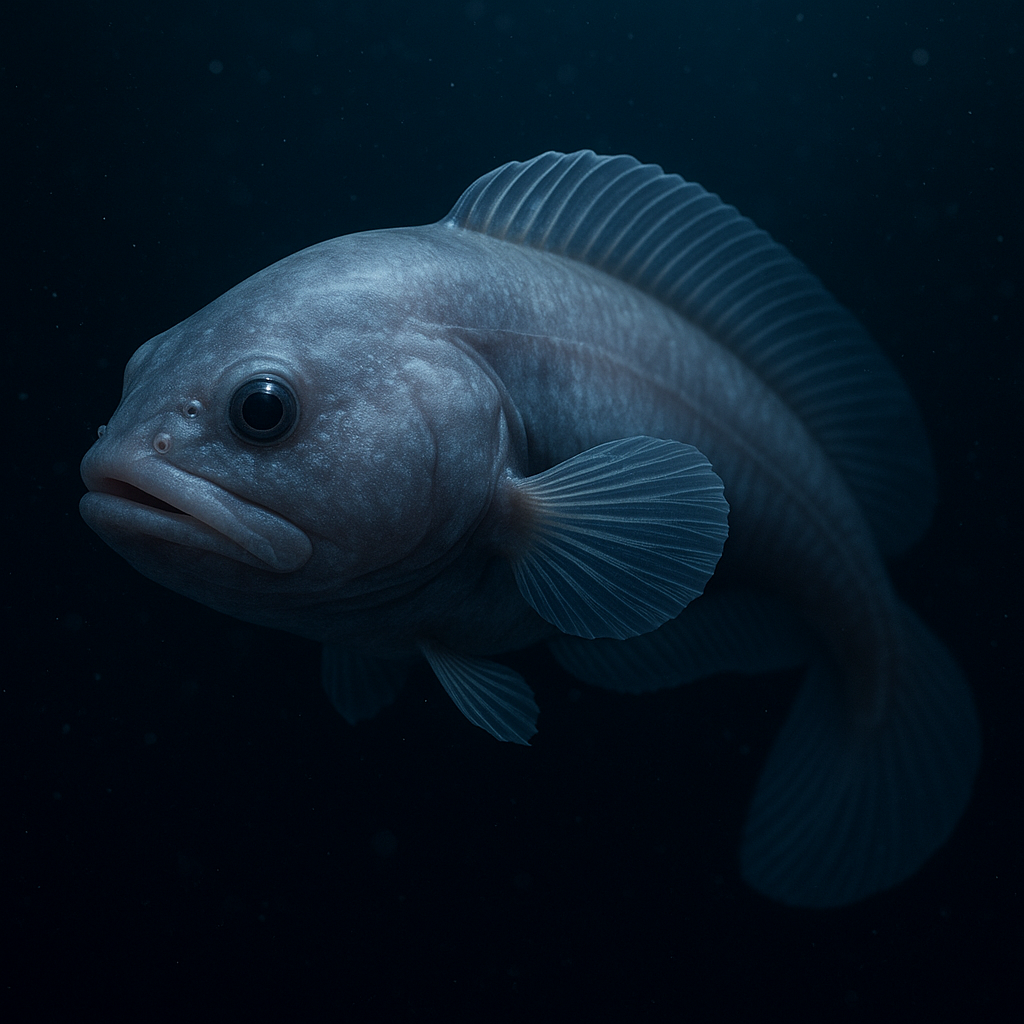
[1부: 한국어 버전]
Animalia > Actinopterygii > Liparidae
Hook: 심연의 오아시스, 그곳의 터줏대감
지구상 가장 깊은 곳, 태양조차 도달하지 못하는 암흑의 심연. 상상만 해도 숨이 막히는 그곳에, ‘압력? 그게 뭔데?’라며 유유히 헤엄치는 대범한 생명체가 있습니다. 오늘의 주인공은 바로 마리아나 심해어 (Mariana Snailfish), 학명 Pseudoliparis swirei입니다. 무려 8,000미터 아래에서 ‘수압 쯤이야!’라며 진짜 강심장을 뽐내는 이 초고압 생존의 달인을 함께 만나볼까요?
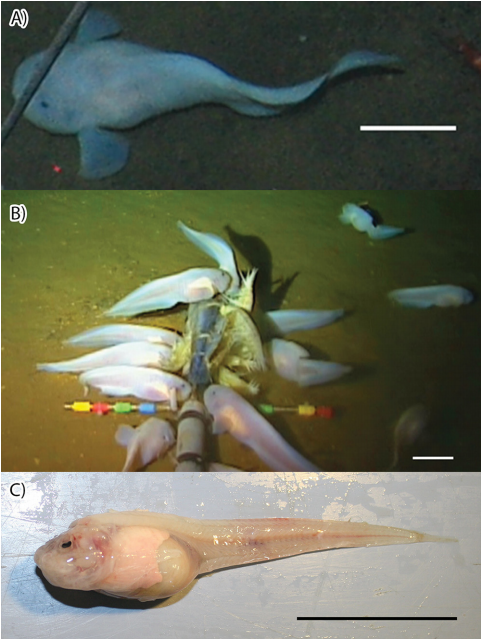
Scientific Backbone: 학명의 미학, 그리고 그 의미
*Pseudoliparis swirei*는 꼼치과(Liparidae)에 속하는 어류로, 그 이름 자체에 흥미로운 이야기가 담겨 있습니다. ‘Pseudoliparis’는 ‘거짓 꼼치’를 의미하며, ‘swirei’는 이 놀라운 생명체를 발견하는 데 기여한 조사원 스와이어(Swire)의 이름을 따서 명명되었습니다. 꼼치과 어류는 주로 냉수역이나 심해에 서식하며, 전 세계적으로 약 400종 이상이 알려져 있습니다. 마리아나 심해어는 이 중에서도 지구상에서 가장 깊은 곳에 사는 척추동물로 기록되어, 심해 생존의 끝판왕이라는 타이틀을 거머쥐었죠.
Deep Anatomy: 압력 쯤이야! 초고압 생존의 비밀
8,000미터 깊이의 심해는 제곱센티미터당 800kg이 넘는 어마어마한 수압이 지배하는 곳입니다. 이는 마치 손톱만 한 공간에 코끼리 한 마리가 올라앉은 것과 같은 압력이라고 할 수 있죠. 그런데 이 친구는 어떻게 멀쩡할까요? 에디터 택슨구루가 그 비밀을 파헤쳐 봅니다. 마리아나 심해어의 비결은 바로 ‘흐물흐물’한 몸과 ‘비장의 무기’에 있습니다. 이들은 몸이 마치 젤리처럼 부드러워 외부 압력을 유연하게 흡수하고 고르게 분산시킵니다. 단단한 뼈 대신 유연한 연골 조직이 몸을 지탱하며, 심지어 부력을 조절하는 부레조차 없습니다. 부레는 고압에서 터져버릴 위험이 있기 때문이죠. 하지만 가장 결정적인 생존 전략은 바로, 삼투압 조절 물질인 ‘트리메틸아민 N-옥사이드(TMAO)’를 엄청나게 많이 생산한다는 것입니다! 이 물질 덕분에 세포 내 단백질이 고압에서도 변성되지 않고 본래 기능을 유지할 수 있습니다. 한마디로, 압력을 씹어 먹는 강철 멘탈 대신, 젤리 몸과 슈퍼 단백질 보호막을 가진 셈이죠. 역시 아는 것이 힘, 과학이 곧 생존입니다!
Evolutionary Context: 깊이를 향한 진화의 여정
수억 년에 걸친 진화의 과정 속에서, 일부 어류는 새로운 서식지를 찾아 심연으로 향했습니다. 빛이 없는 극한의 환경은 생존을 위한 처절한 재설계를 요구했고, 마리아나 심해어는 이 도전에 완벽하게 성공한 케이스입니다. 이들은 몸의 구조를 단순화하고 에너지 효율을 극대화하는 방향으로 진화했습니다. 예를 들어, 시력은 거의 퇴화하고 대신 측선이나 촉각을 이용해 먹이를 찾습니다. 마치 럭셔리 스포츠카가 불필요한 장비를 다 떼어내고 오직 속도에만 집중하는 것처럼, 마리아나 심해어는 심해 생존에 불필요한 모든 것을 버리고 핵심 기능에만 집중하는 진화를 선택한 것입니다.
Verdict & Trivia: 심해 생존 챔피언의 마지막 인사
마리아나 심해어는 단순한 심해어가 아닙니다. 극한의 압력 속에서도 삶의 터전을 일궈낸 진정한 생존 챔피언이자, 우리에게 ‘한계는 없다’는 메시지를 던지는 작은 철학자입니다. 우리가 상상하는 모든 극한의 환경에는 반드시 그곳에서 번성하는 생명체가 있다는 것을 보여주는 살아있는 증거죠.
- 흥미로운 사실: 이들은 압력이 낮은 수조에서는 오히려 생존하지 못합니다. 자신의 ‘고향’인 초고압 환경이 아니면 몸의 구조가 기능을 잃기 때문이죠! 진정한 ‘집돌이’ 혹은 ‘집순이’라고 할 수 있겠네요!
- 또 다른 사실: 마리아나 해구는 가장 깊은 곳이 약 11,000미터에 달하며, 이는 에베레스트 산을 거꾸로 박아 넣고도 남는 깊이입니다.
이상, 심해의 압력을 씹어 먹는 달인, 마리아나 심해어에 대한 이야기였습니다. 다음 시간에도 흥미로운 생명체 이야기로 찾아뵙겠습니다.
에디터 택슨구루 드림.
[2부: Global Readers English Version]
Animalia > Actinopterygii > Liparidae
Hook: Oasis of the Abyss, The Ultimate Deep-Sea Resident
In the deepest trenches of our planet, where the sun’s rays dare not penetrate the eternal darkness, there exists a creature so unfazed by crushing pressure that it practically winks and says, ‘Pressure? What pressure?’ Meet our star of the day: the Mariana Snailfish (*Pseudoliparis swirei*). This ultimate master of hyperbaric survival casually swims at depths exceeding 8,000 meters, truly embodying a “strong heart” that just shrugs off the colossal water pressure!
Scientific Backbone: The Art of the Name, and Its Meaning
*Pseudoliparis swirei* belongs to the family Liparidae (snailfishes), and its name itself tells an interesting story. ‘Pseudoliparis’ translates to ‘false snailfish,’ while ‘swirei’ honors Swire, one of the researchers who contributed to the discovery of this remarkable creature. Snailfish species primarily inhabit cold or deep waters, with over 400 species known worldwide. Among them, the Mariana Snailfish holds the record as the deepest-living vertebrate on Earth, earning it the title of the ultimate deep-sea survival champion.
Deep Anatomy: “Pressure? No Problem!” Secrets of Hyperbaric Survival
The deep sea at 8,000 meters is ruled by immense water pressure, exceeding 800 kilograms per square centimeter. That’s equivalent to an elephant standing on a space the size of your thumbnail! So, how does this little fish manage to thrive? Editor TaxonGuru is here to unravel its secrets. The Mariana Snailfish’s survival strategy hinges on its ‘gelatinous’ body and its ‘secret weapon.’ Its body is remarkably soft and jelly-like, allowing it to flexibly absorb and evenly distribute external pressure. Instead of rigid bones, it possesses flexible cartilaginous tissue, and it even lacks a swim bladder, which would simply implode under such conditions. But the most crucial survival strategy is its ability to produce enormous amounts of the osmolyte ‘trimethylamine N-oxide (TMAO)’! This compound prevents cellular proteins from denaturing and losing their function under extreme pressure. In essence, instead of a ‘steel mind’ to chew through pressure, it has a jelly body and a super protein shield. Knowledge is power, and science is survival!
Evolutionary Context: The Journey of Deep-Sea Evolution
Over hundreds of millions of years of evolution, some fish species ventured into the abyss in search of new habitats. The lightless, extreme environment demanded a drastic redesign for survival, and the Mariana Snailfish is a prime example of a species that flawlessly met this challenge. They evolved to simplify their body structure and maximize energy efficiency. For instance, their eyesight is almost completely reduced, relying instead on their lateral line system and tactile senses to find food. Much like a luxury sports car stripping down all unnecessary features to focus solely on speed, the Mariana Snailfish chose an evolutionary path that discarded everything superfluous for deep-sea survival, focusing only on core functions.
Verdict & Trivia: A Final Word from the Deep-Sea Survival Champion
The Mariana Snailfish is more than just a deep-sea inhabitant. It is a true survival champion that has carved out a life in the most extreme pressures, a tiny philosopher that sends us the message: ‘There are no limits.’ It is living proof that every extreme environment we can imagine harbors life that thrives within it.
- Fun Fact: These fish cannot survive in low-pressure aquariums. Their body structure relies on the ultra-high-pressure environment of their ‘home’ to function! Talk about a true ‘homebody’!
- Another Fact: The Mariana Trench, where they live, reaches depths of approximately 11,000 meters at its deepest point – a depth so profound that Mount Everest could be submerged in it with room to spare.
That concludes our story about the Mariana Snailfish, the master of “chewing through” deep-sea pressure. Join us next time for more fascinating tales from the world of living creatures!
Sincerely, Editor TaxonGuru.