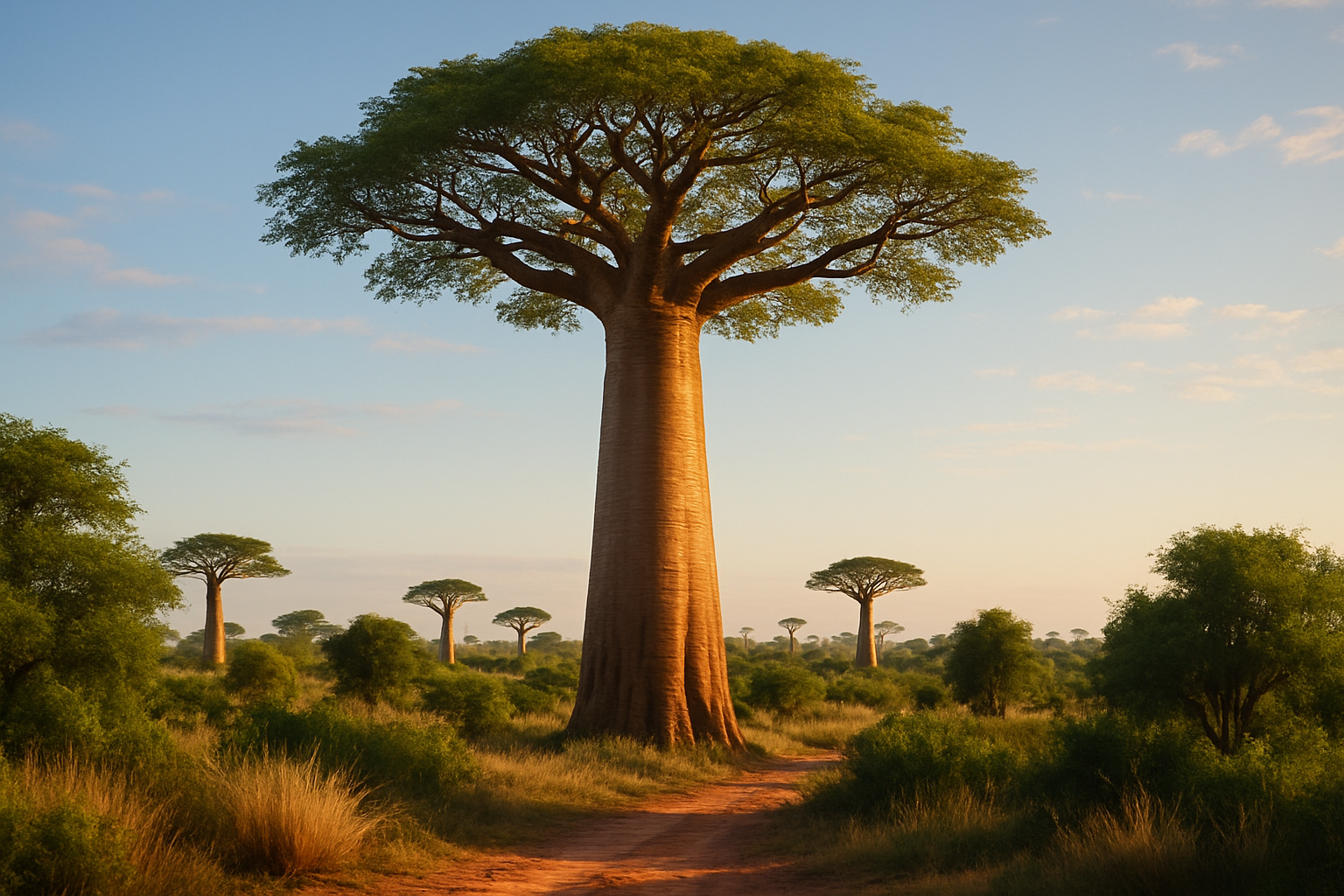
Standing beneath the twilight sky in western Madagascar, you might swear an ancient tree was uprooted, flipped upside down, and thrust headfirst back into the dry earth. Branches fan out like exposed, root-like appendages against the horizon, crowning an immense, smooth pillar. This remarkable silhouette belongs to Grandidier’s baobab (Adansonia grandidieri), recognized as the largest species within the genus Adansonia [1][5]. Is this stark form merely a botanical oddity, or is it a precisely calibrated water storage machine built for severe drought?
A Monolith in the Malagasy Drylands
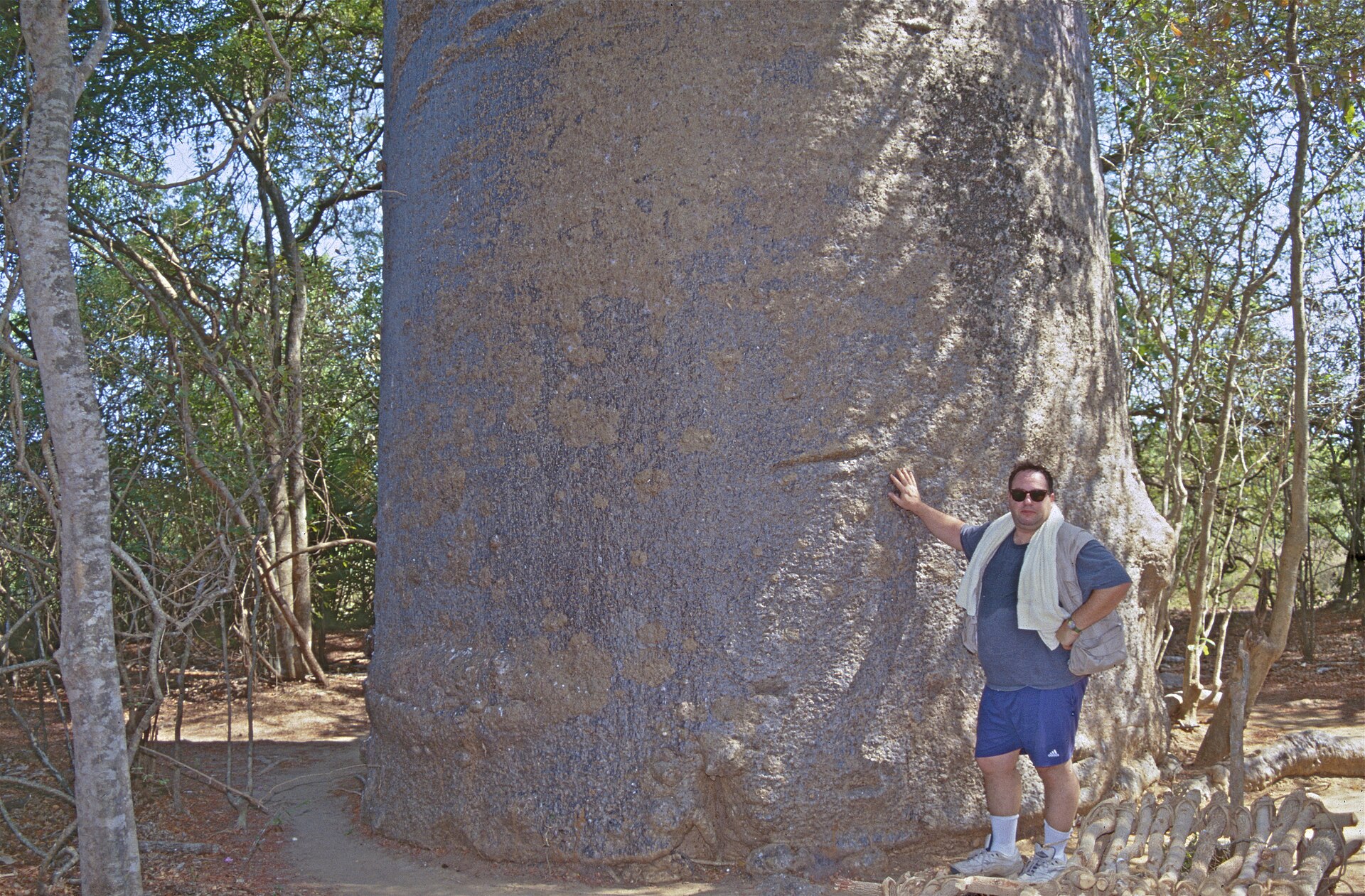
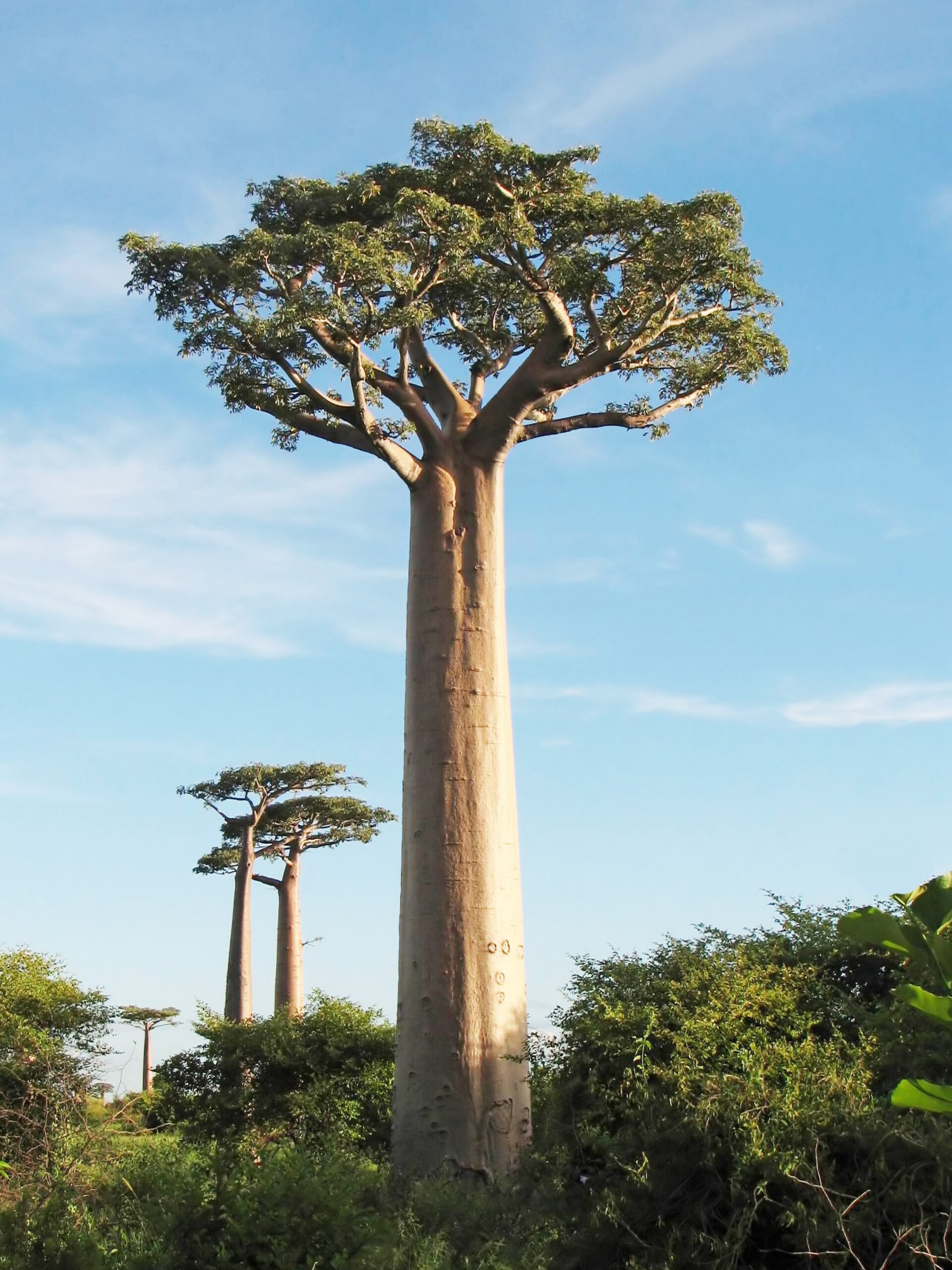
Grandidier’s baobab is an endemic species, meaning it naturally grows exclusively in one geographic location: the dry western and southwestern regions of Madagascar, particularly within the Menabe and Atsimo-Andrefana areas [1][5]. Belonging to the mallow family, Malvaceae, within the order Malvales, this giant reaches impressive heights of 25 to 30 meters [1][5]. Its immense trunk forms a massive cylinder coated in smooth, fibrous bark of a distinct reddish-grey shade [1][5]. These trunks routinely exceed 3 meters in diameter and can reach a circumference of over 20 meters [1][5].
Historically, these giants grew within contiguous dry deciduous forests—woodlands where trees naturally lose their leaves during dry periods [1][5]. Today, extensive land clearing caused by slash-and-burn agriculture has left many trees isolated within fragmented agricultural fields or clustered along famous sites like the Avenue of the Baobabs [1][5]. As a result of habitat destruction and poor sapling survival, the species is formally classified as Endangered on the IUCN Red List and is listed under CITES Appendix II to monitor international trade [1][5].
Spongy Timbers and Seasonal Leaf Loss
Surviving in dry ecosystems requires an aggressive water conservation strategy. Grandidier’s baobab accomplishes this through seasonal leaf dropping, shedding its foliage at the start of the dry season, which spans from May to October [5][6]. Dropping leaves minimizes transpiration—the biological process where plants evaporate water into the air through microscopic leaf pores [5][6]. Without leaves drawing away moisture, the tree conserves vital water resources throughout the rainless months [5][6].
Complementing this leaf-dropping strategy is the tree’s specialized trunk anatomy. Rather than dense, hard timber, the interior of the trunk consists of spongy, highly porous fibrous tissue capable of storing thousands of liters of water [5][6]. This internal reservoir acts as a giant living water tank, supplying essential hydration to keep internal tissues functional while surrounding vegetation wilts in the scorching dry heat [5][6].
Twilight Blossoms and Nocturnal Nectar Feasts
While many tropical trees bloom during the rainy months, Grandidier’s baobab produces its blossoms during the dry season [2][5]. The tree produces large white flowers that open specifically at dusk, avoiding the hot daytime air [2][5]. Upon opening, these flowers secrete copious amounts of sweet nectar, creating a rich feeding station under the cover of night [2][5].
This evening schedule aligns with its specialized animal pollinators. Rather than rely on daytime insects, the tree relies heavily on nocturnal mammals for pollination—the critical transfer of pollen between flowers to allow seed production [2][5]. Fruit bats and nocturnal primates, including fork-marked lemurs from the genus Phaner, visit the opened white flowers to feast on nectar, transferring pollen stuck to their fur as they travel from branch to branch [2][5].
Edible Yields and the Missing Disperser Theory
Following successful pollination, Grandidier’s baobab develops large fruits that offer substantial resources for both wild fauna and local human populations [5][6]. Local communities harvest the fruit pulp, which is rich in Vitamin C, for dietary nutrition [5][6]. The oil-rich seeds inside are collected and pressed to extract edible cooking oil, while the fibrous inner bark is harvested and woven into strong, durable ropes [5][6].
Despite abundant fruit production, researchers face an ecological puzzle regarding seed dispersal—the mechanism by which seeds are transported away from the parent tree to germinate in new ground [3][5]. Ecologists have proposed a hypothesis suggesting that now-extinct Malagasy megafauna, such as giant lemurs or giant tortoises, were once the primary animals that consumed the fruit and spread the seeds across long distances [3][5]. According to this theory, the loss of these large creatures explains why modern seeds struggle to travel and germinate far from parent trees [3][5]. However, direct fossil evidence showing these extinct animals actively consumed and dispersed baobab seeds remains limited [3][5]. Consequently, this idea stands as a plausible ecological inference rather than an established historical fact [3][5].
Debunking Tree Rings and Single-Trunk Myths
For decades, general assumptions held that a baobab’s age could be determined by simply counting growth rings in a cross-section of its trunk, as is done with temperate trees. However, tropical baobabs do not form distinct annual growth rings because their fibrous, porous trunk tissue expands and contracts with water availability rather than annual cold-warm cycles [2][5]. To overcome this challenge, scientists use accelerator mass spectrometry (AMS)—an advanced laboratory technique that analyzes radiocarbon isotopes in tiny wood samples—to reliably date the trees [2][5].
This precise radiocarbon testing revealed another surprising discovery regarding the tree’s structural form [2][4]. While a mature Grandidier’s baobab looks like a single monopodial column—a tree growing from a single central stem—AMS analysis proved that many large trees are actually multi-stem structures [2][4]. During early growth, multiple saplings or stems sprout in close proximity and gradually fuse together over decades, forming a single, massive composite trunk [2][4].
Regeneration Obstacles and Scientific Uncertainties
Despite their massive physical size and longevity, populations of Grandidier’s baobab face a precarious future due to extremely low natural regeneration rates [1][6]. In agricultural landscapes, free-roaming domestic livestock readily graze on young saplings, killing them before their protective bark develops [1][6]. Additionally, frequent slash-and-burn agricultural fires burn through sapling recruitment zones, eliminating new generations before they can establish deep roots [1][6].
Botanists also highlight notable gaps in current scientific research regarding this species [1][6]. Comprehensive tracking data detailing long-term population trends across individual isolated forest fragments remain incomplete [1][6]. Furthermore, researchers have limited empirical data regarding how increasing water stress caused by changing regional climate patterns will affect the long-term water-storage physiology of these giant trunks [5][6].
Returning to the Upside-Down Crown
Looking back at the twilight skyline of western Madagascar, the stark, upside-down silhouette of Grandidier’s baobab takes on a renewed significance. What initially resembles a bizarre botanical anomaly is actually an intricately integrated biological system: a multi-stemmed column storing thousands of liters of life-saving water, paired with a leaf-dropping seasonal cycle and dusk-blooming flowers tailored for nocturnal lemurs and bats [1, 2, 5]. Rather than an upside-down accident, Grandidier’s baobab remains an extraordinary masterwork of survival standing firm against the dry Malagasy horizon [1][5].
Featured image credit
Created by TaxonGuru · AI-generated featured explanatory reconstruction · not a documentary photograph · generated 2026-08-11
Sources and editorial policy
This feature is based on publicly available scientific and institutional sources listed below. Read our AI and editorial policy. Report a correction: kjhtime@gmail.com
References
- wikipedia.org — vertexaisearch.cloud.google.com, accessed 2026-08-10
- ubbcluj.ro — vertexaisearch.cloud.google.com, accessed 2026-08-10
- wordpress.com — vertexaisearch.cloud.google.com, accessed 2026-08-10
- ghislainv.fr — vertexaisearch.cloud.google.com, accessed 2026-08-10
- llifle.com — vertexaisearch.cloud.google.com, accessed 2026-08-10
- theferns.info — vertexaisearch.cloud.google.com, accessed 2026-08-10