
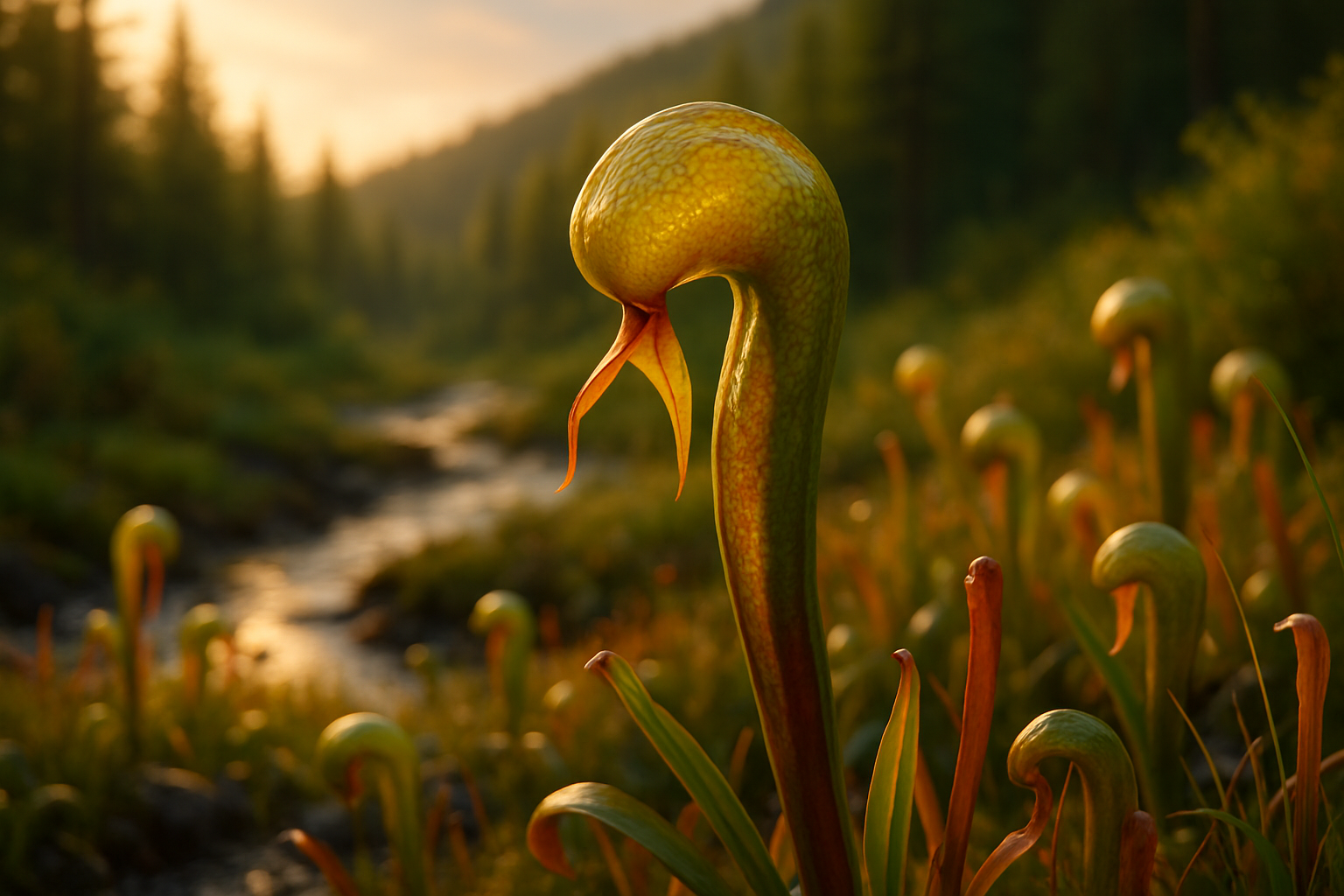
Along the margins of cold, running mountain streams and soggy wetlands in the Pacific Northwest, a strange shape rises above wet soil. It resembles a serpent poised to strike, complete with a swollen hood and trailing appendages hung directly beneath a hidden entrance [1][4]. An insect drawn to the plant crawls into the dark opening on the underside of the hood, only to look up and see what appears to be dozens of illuminated exits overhead [1, 2, 4]. Driven by instinct, the creature flies toward the light, repeatedly colliding with solid walls until it collapses into a fluid pool below [1][2]. How did an immobile plant evolve such a deceptive optical maze, and what allows it to thrive in nutrient-poor environments where other species struggle to survive [1, 2, 4, 6]?
A Solitary Serpent in Plant Taxonomy
The botanical world classifies this specialized carnivorous predator under the scientific name Darlingtonia californica [1][3]. Belonging to the pitcher plant family Sarraceniaceae, it is widely recognized by its descriptive common name, the Cobra Lily [1, 3, 4]. What makes this species particularly fascinating to evolutionary biologists is its isolated taxonomic position [1, 3, 4]. It is the single species within the genus Darlingtonia, making it a monotypic genus—a biological category in taxonomy that contains only one solitary species rather than a broad family of related species [1, 3, 4].
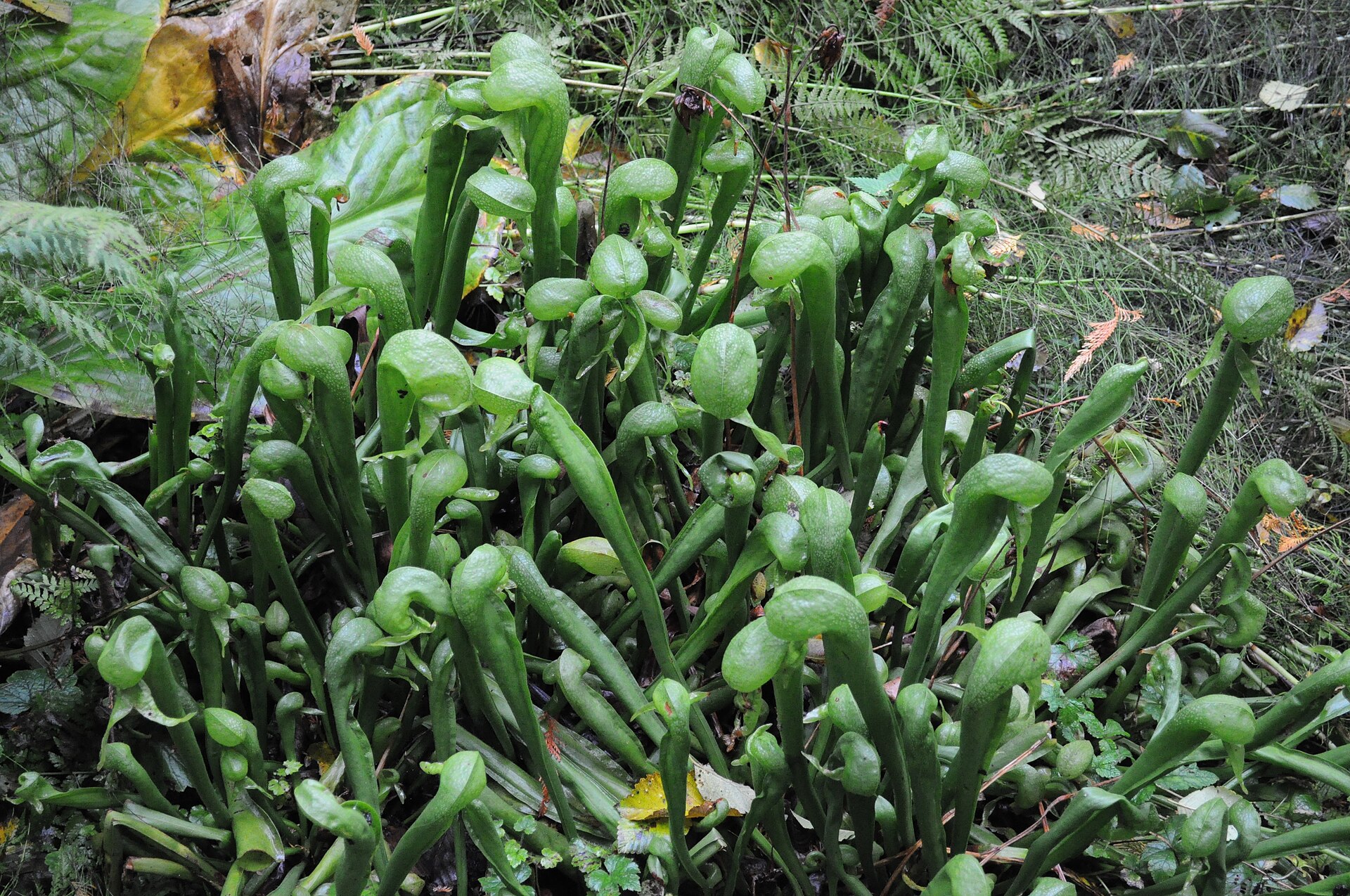
The overall structure of Darlingtonia californica is unlike most typical pitcher plants [1][4]. Its modified leaves grow upward to form hollow tubular traps that curve at the top, forming an arched chamber that closely mirrors the expanded hood of a cobra [1][4]. Hanging directly underneath this dome is a divided, leaf-like structure that splits into two downward ribbon-like lobes [1][4]. This split appendage resembles a snake’s tongue, but its functional role is to direct crawling insects toward the actual trap entrance concealed on the underside of the curved hood [1][4].
The Illusion of Exit: How Translucent Fenestrations Trap Insect Prey
The trapping mechanism of the Cobra Lily relies entirely on visual deception rather than quick mechanical movement [1, 2, 4]. Once a foraging insect enters the downward-facing opening hidden under the curved hood, it finds itself inside a dimly lit upper chamber [1][4]. Looking around for a way out, the insect naturally moves toward the brightest visible light sources [1][2]. It beholds dozens of glowing patches peppering the upper walls of the hood, which look exactly like open passages to the outside world [1, 2, 4].
These glowing patches are not openings at all, but specialized translucent light windows known as fenestrations—semi-transparent spots in the plant tissue that allow external sunlight to shine through into the interior [1, 2, 4]. The trapped insect, tricked by the optical illusion of an easy escape path, flies again and again into the hard, translucent walls [1][2]. Exhausted by these repeated collisions against the solid tissue, the insect loses its grip, falls through the slick vertical tube, and plunges into the liquid collected at the bottom of the pitcher [1, 2, 4].
Dispelling the Rainwater Fallacy
A widespread misconception regarding pitcher plants is that their deep tubular leaves simply serve as open buckets designed to collect falling rainwater, drowning whatever creatures tumble inside [1, 4, 5]. In the case of Darlingtonia californica, this assumption is completely incorrect [1, 4, 5]. The curved cobra hood curves downward directly over the top of the pitcher opening, acting as a natural physical umbrella that prevents rainwater from pouring into the chamber [1, 4, 5].
Because rainwater is effectively excluded by the structural hood, the plant must manage its internal liquid levels through its own physiological effort [1, 4, 5]. The Cobra Lily absorbs moisture from the wet ground using its root system and actively pumps that water upward into the bottom cavity of the tubular leaf [1, 4, 5]. By actively raising and maintaining its internal liquid level, the plant guarantees that its aquatic trap remains fully functional regardless of weather conditions or rainfall [1, 4, 5].
Digestive Partnerships and the Enzymatic Debate
The intense effort required to build deceptive traps and pump water pays off in essential nutrients [2][4]. Living in nutrient-deficient soils, Darlingtonia californica secures up to approximately 76% of its crucial nitrogen requirements through the digestion of trapped insects [2][4]. However, the exact physiological process behind how the plant breaks down its prey has been a subject of scientific refinement [1, 2, 4].
For many years, botanists held that the Cobra Lily was unique among pitcher plants for producing zero digestive enzymes of its own, relying 100% on outside organisms to process captured prey [1, 2, 4]. The liquid inside the pitcher relies heavily on mutualism—an ecological interaction where different species live together in mutually beneficial relationships [1, 2, 4]. Communities of resident bacteria and specialized midge larvae, such as Metriocnemus edwardsii, reside within the pitcher liquid [1, 2, 4]. These organisms chew through tough exoskeletons and digest animal tissue, releasing dissolved nitrogenous compounds that the plant can readily absorb through its pitcher walls [1, 2, 4].
While these symbiotic partners do carry out the vast majority of the physical breakdown work, modern physiological studies have clarified the story [1, 2, 4]. Recent findings revealed that Darlingtonia californica actually secretes at least one digestive enzyme of its own—specifically a protease, which is a protein-degrading enzyme that actively breaks down complex proteins into simpler compounds [1, 2, 4]. This updated discovery corrected the historical belief that the plant played a purely passive role in chemical digestion, demonstrating a dual strategy of internal enzyme secretion combined with microbial mutualism [1, 2, 4].
Toxic Soils, Chilled Water, and Wild Pollinators
The natural distribution of Darlingtonia californica is highly restricted within the Pacific Northwest of North America, occurring only in northern California and southwestern Oregon [1, 4, 6]. Across this geography, the plant inhabits specialized wetlands such as coastal or mountain bogs, fens (peat-forming wetlands fed by nutrient-poor groundwater), and the edges of cold mountain streams [1, 4, 6]. These habitats frequently feature serpentine soils, which are unusual soils derived from mineral-rich rocks that possess extremely low nutrient levels alongside high concentrations of heavy metals [1, 4, 6].
To survive in these harsh substrates, the roots of the Cobra Lily require very specific environmental conditions [4, 5, 6]. A continuous supply of cool, running water moving around the roots is essential to keep root temperatures low [4, 5, 6]. The plant requires oxygen-rich water temperatures around 15–27 °C or below to remain healthy [4, 5, 6]. If the temperature surrounding the root zone rises above these cool limits, the survival of the plant is severely threatened [4, 5, 6].
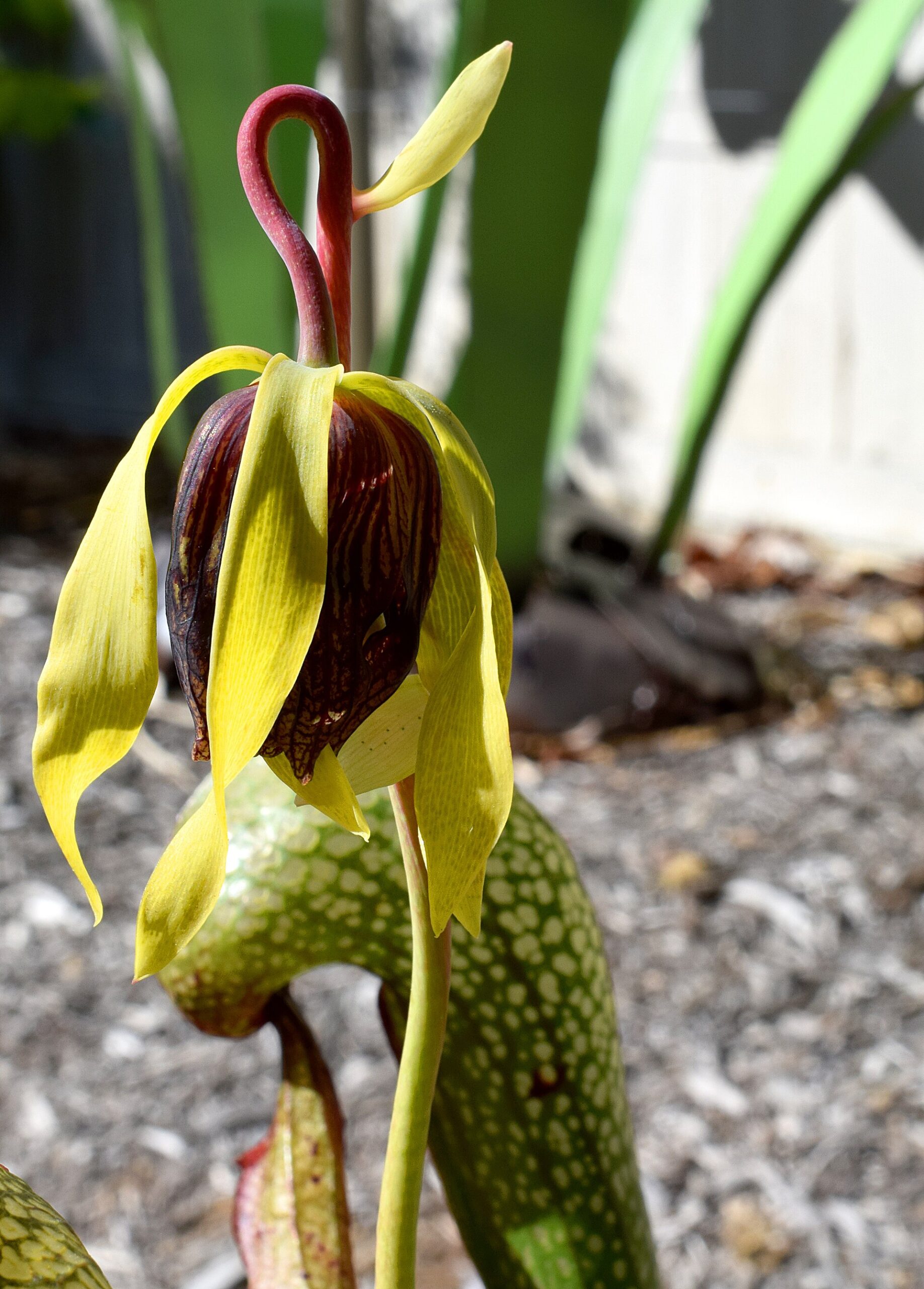
While the mechanics of its carnivorous traps are well understood, the reproductive cycle of the Cobra Lily long presented unanswered questions [1][2]. For a long period, the primary insect pollinators of the species were uncertain [1][2]. Field studies conducted at research sites in Northern California finally identified effective pollinators, confirming that wild bees—specifically mining bees such as Andrena nigrihirta as well as megachilid bees—regularly visit the flowers and successfully carry out cross-pollination [1][2]. However, comprehensive pollinator surveys across the remainder of its native range outside Northern California are still limited, leaving scientists with more to discover about its reproductive dynamics in other regions [1][2].
Conservation Status and Environmental Pressures
When evaluated across its entire native habitat on a global scale, Darlingtonia californica is categorized as Least Concern (LC) on the IUCN Red List [1][6]. Yet this global designation conceals local vulnerabilities [1][6]. On the state level in both Oregon and California, conservation managers classify the species as Vulnerable and treat it as a restricted native plant [1][6].
Because the Cobra Lily relies heavily on precise aquatic conditions, it faces significant risks from habitat destruction and ongoing climate change [1][6]. Any environmental shift that warms local stream temperatures or alters delicate water flows can easily destroy the specialized cold-water microhabitats that its sensitive root system demands for survival [4, 5, 6]. Protecting these unique serpentine bogs and mountain streams is therefore vital to preserving this singular species in the wild [1, 4, 6].
Stepping back to the edge of that cold mountain stream in the Pacific Northwest, the Cobra Lily stands as a testament to evolutionary specialization [1, 4, 6]. Through a combination of hooded light windows that baffle trapped insects, active fluid pumping, mutualistic digestive partners, and root systems cooled by running water, Darlingtonia californica turns toxic, nutrient-poor ground into a thriving hunting ground [1, 2, 4, 6]. As long as cold mountain waters continue to flow through these delicate bogs, the deceptive optical maze under the hooded leaf will remain one of nature’s most effective evolutionary traps [1, 2, 4, 6].
Featured image credit
Created by TaxonGuru · AI-generated featured explanatory reconstruction · not a documentary photograph · generated 2026-08-10
Sources and editorial policy
This feature is based on publicly available scientific and institutional sources listed below. Read our AI and editorial policy. Report a correction: kjhtime@gmail.com
References
- wikipedia.org — vertexaisearch.cloud.google.com, accessed 2026-08-10
- indefenseofplants.com — vertexaisearch.cloud.google.com, accessed 2026-08-10
- wikidata.org — vertexaisearch.cloud.google.com, accessed 2026-08-10
- carnivorousplants.org — vertexaisearch.cloud.google.com, accessed 2026-08-10
- carnivorousplantnursery.com — vertexaisearch.cloud.google.com, accessed 2026-08-10
- oregon.gov — vertexaisearch.cloud.google.com, accessed 2026-08-10