데이노코커스 라디오두란스: 핵폭탄 맞아도 끄떡없는 지구 최강의 ‘좀비 박테리아’!
분류 트리: Bacteria > Deinococcus-Thermus > Deinococci > Deinococcaceae > Deinococcus
[1부: 한국어 버전]
훅 (Hook): 당신의 컴퓨터보다 수천 배 강한 복원력의 비결은?
안녕하세요, 지구상 모든 생명의 신비와 경이로움을 탐구하는 에디터 택슨구루입니다. 오늘은 여러분의 상식을 뒤엎을, 그야말로 ‘괴물’ 같은 미생물을 소개할까 합니다. 상상해 보세요. 핵폭탄이 터진 자리, 우주 방사능 가득한 공간, 극한의 건조함… 그 어떤 지옥도 이 녀석 앞에서는 ‘어, 좀 따끔하네?’ 수준이라는 겁니다! 이름하여 데이노코커스 라디오두란스, 일명 ‘좀비 박테리아’. 당신의 고성능 컴퓨터가 고장 나면 멘붕에 빠지지만, 이 박테리아는 그 어떤 파괴적인 상황에서도 뚝딱 스스로를 복구하는 초능력을 지녔습니다. 과연 이 작은 생명체의 복원력 비결은 무엇일까요? 오늘 그 비밀을 파헤쳐 봅니다!

과학적 골격 (Scientific Backbone): 방사능을 사랑한 ‘이상한 알갱이’
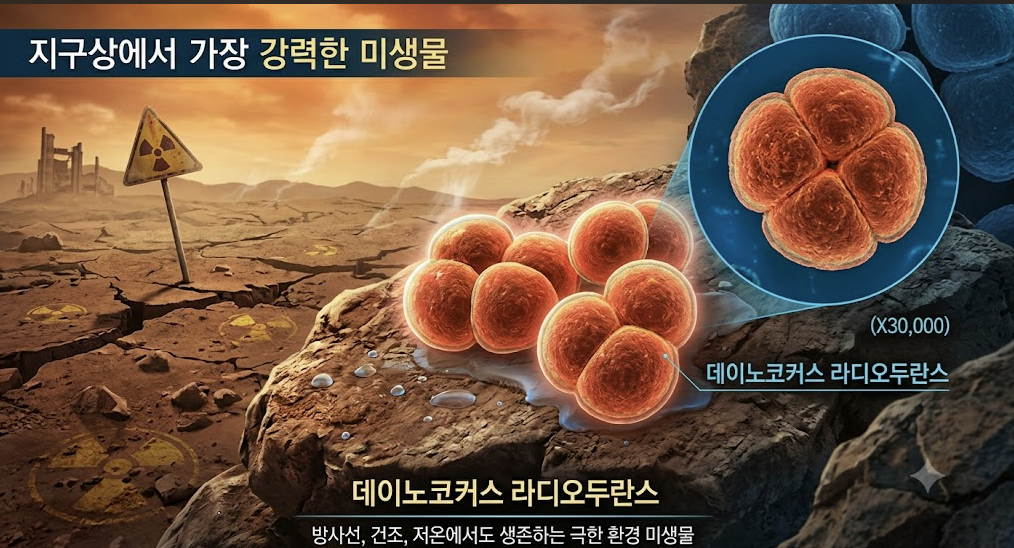
데이노코커스 라디오두란스(Deinococcus radiodurans)는 이름부터 심상치 않습니다. ‘데이노코커스’는 고대 그리스어로 ‘무서운 알갱이’를, ‘라디오두란스’는 ‘방사능에 저항하는’이라는 뜻을 지녔으니, 문자 그대로 ‘방사능에도 끄떡없는 무서운 알갱이’인 셈이죠. 이 녀석은 1956년, 통조림 식품의 방사능 살균 과정에서도 살아남아 관계자들을 경악시키며 세상에 그 존재를 알렸습니다. 당시 과학자들은 “어떻게 방사능을 쬐고도 죽지 않을 수 있지?”라며 멘붕에 빠졌고, 그 후 수십 년간 이 미생물의 놀라운 생존 능력은 수많은 연구의 대상이 되었습니다. 이 작은 존재는 우리가 아는 생명의 한계를 재정의하고 있습니다.
심층 해부 (Deep Anatomy): DNA 수리의 달인, 초고속 복구 시스템
데이노코커스 라디오두란스의 가장 큰 비결은 바로 ‘DNA 복구 능력’에 있습니다. 일반적인 생명체는 DNA가 심하게 손상되면 회복 불능 상태에 빠지지만, 이 녀석은 다릅니다. 마치 슈퍼카의 피트 크루처럼, DNA가 조각조각 부서져도 거의 완벽하게 원래 상태로 되돌리는 초고속, 초정밀 수리 시스템을 갖추고 있죠. 비결은 크게 두 가지로 추정됩니다. 첫째, 하나의 세포 안에 DNA 복제본을 여러 개 가지고 있어, 손상된 DNA를 다른 온전한 복제본을 이용해 재빨리 재구성합니다. 마치 중요한 파일을 여러 백업 드라이브에 저장해 두는 것과 비슷하죠. 둘째, ‘SOS 반응’이라는 특별한 유전자 발현을 통해 손상된 DNA를 인지하고 수리하는 단백질들을 엄청나게 활성화시킵니다. 이 메커니즘 덕분에 치명적인 방사능 환경에서도 끄떡없이 생존할 수 있는 것입니다. 정말이지, 생체 공학의 끝판왕이 아닐 수 없습니다!
진화적 맥락 (Evolutionary Context): 방사능이 아닌, 건조함에 대한 적응?
그렇다면 데이노코커스 라디오두란스는 처음부터 방사능을 견디기 위해 진화했을까요? 놀랍게도 학자들은 그렇지 않다고 보고 있습니다. 초기 연구에서는 핵폐기물 처리장 같은 곳에서 발견될 줄 알았지만, 실제로는 건조하고 영양분이 부족한 환경에서 더 흔히 발견됩니다. 이 박테리아의 엄청난 DNA 복구 능력은 사실 극한의 건조함에 대한 적응 결과일 가능성이 높습니다. 세포가 건조해지면 DNA가 파편화되는 현상이 발생하는데, 이를 복구하는 과정에서 방사능 내성도 함께 얻게 된 것이죠. 마치 운동선수가 강도 높은 훈련을 통해 예상치 못한 다른 능력까지 얻는 것과 비슷합니다. 즉, 방사능 저항은 그들의 궁극적인 목표가 아닌 ‘부수적인 이득’이었던 셈입니다.
평결 및 잡학 (Verdict & Trivia): 미래를 바꿀 ‘슈퍼 히어로’ 박테리아?
데이노코커스 라디오두란스는 단순한 ‘좀비 박테리아’를 넘어 미래 과학에 엄청난 영감을 주고 있습니다. 이 녀석의 뛰어난 DNA 복구 메커니즘을 연구하면 암 치료, 노화 방지, 심지어 우주 식민지 건설 시 방사능으로부터 생명체를 보호하는 기술 개발에도 활용될 수 있습니다. 핵폐기물 정화(bioremediation)나 우주 탐사선 소독 등 다양한 분야에서 ‘슈퍼 히어로’ 같은 역할을 할 잠재력을 지니고 있죠. 정말이지, 이 작은 미생물은 “생명의 한계는 어디까지인가?”라는 질문에 가장 극적인 답변을 제시하는 존재가 아닐까 싶습니다. 언젠가 우리의 몸도 이 박테리아처럼 DNA 손상에 강해지는 날이 오지 않을까요? 그날을 기대하며, 에디터 택슨구루는 다음 신비로운 생명체 이야기로 돌아오겠습니다!
[2부: Global Readers English Version]
Deinococcus radiodurans: Earth’s Toughest ‘Zombie Bacteria’ That Survives Nuclear Bombs!
Classification Tree: Bacteria > Deinococcus-Thermus > Deinococci > Deinococcaceae > Deinococcus
Hook: What’s the Secret to Its Resilience, Thousands of Times Stronger Than Your Computer?
Hello, fellow explorers of life’s wonders and mysteries! This is Editor TaxonGuru, ready to introduce you to a truly ‘monstrous’ microorganism that will shatter your preconceptions. Imagine a post-nuclear blast zone, a space filled with cosmic radiation, extreme desiccation… Any of these hellish scenarios would merely be a “mild annoyance” to this little guy! Meet Deinococcus radiodurans, famously known as the ‘Zombie Bacteria’. While your high-performance computer might crash and cause despair, this bacterium possesses a superpower: it can miraculously repair itself even after the most destructive events. What’s the secret to this tiny organism’s incredible resilience? Today, we delve into that very mystery!
Scientific Backbone: The ‘Terrible Berry’ That Loves Radiation
The name Deinococcus radiodurans itself hints at its extraordinary nature. ‘Deinococcus’ comes from ancient Greek, meaning ‘terrible berry’ or ‘fearful grain’, while ‘radiodurans’ means ‘radiation-enduring’. So, it literally translates to the ‘terrible berry that endures radiation’! This creature made its astonishing debut in 1956 when it survived the radiation sterilization process of canned food, shocking researchers. Scientists at the time were baffled, exclaiming, “How can it survive after being irradiated?” For decades thereafter, this microbe’s astonishing survival capabilities became the subject of extensive research. This tiny entity is redefining the known limits of life.
Deep Anatomy: The DNA Repair Maestro, a High-Speed Recovery System
The biggest secret to Deinococcus radiodurans‘ resilience lies in its unparalleled DNA repair capabilities. While conventional organisms suffer irreversible damage when their DNA is severely harmed, this bacterium is different. Much like a super-efficient pit crew for a race car, it possesses a high-speed, ultra-precise repair system that can almost perfectly restore its DNA, even if it’s shattered into fragments. Two main factors are believed to be key. First, each cell contains multiple copies of its genome, allowing it to quickly reconstruct damaged DNA using intact duplicates, much like saving important files on several backup drives. Second, it activates an immense number of DNA-repairing proteins through a special gene expression known as the ‘SOS response’. This mechanism allows it to survive effortlessly in deadly radiation environments. Truly, it’s the ultimate marvel of bioengineering!
Evolutionary Context: Adaptation to Desiccation, Not Radiation?
So, did Deinococcus radiodurans evolve specifically to withstand radiation? Surprisingly, scientists believe not. While early research expected to find it in places like nuclear waste dumps, it’s actually more commonly found in dry, nutrient-poor environments. The bacterium’s incredible DNA repair capabilities are likely an adaptation to extreme desiccation. When cells dry out, their DNA tends to fragment, and it’s during the process of repairing this fragmentation that they also acquired radiation resistance. It’s similar to an athlete gaining unexpected additional abilities through intense training. In essence, radiation resistance was a ‘side benefit,’ not their ultimate evolutionary goal.
Verdict & Trivia: A ‘Superhero’ Bacterium That Could Change the Future?
Deinococcus radiodurans is more than just a ‘zombie bacterium’; it offers immense inspiration for future science. Studying its remarkable DNA repair mechanisms could lead to advancements in cancer therapy, anti-aging solutions, and even technologies to protect life from radiation during space colonization. It holds the potential to act as a ‘superhero’ in various fields, such as bioremediation of nuclear waste or sterilization of spacecraft. Indeed, this tiny microorganism presents one of the most dramatic answers to the question, “What are the limits of life?” Perhaps one day, our own bodies will become as resistant to DNA damage as this bacterium. Looking forward to that day, Editor TaxonGuru will return with another mystical creature’s tale!