What creature possesses eyes as wide as dinner plates, floats effortlessly through total darkness six hundred meters below the waves, and spent centuries inspiring tales of multi-tentacled ocean monsters [1][4]? For generations, mariners whispered stories of the legendary Kraken dragging ships into the abyss, but modern marine biology reveals a reality that is every bit as extraordinary as the folklore [1]. That creature is Architeuthis dux, commonly known as the giant squid—a deep-sea cephalopod that stands as one of the most remarkable examples of deep-sea giant growth, or abyssal gigantism, on Planet Earth [1].
Size Lab: How Big Is the Giant Squid Really?
When measuring Architeuthis dux, marine scientists separate the body into distinct anatomical sections: the mantle—the main muscular body tube housing the internal organs—and the appendages, which consist of eight arms and two elongated feeding tentacles [1][7]. To truly grasp the magnitude of this deep-sea inhabitant, let us translate its verified scientific dimensions into a practical scale comparison [1][7].
The maximum scientifically verified mantle length for female giant squids reaches approximately 2.0 to 2.25 meters [1][7]. This means that the main body tube alone is longer than a tall adult human lying flat from head to toe [1][7]. When you extend the full length of the animal to include its long feeding tentacles, the maximum scientifically verified total length of a female giant squid reaches approximately 12 to 13 meters [1][7]. That total length is roughly equal to a full-sized city transit bus stretched out across the water [1][7].
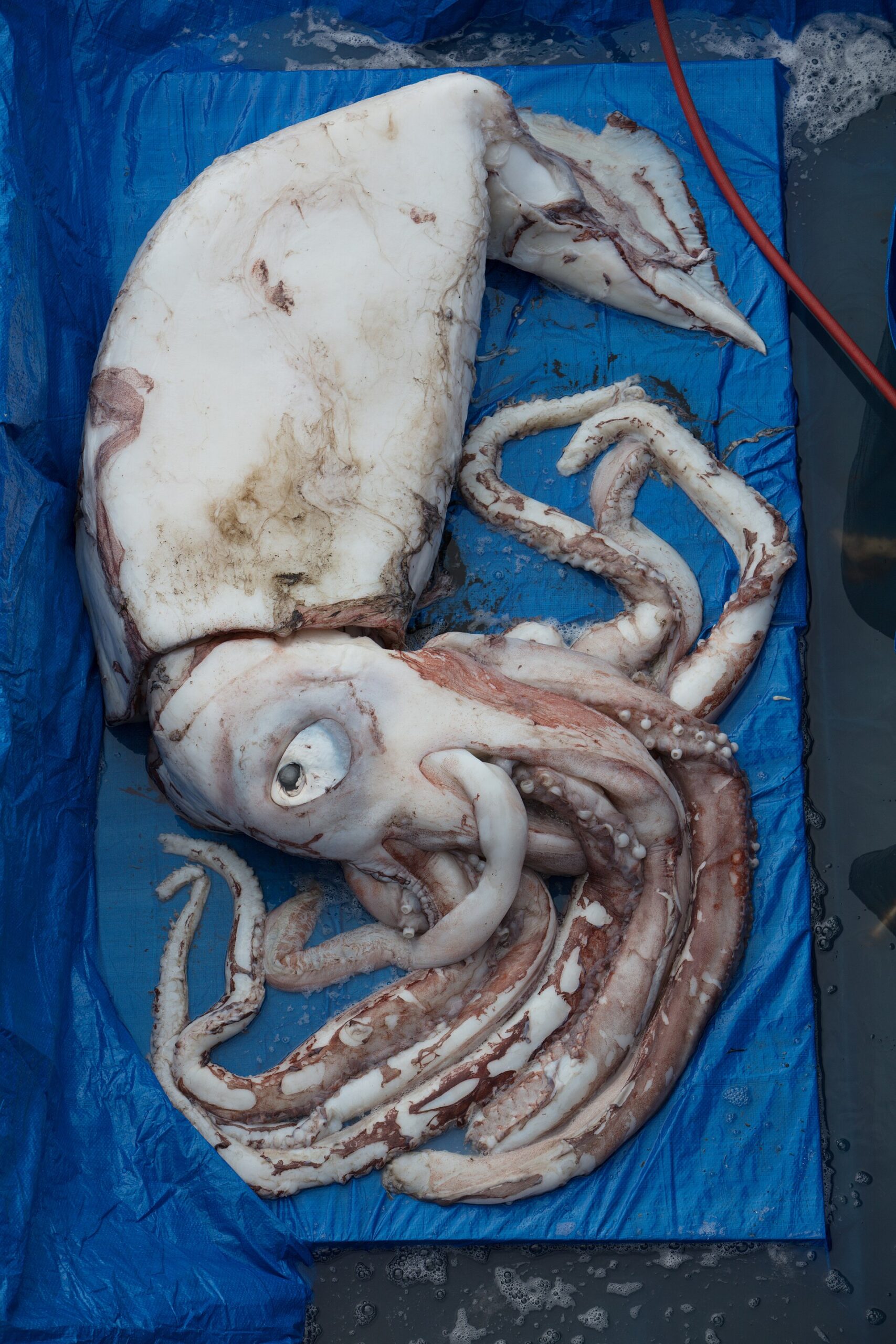
In addition to its immense length, the giant squid possesses some of the largest visual organs in the entire animal kingdom [1][4]. Its eyes measure an astounding 27 to 30 centimeters in diameter, paired with a pupil that spans 9 centimeters across [1][4]. To visualize this scale, the eye of Architeuthis dux is larger than an official regulation basketball and matches the width of a broad family dinner plate, while its pupil alone is wider than a standard baseball [1][4].
Myth vs. Fact: Unraveling the 20-Meter Monster Myth
Can the giant squid actually grow past 20 meters in total length, as old maritime tales and historical sighting reports claim? Modern scientific evidence indicates that these extreme figures are unfounded [1][7]. While historic strandings and surface observations frequently cited lengths exceeding 20 meters, rigorous anatomical evaluations have debunked these claims as post-mortem measurement errors or unverified exaggerations [1, 6, 7].
The feeding tentacles of Architeuthis dux are extremely flexible and prone to substantial stretching after death [1][6]. When stranded specimens wash ashore, post-mortem tissue relaxation and mechanical pulling can artificially elongate the tentacles far beyond their living physical limits [1][6]. When researchers enforce strict scientific standards measuring intact mantle tissue and unstretched tentacles, verified total lengths consistently max out at 12 to 13 meters [1][7].
Another widespread misconception is that Architeuthis dux is the heaviest squid species roaming the ocean depths [1][7]. While the giant squid achieves impressive total lengths due to its long, slender feeding tentacles, it is not the most massive cephalopod in terms of weight [1][7]. That title belongs to the colossal squid (Mesonychoteuthis hamiltoni), which features a vastly bulkier body structure and significantly greater overall mass, demonstrating that maximum length does not equate to maximum weight in ocean life [1][7].
One Single Species Across Global Oceans
Where in the ocean do these giant cephalopods reside, and how many different species exist worldwide? Historically, taxonomists debated whether regional physical variations pointed to as many as eight to ten distinct species of giant squids scattered across different oceanic regions [2][3]. However, modern genomic sequencing has completely altered our understanding of cephalopod classification [2][3].
Genomic analysis conducted on giant squid tissue samples collected from around the world revealed an unexpectedly low level of genetic diversity across populations [2][3]. Rather than finding isolated regional subspecies or distinct species, researchers confirmed that all giant squids across the globe belong to a single, global, panmictic species—meaning a single, interconnected breeding population without localized genetic isolation: Architeuthis dux [2][3].
This single global species inhabits the middle-depth mesopelagic zone and deeper bathypelagic zone, living primarily at depths between 300 and 1,000 meters along continental slopes and oceanic islands [1]. Distributed widely throughout temperate and subpolar waters around the globe, Architeuthis dux maintains a stable population structure that earns it a conservation status of Least Concern on the IUCN Red List [1].
Chemical Physics: How to Float and Why You Cannot Eat It
Living hundreds of meters beneath the ocean surface presents a major physics challenge: how does a large animal remain suspended in the water without constantly spending energy to prevent sinking? Unlike bony fish that rely on gas-filled swim bladders, Architeuthis dux employs an ingenious biochemical solution to achieve neutral buoyancy—a state where an organism neither sinks nor floats, allowing it to hover effortlessly [1][4].
Throughout its muscular tissues, the giant squid stores a concentrated aqueous solution of ammonium chloride [1][4]. Because ammonium ions are lighter than surrounding seawater, this internal fluid provides natural lift throughout the animal’s body [1][4]. This chemical adaptation allows Architeuthis dux to maintain position in the water column without wasting energy on continuous swimming, perfectly suiting its deep-sea lifestyle [1][4].
This same chemical buoyancy mechanism resolves another persistent question: why isn’t giant squid harvested for human food like smaller squid species? Unlike standard commercial squid species, the flesh of Architeuthis dux is saturated with ammonium chloride, giving the tissue a strong ammonia odor and an extremely bitter taste [1][4]. As a result, despite its massive yield of muscle tissue, the giant squid is completely unpalatable and unsuited for human consumption [1][4].
Deep-Sea Predators and Visual Adaptations
Why did Architeuthis dux evolve eyes as large as basketballs? In the twilight world between 300 and 1,000 meters deep, sunlight is virtually non-existent, leaving the ocean in near-total darkness [1][4]. Equipped with a 9-centimeter pupil, the giant squid’s massive optical system is designed to capture tiny traces of light, allowing it to detect faint bioluminescence—light produced by living organisms—emitted by nearby prey or approaching predators [1][4].
The primary natural predator of fully grown giant squids is the sperm whale [1][4]. The predatory relationship between these two ocean giants is firmly established through marine forensic evidence [1][4]. Marine biologists regularly recover hard, indigestible giant squid beaks—the parrot-like jaw structures used by squids to tear prey—from inside the stomachs of stranded sperm whales [1][4].
In addition, sperm whales frequently exhibit permanent circular scars across their skin [1][4]. These round marks are left by the sharply tipped circular suction cups attached to the giant squid’s arms and tentacles as it fights back during attacks [1][4]. These physical scars offer unmistakable physical evidence of dramatic battles fought hundreds of meters below the sunlit surface [1][4].
Illuminating the Deep: Synthetic Insights and Science Frontiers
By synthesizing the verified facts of Architeuthis dux—its ammonium-based buoyancy system, low genetic diversity, vast eye structure, and predator-prey dynamics with sperm whales—we uncover a complete picture of an evolutionary specialist [1, 2, 4]. The tissue-level ammonium chloride system provides energy-efficient neutral buoyancy across deep continental slopes, while simultaneously making its meat distasteful to human fisheries [1][4]. Combined with a single, panmictic worldwide population, Architeuthis dux has successfully occupied a specialized deep-water ecological niche across the global ocean [1][2].
For decades, popular claims suggested that humanity had never observed a live giant squid in its natural habitat [1][5]. Modern marine research completely corrected this myth in the early 21st century [1][5]. Researchers captured the first live photographs of an active wild giant squid in 2004 off Japan’s Ogasawara Islands at a depth of 900 meters [1][5]. This was followed by the first live deep-sea video footage recorded in 2012 at a depth of 630 meters, as well as subsequent deep-ocean encounters documented by NOAA expeditions in 2019 [1][5].
Despite these technological achievements, critical aspects of the giant squid’s life history remain unknown [1]. Because living specimens cannot be easily maintained in artificial environments and deep mid-water environments are vast, scientists have never directly observed the precise spawning grounds of Architeuthis dux or determined its exact lifespan in the wild [1]. Furthermore, the specific genetic mechanisms driving its deep-sea gigantism require ongoing genomic research [1][3].
The next time you look out across the open ocean, picture the quiet reality occurring hundreds of meters below: a single global species with eyes larger than basketballs and a body stretching the length of a city transit bus gliding silently through the dark [1, 4, 7]. The true story of Architeuthis dux proves that the deep sea needs no exaggerated 20-meter legends—the scientifically verified giant of the deep is already extraordinary enough [1][7].
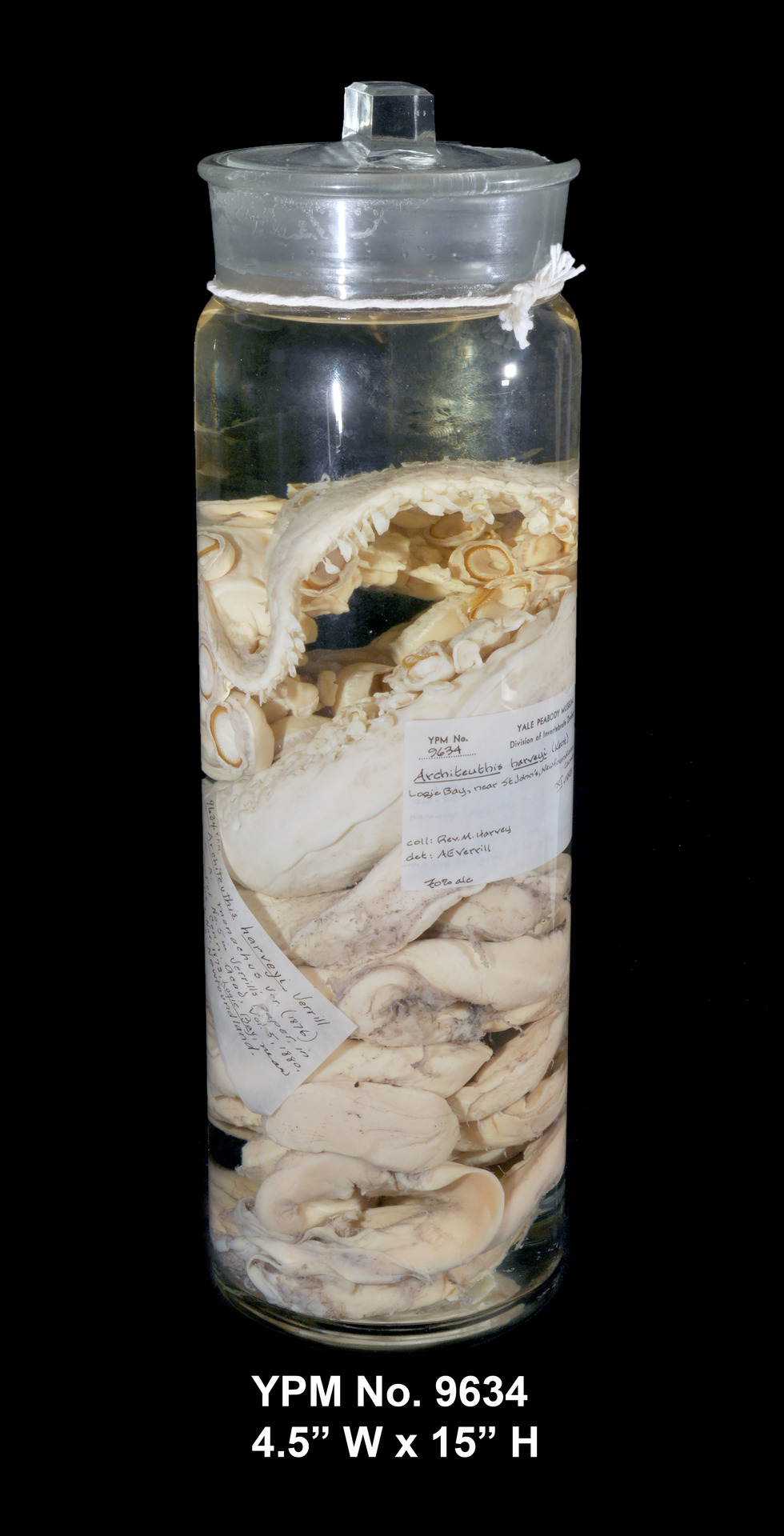
Featured image credit
Image: Eric A. Lazo-Wasem · Wikimedia Commons · CC0 · original file
Sources and editorial policy
This feature is based on publicly available scientific and institutional sources listed below. Read our editorial and fact-checking policy and AI use policy. Report a correction: kjhtime@gmail.com
References
- wikipedia.org — en.wikipedia.org, accessed 2026-09-22
- nih.gov — pmc.ncbi.nlm.nih.gov, accessed 2026-09-22
- futurity.org — www.futurity.org, accessed 2026-09-22
- molluscs.at — www.molluscs.at, accessed 2026-09-22
- worldatlas.com — www.worldatlas.com, accessed 2026-09-22
- Figure 13: Linear regressions for Architeuthis dux . — PeerJ, accessed 2026-09-22
- Figure 12: Distribution of (A) Total Length (m), (B) Mantle Length (m), and (A) Mass (kg) for Architeuthis dux . — PeerJ, accessed 2026-09-22