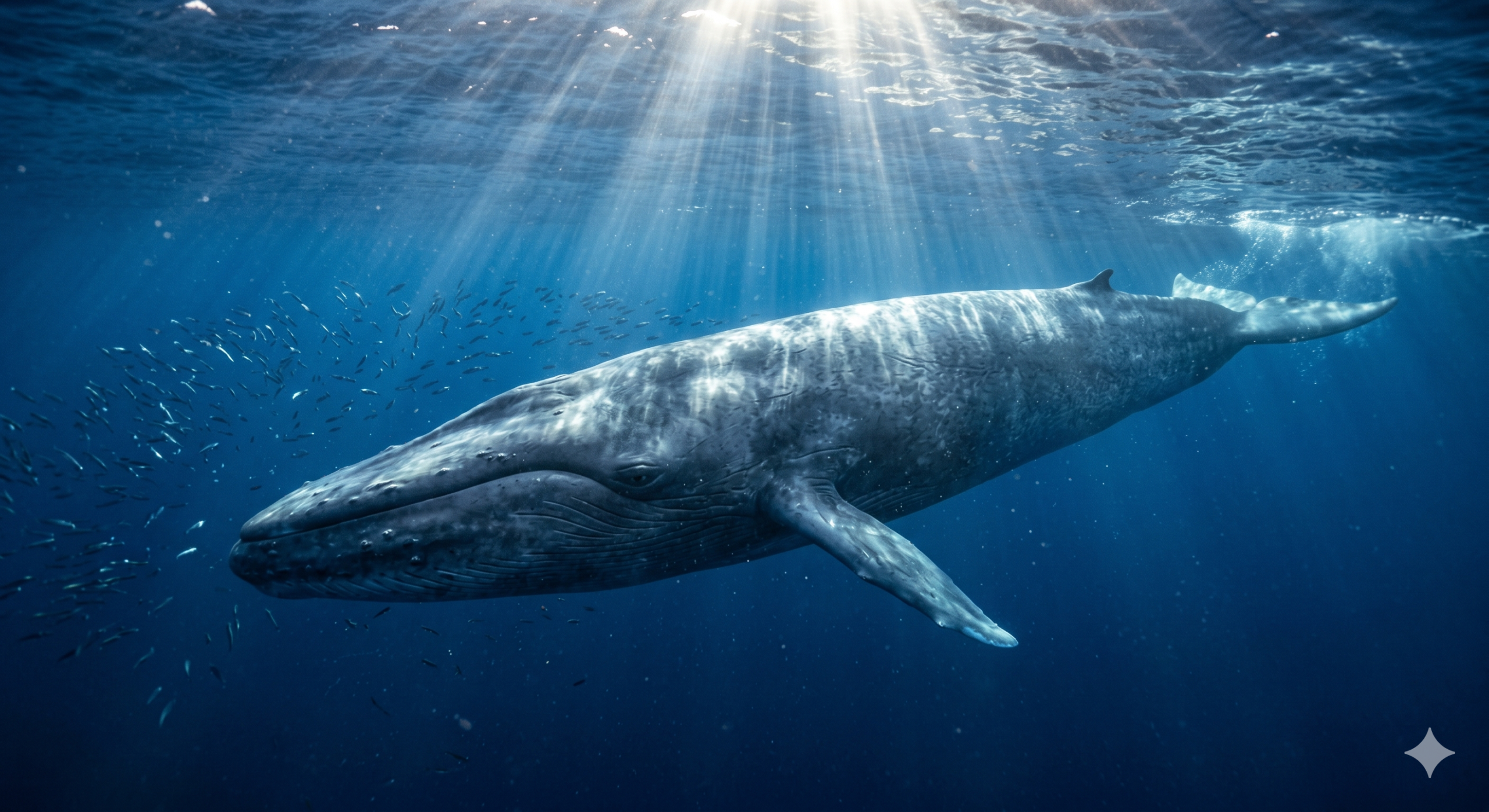
대왕고래: 지구상 가장 위대한 거인, 그 압도적인 스케일의 비밀
분류 트리: Animalia > Chordata > Mammalia > Cetacea > Balaenopteridae
Hook: 거대함, 그 이상의 경외심
상상해 보세요. 당신의 심장보다 훨씬 큰 심장이 쿵쾅거리고, 혀 하나가 코끼리 한 마리 무게와 맞먹는 동물. 그리고 그 동물의 혈관 속에서는 사람이 수영할 수도 있다고 합니다! 마치 SF 영화 속 이야기 같지만, 이는 지구가 품고 있는 가장 위대한 생명체, 바로 대왕고래 (Balaenoptera musculus)의 이야기입니다. 에디터 택슨구루는 오늘, 압도적인 크기로 우리를 경외하게 만드는 이 바다의 신사를 만나보려 합니다. 그저 큰 것이 아니라, 존재 자체가 하나의 경이인 대왕고래의 세계로 함께 뛰어들어 보시죠!

Scientific Backbone: 바다의 거인이 된 포유류
대왕고래는 ‘고래류(Cetacea)’에 속하는 포유류입니다. 한때 육상에서 살던 포유류의 후손이라는 사실이 놀랍지 않나요? 이들은 수백만 년에 걸쳐 바다 환경에 완벽하게 적응하며, 육중한 몸을 지탱할 중력을 덜 받는 바다에서 더욱 거대해질 수 있었습니다. 특히 대왕고래는 수염고래(Balaenopteridae)과에 속하며, 이빨 대신 ‘고래수염판’을 이용해 작은 크릴새우들을 걸러 먹는 독특한 섭식 방식을 가지고 있습니다. 이 거대한 몸을 유지하기 위해 하루에 수 톤의 크릴을 먹어치우는, 진정한 ‘크릴 흡입기’라고 할 수 있죠!
Deep Anatomy: 스케일이 다른 몸의 비밀
대왕고래의 평균 길이는 약 25~30미터, 무게는 무려 100~200톤에 달합니다. 이는 보잉 737 비행기 2대 또는 자동차 30대와 맞먹는 무게라고 하니, 그 규모가 짐작이 가시나요? 앞서 언급했듯, 그들의 심장은 폭스바겐 비틀만 한 크기이고, 매 박동마다 약 220리터의 피를 온몸으로 보냅니다. 주요 혈관의 지름은 사람이 기어들어갈 수 있을 정도이고, 혀는 성인 코끼리 한 마리보다 무거운 4톤에 달합니다. 폐는 5,000리터의 공기를 담을 수 있어 한 번 숨 쉬면 20분 넘게 잠수할 수 있죠. 이 모든 것이 바닷속에서 효율적으로 기능하기 위해 진화한 결과라니, 에디터 택슨구루는 그저 감탄할 따름입니다!

Evolutionary Context: 거대함의 대가와 도전
대왕고래의 거대함은 단순한 우연이 아닙니다. 차가운 극지방 해역에서 살아가기 위해 체온 유지에 유리하고, 엄청난 양의 크릴이 모여드는 해역에서 효율적으로 먹이를 섭취하기 위한 적응의 결과입니다. 하지만 이러한 거대함은 동시에 큰 시련을 가져오기도 했습니다. 한때 인간의 무분별한 포경으로 인해 멸종 위기에 처하기도 했으며, 지금은 기후 변화로 인한 먹이 감소, 해양 소음 공해, 선박 충돌 등 다양한 위협에 직면해 있습니다. 지구상 가장 큰 생명체로서의 존재감은 여전히 압도적이지만, 그들의 미래는 우리의 손에 달려있습니다.
Verdict & Trivia: 경이로운 존재를 지켜나가기
대왕고래는 단순히 큰 동물이 아닙니다. 그들은 지구 생명체의 한계를 보여주는 살아있는 증거이자, 우리에게 끊임없이 자연의 경이로움을 일깨워주는 존재입니다. 그들의 거대한 울음소리는 수백 킬로미터 밖에서도 들릴 정도로 지구상에서 가장 큰 소리를 내는 동물 중 하나입니다. 이 모든 놀라운 사실들을 알게 되니, 에디터 택슨구루는 대왕고래가 계속해서 푸른 바다를 유영하며 후손에게 그 웅장함을 물려주기를 간절히 바랍니다. 그들을 지키는 것은 곧 우리 자신과 지구의 건강을 지키는 일임을 잊지 말아야 할 것입니다!
Blue Whale: The Earth’s Greatest Giant, Unveiling the Secrets of Its Overwhelming Scale
Classification Tree: Animalia > Chordata > Mammalia > Cetacea > Balaenopteridae
Hook: Immensity, Beyond Awe
Imagine an animal with a heart larger than yours, a tongue weighing as much as an entire elephant, and blood vessels so wide a human could swim inside them! This might sound like a sci-fi movie, but it’s the reality of the Earth’s greatest living creature: the Blue Whale (Balaenoptera musculus). Today, Editor TaxonGuru invites you to meet this gentleman of the sea, whose overwhelming size inspires nothing short of awe. It’s not just big; its very existence is a marvel. Let’s dive into the world of the blue whale!
Scientific Backbone: A Mammal that Conquered the Ocean
The blue whale is a mammal belonging to the order ‘Cetacea’. Isn’t it astounding to think they are descendants of land mammals? Over millions of years, they perfectly adapted to marine environments, growing to colossal sizes in the ocean where gravity’s pull is lessened. Blue whales specifically belong to the Balaenopteridae family (rorquals) and possess ‘baleen plates’ instead of teeth, which they use to filter-feed on tiny krill. To sustain their immense bodies, they consume tons of krill daily, truly earning the title of ‘krill hoover’!
Deep Anatomy: Secrets of a Body on a Different Scale
Blue whales average about 25 to 30 meters (82-98 feet) in length and can weigh a staggering 100 to 200 tons. That’s equivalent to two Boeing 737 airplanes or 30 cars – can you even grasp the scale? As mentioned, their heart is the size of a Volkswagen Beetle, pumping approximately 220 liters (58 gallons) of blood with each beat. Their main arteries are wide enough for a human to crawl through, and their tongue alone weighs about 4 tons, heavier than an adult elephant. Their lungs can hold 5,000 liters (1,320 gallons) of air, allowing them to dive for over 20 minutes on a single breath. All of this has evolved to function efficiently underwater – Editor TaxonGuru is simply in awe!

Evolutionary Context: The Cost and Challenges of Gigantism
The blue whale’s enormous size is no mere accident. It’s a result of adaptations that favor heat retention in cold polar waters and efficient feeding in krill-rich areas. However, this immensity has also brought significant challenges. They were once driven to the brink of extinction by indiscriminate human whaling, and now face various threats, including reduced food sources due to climate change, ocean noise pollution, and ship strikes. While their presence as the largest creature on Earth remains overwhelmingly majestic, their future largely rests in our hands.
Verdict & Trivia: Protecting a Wondrous Existence
Blue whales are more than just large animals. They are living proof of the limits of Earth’s life forms and constant reminders of nature’s wonders. Their colossal calls are among the loudest of any animal on Earth, audible hundreds of kilometers away. Knowing all these incredible facts, Editor TaxonGuru earnestly hopes that blue whales will continue to gracefully navigate the blue oceans, passing on their grandeur to future generations. We must remember that protecting them is synonymous with protecting ourselves and the health of our planet!