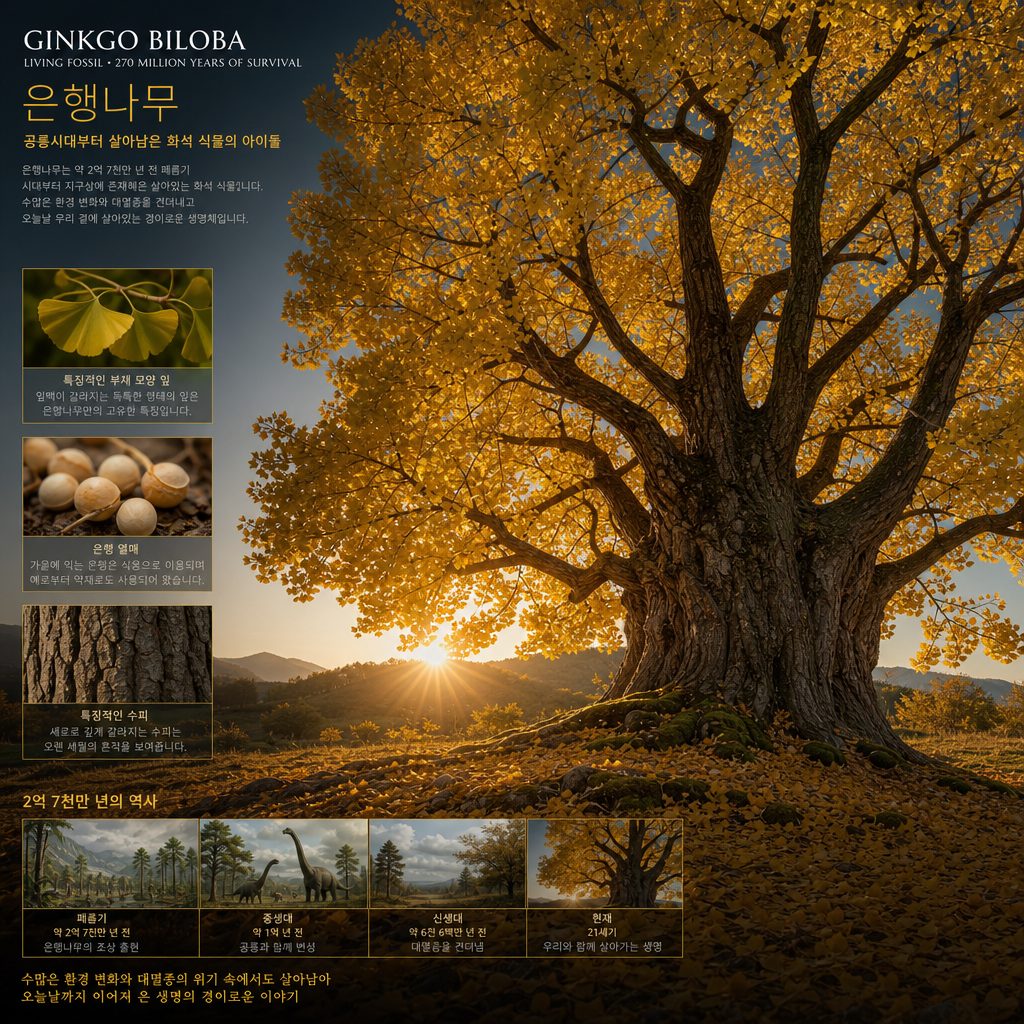
은행나무 (Ginkgo biloba): 공룡 친구들의 노랗게 물든 추억!
Plantae > Ginkgophyta > Ginkgoales
1. 훅! (Hook!) – 가을마다 찾아오는 살아있는 화석의 금빛 퍼포먼스
가을이 되면 도시를 온통 노란색으로 물들이며 우리 마음을 설레게 하는 존재가 있습니다. 바로 ‘은행나무’!
매년 가을이면 “와, 진짜 예쁘다!”를 외치게 만드는 이 나무는 사실 그냥 예쁜 나무가 아닙니다.
무려 공룡 형님들이 한창 지구를 주름잡던 그 시절부터 지금까지, 억겁의 세월을 버텨낸 진정한 ‘고인물’이자 ‘리빙 레전드’죠!
공룡 밥이었던 추억을 가진 이 시대의 아이돌, 은행나무의 시공간을 초월한 스토리를 에디터 택슨구루가 파헤쳐 드립니다!

2. 과학적 뼈대 (Scientific Backbone) – 이름값 하는 살아있는 화석
은행나무의 학명은 Ginkgo biloba. ‘Ginkgo’는 일본어 ‘긴쿄(銀杏)’에서 유래했고, ‘biloba’는 잎이 두 갈래로 나뉜다는 뜻입니다.
놀라운 사실은 은행나무가 현존하는 모든 식물 중에서 유일하게 ‘은행나무문(Ginkgophyta)’에 속하는 종이라는 겁니다.
마치 자기 혼자만 독점 상표를 가지고 있는 격이죠!
이런 독보적인 분류학적 위치는 은행나무가 얼마나 오랜 진화의 역사를 가졌는지, 그리고 얼마나 독자적인 길을 걸어왔는지를 여실히 보여줍니다.
그래서 ‘살아있는 화석’이라는 별명이 괜히 붙은 게 아니라고 에디터 택슨구루는 단언합니다.
3. 심층 해부 (Deep Anatomy) – 너의 모든 것을 파헤쳐 줄게
은행나무를 보면 가장 먼저 눈에 띄는 것이 바로 부채꼴 모양의 독특한 잎입니다.
마치 고대의 유물을 보는 듯한 디자인이죠! 이 잎은 잎맥이 방사상으로 퍼져 있고, 가운데가 살짝 갈라져 ‘biloba’라는 학명과도 연결됩니다.
그리고 가을에 지독한 냄새를 풍기는 열매(?)! 사실 이건 엄밀히 말하면 ‘열매’가 아니라 은행나무의 씨앗을 감싸는 외종피 부분입니다.
은행나무는 암나무와 수나무가 따로 있는 ‘암수딴그루(Dioecious)’ 식물인데, 이 냄새나는 씨앗은 암나무에서만 열립니다.
아마 공룡들이 이 씨앗을 먹고 ‘크앙! 이게 무슨 냄새지?’ 했을지도 모르겠습니다.
하지만 씨앗 속의 알맹이, 바로 은행은 우리에게 귀한 먹거리가 되죠.
냄새는 좀 그렇지만, 비주얼과 실속을 모두 챙긴 이 시대의 진정한 ‘인싸’ 식물입니다.
고대부터 내려온 유니크한 생존 전략이 아닐 수 없습니다!

4. 진화적 맥락 (Evolutionary Context) – 공룡시대부터 이어진 질긴 생명력
은행나무의 조상들은 약 2억 7천만 년 전 페름기부터 출현하기 시작했습니다.
쥐라기와 백악기에는 지구 전역에 걸쳐 다양한 종류의 은행나무가 번성했고, 거대한 공룡들이 그 잎을 뜯어 먹었을 겁니다.
티라노사우루스가 은행잎 샐러드를 즐기고, 브라키오사우루스가 높은 곳의 은행잎을 따 먹던 시절을 상상해 보세요!
수많은 식물 종들이 빙하기와 대멸종을 거치며 사라졌지만, 은행나무는 놀랍게도 살아남아 오늘날까지 그 명맥을 이어오고 있습니다.
이것은 단순히 운이 좋아서가 아니라, 극한의 환경에도 적응할 수 있는 은행나무만의 탁월한 생존 전략 덕분입니다.
도시의 매연과 가뭄에도 끄떡없는 끈질긴 생명력, 이것이야말로 ‘진정한 고인물의 품격’이라고 에디터 택슨구루는 말합니다.
5. 에디터 택슨구루의 한마디 & 깨알 상식 (Verdict & Trivia)
가을, 노랗게 물든 은행잎 아래를 걷다 보면 문득 생각합니다.
‘수억 년 전에도 이 길을 거대한 공룡들이 걸었을까? 그들도 이 노란색에 감탄했을까?’
은행나무는 단순히 아름다운 가로수가 아니라, 우리에게 시간여행의 통로를 열어주는 살아있는 역사서입니다.
도시의 삭막함 속에서 고대의 숨결을 느끼게 해주는 유일무이한 존재죠.
에디터 택슨구루는 은행나무를 보며 언제나 겸손해집니다.
우리의 짧은 생애 동안 그들은 얼마나 많은 지구의 변화를 지켜봐 왔을까요?
깨알 상식: 은행나무는 환경오염에 매우 강하고, 병충해에도 강해서 도시 가로수로 사랑받습니다. 또한, 씨앗(은행)은 한약재로도 사용되며, 이뇨 작용과 호흡기 질환에 도움을 준다고 알려져 있습니다. 다만, 날것으로 많이 먹으면 독성이 있을 수 있으니 꼭 익혀서 적당량만 섭취해야 합니다!
오늘도 변함없이 자리를 지키며 가을을 빛내는 은행나무에게 박수를 보냅니다!
Ginkgo Tree (Ginkgo biloba): The Golden Memories of Our Dinosaur Friends!
Plantae > Ginkgophyta > Ginkgoales
1. Hook! – The Golden Performance of a Living Fossil Every Autumn
As autumn arrives, there’s a presence that excites our hearts, painting the city entirely in yellow: the Ginkgo Tree!
Every fall, this tree makes us exclaim, “Wow, it’s so beautiful!” But it’s not just a pretty tree.
From the era when the mighty dinosaurs ruled the Earth, until now, it has endured eons of time, making it a true ‘old-timer’ and a ‘living legend’!
A modern-day idol with memories of being dinosaur food, Editor TaxonGuru will delve into the Ginkgo tree’s timeless story.
2. Scientific Backbone – A Living Fossil Worth Its Name
The scientific name for the Ginkgo tree is Ginkgo biloba. ‘Ginkgo’ is derived from the Japanese ‘ginkyō (銀杏)’, and ‘biloba’ means its leaves are divided into two lobes.
The astonishing fact is that the Ginkgo tree is the only extant species belonging to the ‘Ginkgophyta’ phylum among all living plants.
It’s like it has a monopoly on its own trademark!
This unique taxonomic position clearly shows how long its evolutionary history is and how independently it has walked its path.
That’s why Editor TaxonGuru asserts that its nickname ‘living fossil’ isn’t just for show.
3. Deep Anatomy – Let’s Unpack Everything About You
The first thing that catches your eye about the Ginkgo tree is its distinctive fan-shaped leaves.
They look like an ancient artifact! These leaves have veins radiating outwards and are slightly notched in the middle, connecting to its scientific name ‘biloba’.
And then there are the incredibly smelly fruits (?) in autumn! Strictly speaking, these aren’t ‘fruits’ but rather the outer integument surrounding the Ginkgo’s seeds.
Ginkgo trees are ‘dioecious’ plants, meaning they have separate male and female trees, and these smelly seeds only grow on female trees.
Perhaps dinosaurs ate these seeds and thought, ‘Grrr! What is this smell?’
However, the kernel inside the seed, the ginkgo nut, becomes a valuable food source for us.
The smell might be a bit much, but it’s a true ‘influencer’ plant of our time, boasting both visual appeal and practical value.
It’s nothing short of a unique survival strategy passed down from antiquity!

4. Evolutionary Context – A Tenacious Life Force from the Dinosaur Age
The ancestors of Ginkgo trees began to appear around 270 million years ago during the Permian period.
During the Jurassic and Cretaceous periods, various types of Ginkgo flourished across the globe, and colossal dinosaurs would have munched on their leaves.
Imagine T-Rex enjoying a Ginkgo leaf salad, and Brachiosaurus reaching for high Ginkgo leaves!
While countless plant species vanished during ice ages and mass extinctions, the Ginkgo tree astonishingly survived, maintaining its lineage to this day.
This wasn’t just luck but due to the Ginkgo’s exceptional survival strategies, enabling it to adapt to extreme environments.
Its tenacious vitality, unfazed by urban smog and drought, is what Editor TaxonGuru calls ‘the true dignity of an old-timer’.
5. Editor TaxonGuru’s Verdict & Fun Facts
Walking beneath the golden Ginkgo leaves in autumn, I sometimes ponder:
‘Did colossal dinosaurs walk this path hundreds of millions of years ago? Did they, too, marvel at this golden hue?’
The Ginkgo tree is not merely a beautiful street tree; it’s a living history book that opens a portal for us to time travel.
It’s a singular entity that allows us to feel the breath of ancient times amidst the urban concrete jungle.
Editor TaxonGuru always feels humbled by the Ginkgo tree.
How many changes on Earth have they witnessed during our short lifetimes?
Fun Fact: Ginkgo trees are highly resistant to environmental pollution and pests, making them popular as urban street trees. Additionally, their seeds (ginkgo nuts) are used in traditional medicine, believed to aid in diuretic functions and respiratory ailments. However, consuming too many raw ginkgo nuts can be toxic, so they should always be cooked and eaten in moderation!
We applaud the Ginkgo tree, which steadfastly holds its place and brightens our autumns!