[1부: 한국어 버전]
분류 트리: Animalia > Annelida > Siboglinidae
심해의 뼈 도둑: 오세닥스, 그 은밀한 식사의 비밀!
1. 심해, 고래의 마지막 여정과 그 손님 (Hook)
수십 톤에 달하는 거대한 고래가 바다의 장례를 치르듯 심해로 가라앉는 순간, 이 거대한 생명체는 단순히 죽음으로 끝나는 것이 아닙니다. 심해 생태계 전체를 뒤흔드는 ‘고래 낙하(Whale Fall)’라는 대형 이벤트를 시작하죠. 빛 한 점 없는 망망대해의 식탁에 난데없이 등장한 초호화 만찬! 하지만 이 만찬의 진짜 주인공은 따로 있습니다. 바로 뼈까지 씹어먹는 심해의 청소부, ‘오세닥스(Osedax bonegma)’입니다. 척추동물의 화석으로 오해받기 십상인 이 기묘한 생명체는 고래 뼈의 마지막 한 조각까지 ‘싹싹’ 긁어먹는 진짜 미식가랍니다. 그럼 이 불가사의한 뼈 도둑 벌레의 세계로, 에디터 택슨구루와 함께 떠나볼까요?
2. 과학의 이름표: Osedax bonegma (Scientific Backbone)
학명 ‘Osedax bonegma’는 라틴어로 ‘뼈를 먹는 자’라는 뜻의 ‘Osedax’와 ‘뼈(bone)’를 뜻하는 그리스어 ‘os’에 ‘먹다(edax)’가 합쳐진 이름인데요, 그만큼 이들의 식성이 직관적으로 드러나는 이름이죠. 이 신비로운 생명체는 동물계(Animalia)의 갯지렁이 무리인 환형동물(Annelida)에 속하며, 깊은 바다에 사는 관벌레류(Siboglinidae)의 한 종류입니다. 처음 발견되었을 때 과학자들은 입도, 항문도 없는 이 벌레가 어떻게 뼈를 먹는지 의문을 품었지만, 이들은 그들만의 독특하고 기발한 생존 전략을 가지고 있습니다. 마치 심해의 ‘뼈 전문 소믈리에’랄까요?
3. 입 없는 식도락가: 뼈 속 영양분의 마법 (Deep Anatomy)
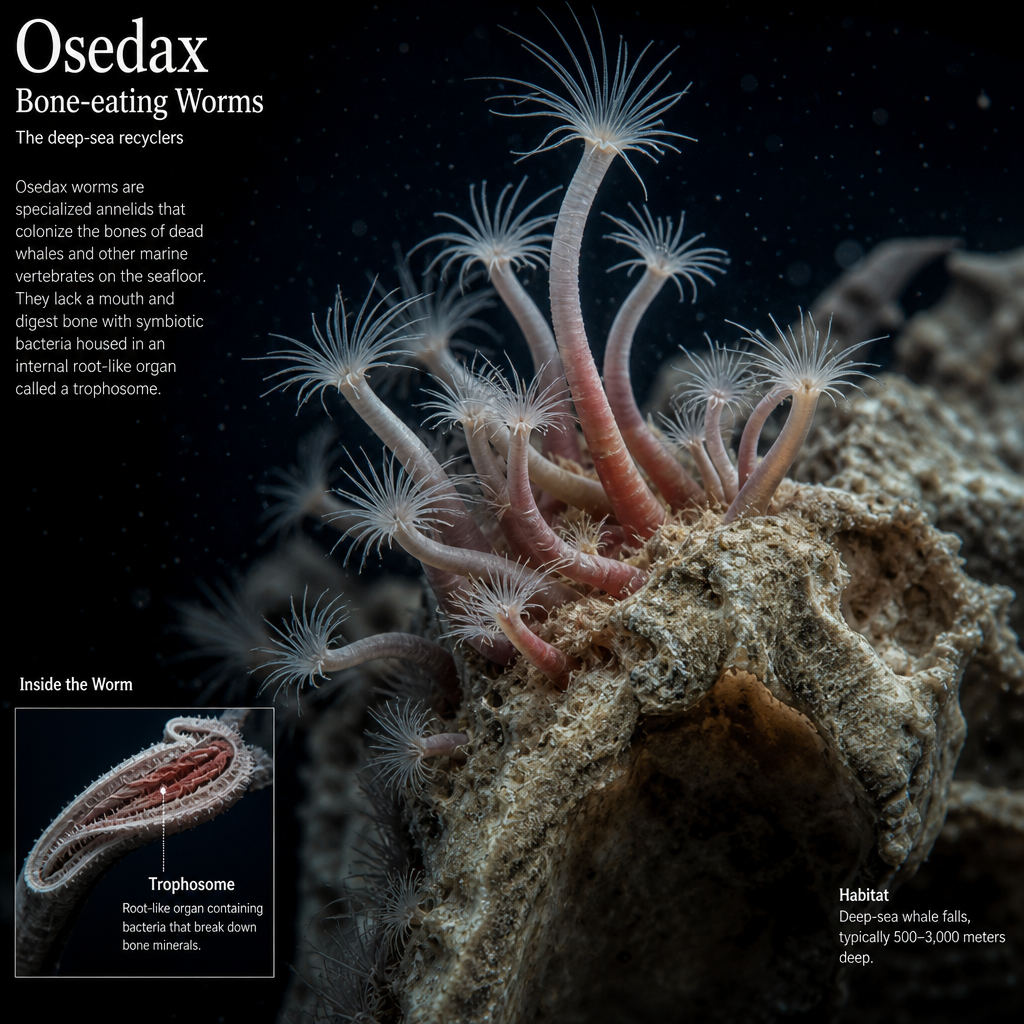
오세닥스의 가장 놀라운 특징은 바로 ‘입도 항문도 없다’는 점입니다. 그럼 어떻게 고래 뼈를 먹냐고요? 비밀은 바로 ‘뿌리’에 있습니다. 오세닥스는 고래 뼈에 마치 나무뿌리처럼 생긴 촉수를 뻗어 침투시키는데, 이 뿌리에는 뼈 속의 콜라겐과 지방을 분해하는 공생 세균들이 살고 있습니다. 이 세균들이 뼈를 분해하면, 오세닥스는 그 영양분을 흡수하여 살아갑니다. 마치 뼈라는 거대한 냉장고에서 유기물을 직접 빨아들이는 흡혈귀처럼 말이죠! 뼈 밖으로 드러난 부분은 화려한 깃털 같은 ‘아가미’를 가지고 있어 산소를 흡수합니다. 암컷은 몸길이 수 센티미터에 달하며, 수컷은 암컷 몸속에 사는 현미경으로나 볼 수 있는 ‘난쟁이 수컷’으로 생존합니다. 어쩌면 심해 최고의 ‘하우스 푸어’가 아닐까 싶네요.
4. 진화의 증언: 심해 생태계의 청소부 (Evolutionary Context)
오세닥스의 발견은 심해 생태계에 대한 우리의 이해를 한 단계 끌어올렸습니다. 이전에는 고래 낙하 시체가 박테리아나 일부 무척추동물에 의해 서서히 분해될 것이라고만 생각했지만, 오세닥스는 이 거대한 유기물 덩어리를 훨씬 더 효율적으로 ‘재활용’하는 역할을 합니다. 고래 사체가 심해에 가라앉는다는 것은 드물지만 강력한 사건이며, 오세닥스는 이러한 일시적인 자원 폭발을 최대한 활용하도록 진화한 전문가입니다. 이는 극한 환경에서 생명이 어떻게 놀라운 적응력을 보여주는지, 그리고 심해 생태계가 얼마나 복잡하고 예측 불가능한 연결망으로 이루어져 있는지 보여주는 살아있는 증거입니다. 진정 ‘버릴 것 없는 생명의 순환’의 표본이라고 할 수 있죠.
5. 에디터 택슨구루의 한마디: 경이로운 생존자 (Verdict & Trivia)
오세닥스, 이 작은 뼈 먹는 벌레는 입도 항문도 없이 거대한 고래 뼈를 녹여 먹는 기상천외한 방법으로 심해의 영양분을 순환시키는 숨은 일꾼입니다. 고래 뼈에서 마지막 영양분 한 방울까지 쥐어짜내는 이들의 끈질긴 생존 전략은 우리에게 생명의 다양성과 적응력에 대한 깊은 경외심을 안겨줍니다. 뼈는 단단한 죽음의 상징인 동시에, 오세닥스에게는 새로운 생명을 꽃피우는 풍요로운 대지인 셈입니다. 이처럼 경이로운 심해 생물의 이야기는 앞으로도 에디터 택슨구루가 계속해서 탐험하고 들려드리겠습니다!
[2부: Global Readers English Version]
Classification Tree: Animalia > Annelida > Siboglinidae
Deep-Sea Bone Thieves: Osedax, The Secret of Their Covert Feast!
1. The Deep, A Whale’s Last Journey, and Its Guests (Hook)
When a massive whale, weighing tens of tons, performs its ocean funeral by sinking into the deep sea, this colossal creature doesn’t just meet its end. It initiates a monumental event known as a ‘Whale Fall,’ shaking up the entire deep-sea ecosystem. Suddenly, a luxurious banquet appears on the abyssal seafloor, where not a single ray of light penetrates! But the true stars of this feast are quite different. They are the deep-sea scavengers that munch on bones: ‘Osedax bonegma.’ These bizarre creatures, often mistaken for vertebrate fossils, are true gourmands who meticulously scour every last bit from whale bones. So, shall we dive into the world of these mysterious bone-eating worms with Editor TaxonGuru?
2. The Scientific Label: Osedax bonegma (Scientific Backbone)
The scientific name ‘Osedax bonegma’ comes from the Latin ‘Osedax,’ meaning ‘bone-eater,’ and the Greek ‘os’ for bone combined with ‘edax’ for eat. It’s a name that clearly reflects their dietary habits! These mysterious organisms belong to the phylum Annelida (segmented worms), a group of marine worms, and are a type of Siboglinidae, found in the deep sea. When first discovered, scientists wondered how these worms, lacking both a mouth and an anus, could possibly consume bones. Yet, they possess a unique and ingenious survival strategy. You could almost call them the deep sea’s ‘bone sommelier,’ couldn’t you?
3. Mouthless Gourmand: The Magic of Bone Nutrients (Deep Anatomy)
Osedax’s most astonishing feature is precisely that they have ‘neither mouth nor anus.’ So, how do they eat whale bones? The secret lies in their ‘roots.’ Osedax extend root-like tentacles into whale bones, and these roots house symbiotic bacteria that break down collagen and lipids within the bone. As these bacteria decompose the bone, Osedax absorb the nutrients to survive. They’re like vampires, directly drawing organic matter from a giant bone refrigerator! The part exposed outside the bone possesses colorful, feathery ‘gills’ for oxygen absorption. Females can grow several centimeters long, while males are microscopic ‘dwarf males’ that live inside the female’s body. Perhaps they are the ultimate ‘house poors’ of the deep sea.
4. Evolutionary Testament: The Deep-Sea Janitors (Evolutionary Context)
The discovery of Osedax has significantly advanced our understanding of deep-sea ecosystems. Previously, it was thought that whale fall carcasses would be slowly decomposed by bacteria and some invertebrates. However, Osedax plays a role in ‘recycling’ these massive organic masses far more efficiently. A whale carcass sinking to the deep is a rare but powerful event, and Osedax are specialists evolved to exploit these ephemeral resource bonanzas to their fullest. This is a living testament to how life exhibits incredible adaptability in extreme environments and how complex and unpredictable the deep-sea ecosystem’s network truly is. Truly a prime example of the ‘circle of life where nothing goes to waste.’
5. Editor TaxonGuru’s Closing Remark: A Marvelous Survivor (Verdict & Trivia)
Osedax, these small bone-eating worms, are hidden workers circulating nutrients in the deep sea through their bizarre method of dissolving and consuming massive whale bones without a mouth or anus. Their tenacious survival strategy, squeezing every last drop of nutrition from whale bones, instills in us a profound awe for the diversity and adaptability of life. Bones, often a symbol of rigid death, are for Osedax a fertile ground where new life flourishes. Editor TaxonGuru will continue to explore and share such marvelous stories of deep-sea creatures!