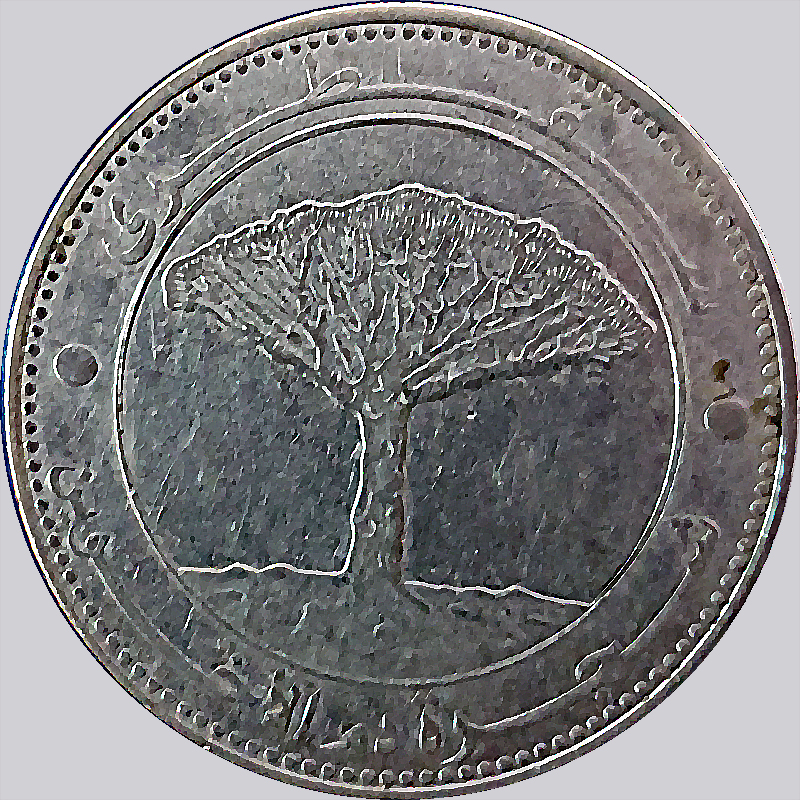
High above the Arabian Sea, on the windswept limestone plateaus of Yemen’s Socotra Archipelago, stands a silhouette that seems entirely detached from ordinary plant life [1][5]. Rising between 300 and over 1,000 meters in elevation, these trees resemble giant mushrooms or upturned umbrellas resting against the dry horizon [1, 4, 5]. This is Dracaena cinnabari, the Socotra dragon blood tree, an endemic species that serves as the official national tree of Yemen [1][5].
At first glance, the tree raises an immediate question: why would a plant evolve such a strange, densely woven crown in an arid environment? The answer lies in its extreme survival strategy, designed to wring moisture directly out of thin air [4][6]. By examining how this species gathers water, defends its tissue, and builds its trunk, field observations reveal a masterclass in desert architecture [2, 4, 8].
An Umbrella Built for Fog Catching
The unique physical structure of Dracaena cinnabari is directly tied to the microclimates of Socotra’s high-altitude regions [4][5]. High plateaus like Firmihin and Diksam, along with nearby granite mountain slopes, are periodically swathed in heavy monsoon clouds and mist [4][5]. Rather than relying solely on erratic rainfall, the tree uses its broad, upturned canopy as an interceptor for atmospheric moisture [4, 6, 8].
The densely packed crown collects water droplets directly from rolling fog clouds [4, 6, 8]. As moisture condenses on the leaves, gravity channels the water inward along the branches toward the main trunk, dropping it straight down into the root zone beneath [4, 6, 8]. This concentrated drip system ensures that the root area receives localized hydration [4, 6, 8].
Simultaneously, the broad, thick canopy casts a wide shadow over the ground around the base of the tree [4, 6, 8]. In a harsh environment where solar radiation quickly bakes the soil, this built-in shade dramatically reduces the evaporation of moisture from the earth below [4, 6, 8]. Through this dual action—fog harvesting and shade provision—the canopy creates a self-sustaining micro-oasis beneath its branches [4, 6, 8].
Does the Dragon Tree Really Bleed?
One of the most widely shared beliefs about Dracaena cinnabari is that cutting into its trunk reveals a red liquid that flows constantly through its vascular system like human blood [1][8]. However, botanical analysis tells a completely different story [1, 8, 9]. The tree does not circulate crimson fluid through its active water-conducting tubes [1][8].
Instead, the dark red liquid is a thick plant resin that remains stored inside specialized tissues until triggered [8, 9, 10]. When the trunk or branches sustain physical wounds from mechanical damage, or when insects and pathogens attempt to breach the bark, the tree secretes this resin over the injured area [8, 9, 10]. Upon exposure to air, the resin thickens to form a protective seal over the wound, stopping moisture loss and blocking invading microbes [8, 9, 10].

From a chemical standpoint, this defense resin is loaded with active compounds [8, 9, 10]. Chemical isolation studies show high concentrations of non-flavonoids and chalcones, which exhibit powerful antimicrobial and pharmacological properties [8, 9, 10]. The red color is simply a visual byproduct of these defensive chemical compounds working together to sterilize injured plant tissue [8, 9, 10].
Historical accounts often confuse the origin of this resin [1][10]. While Socotra was indeed a famous supply hub along ancient trade routes, the commercial material called “dragon’s blood” was not harvested exclusively from Dracaena cinnabari [1][10]. Over centuries, merchants traded similar red resins gathered from Canary Islands dragon trees, South American Croton species, and several Asian rattan palms under the very same common name [1][10].
How a Monocot Builds a Massive Wooden Trunk
To appreciate how Dracaena cinnabari reaches its impressive size, one must look closely at its place in plant taxonomy [1][2]. The species belongs to the family Asparagaceae within the class Liliopsida, making it a monocotyledon—a single seed-leaf plant whose seeds contain only one embryonic leaf [1][2]. Common monocots include grasses, palms, and lilies, which typically lack true wood and do not grow thicker over time in the way oak or pine trees do [2][4].
In standard two seed-leaf trees, secondary growth—the process of growing wider in trunk diameter over consecutive growing seasons—is driven by a thin layer of dividing cells called the vascular cambium [2][4]. Monocots generally lack this continuous ring of tissue [2][4]. Yet, Dracaena cinnabari manages to form thick, rigid, heavy trunks capable of supporting thousands of branches [2][4].
The secret behind this feat is a biological phenomenon known as anomalous secondary growth [2][4]. Rather than using a standard cambium ring, the tree relies on special atypical tissue layers located near the outer edge of the stem [2][4]. These specialized cell zones divide to produce additional vascular bundles and supportive surrounding tissue, allowing the trunk to gradually expand in diameter over hundreds of years [2][4].
This unique stem structure leads directly to another common misunderstanding: can you tell the age of a dragon blood tree by counting its rings? [1, 2, 4] The simple answer is no [1, 2, 4]. Because anomalous secondary growth does not produce the annual rings characteristic of dicot trees, researchers cannot rely on traditional ring counting [1, 2, 4]. Instead, botanists estimate individual tree ages using trunk diameter growth increments, mathematical models, and the repeating structural patterns of branch splits [1, 2, 4].
A Branching Geometry Driven by Flowers
The iconic dome shape of Dracaena cinnabari is not random; it follows a strict architectural ruleset dictated by its reproductive cycle [2][7]. For many years during its early development, a young tree grows as a single, unbranched stem crowned with a rosette of long leaves [2][7].
Branching begins only when the terminal tip of a stem produces flowers [2][7]. The flowering event halts the upward growth of that specific central stem [2][7]. In response, the plant undergoes dichotomous branching—a growth pattern where a single growing point splits precisely into two equal new branches [2][7].
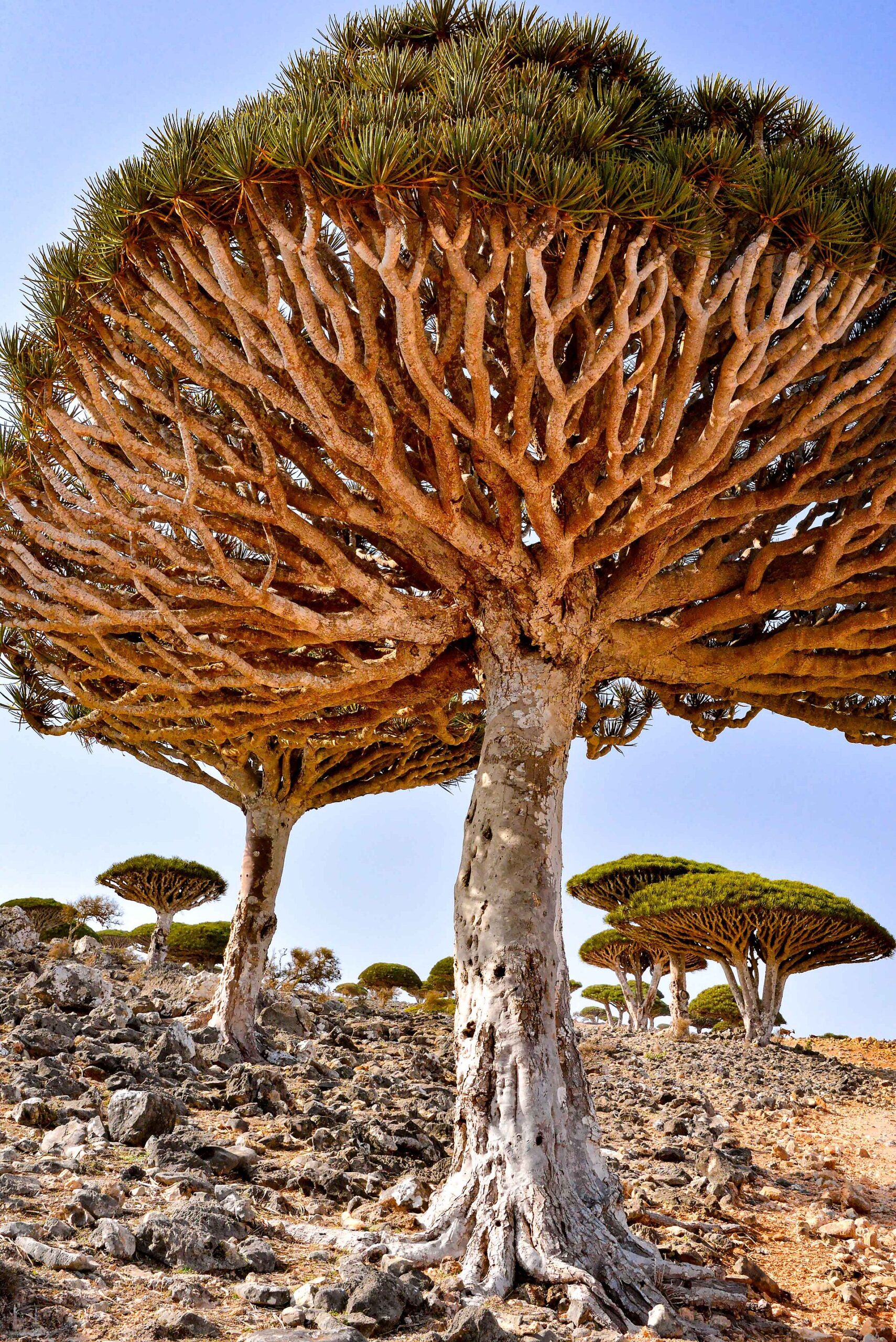
When those two new branches eventually mature and flower in subsequent years, their growth stops at the tip as well, causing each branch to split into two more [2][7]. Over several centuries, this repeated process of flowering, stopping, and binary splitting generates a perfectly balanced, symmetrical lattice of branches [2][7]. This geometric progression ultimately produces the wide, interlocking umbrella head that defines the species [2][7].
Ecological Vulnerabilities and the Regeneration Crisis
Despite its remarkable structural adaptations, Dracaena cinnabari currently faces severe environmental pressures [4][5]. The species is formally categorized as Vulnerable (VU) on the IUCN Red List of Threatened Species [1][5]. Field surveys across Socotra reveal a worrying trend: populations are overwhelmingly dominated by old, mature adult trees, with very few young saplings surviving in the wild [4][5].
The primary driver behind this natural regeneration collapse is overgrazing by introduced livestock [4][5]. Free-roaming goats feed heavily on tender young dragon blood seedlings long before the saplings can establish thick trunks or reach height safety [4][5]. This constant grazing pressure prevents new generations from replacing aging trees [4][5].
Environmental changes compound the crisis [4][5]. Climate change has led to increased aridity across the archipelago, reducing the frequency and density of the monsoon fogs that the canopy relies on for moisture collection [4][5]. Furthermore, non-traditional or aggressive resin harvesting techniques can cause severe physical damage to mature trunks, making individual trees vulnerable to fungal decay or structural failure [1][5].
There is also scientific uncertainty regarding the exact historical boundaries of dragon blood tree forests [3][4]. Ethnobotanical oral traditions among local Socotri communities, alongside recent spatial modeling research, indicate that dense tree stands once covered far wider swathes of the island than they do today [3][4]. However, because detailed botanical mapping was not recorded centuries ago, the exact historical boundaries remain uncertain [3][4]. Nonetheless, spatial modeling offers critical guidelines for contemporary reforested exclusion zones designed to protect saplings from livestock [3][4].
Synthesis: Why Socotra’s Living Umbrella Matters
Connecting these verified facts reveals that Dracaena cinnabari is far more than a visual curiosity—it acts as an essential ecological pillar for Socotra’s fragile mountain ecosystems [4, 5, 6]. Through anomalous secondary growth, the tree constructs a massive wooden scaffolding that can support an immense umbrella canopy [2, 4, 8]. That canopy in turn functions as an active hydrological engine, capturing cloud moisture and shielding the soil from fierce desert evaporation [4, 6, 8]. Meanwhile, its defensive chemical resin seals physical wounds against infection, allowing single individuals to maintain this water-gathering role across centuries [8, 9, 10].
When overgrazing destroys young saplings and warming trends diminish ambient fog mist, this hydrological network begins to break down [4][5]. Without young trees to maintain cloud collection on high plateaus like Firmihin, local water cycles face long-term collapse [4, 5, 6]. Protecting this species is not merely about preserving a single botanical entity; it is about keeping an entire high-altitude water engine alive [4, 5, 6].
Standing on the rocky limestone plateaus of Socotra, watching the monsoon mist drift through the densely woven canopy, one sees that the dragon blood tree is neither an alien visitor nor a creature shedding blood [1, 4, 8]. It is a remarkable product of evolution—an upturned umbrella engineered to harvest fog, protect its wounds with red resin, and anchor the delicate mountain ecosystems of an island continent [4, 6, 8].
Featured image credit
Image: SharabSalam · Wikimedia Commons · CC BY-SA 4.0 · original file
Sources and editorial policy
This feature is based on publicly available scientific and institutional sources listed below. Read our editorial and fact-checking policy and AI use policy. Report a correction: kjhtime@gmail.com
References
- wikipedia.org — en.wikipedia.org, accessed 2026-09-23
- intechopen.com — www.intechopen.com, accessed 2026-09-23
- proquest.com — www.proquest.com, accessed 2026-09-23
- mdpi.com — www.mdpi.com, accessed 2026-09-23
- unep-wcmc.org — world-heritage-datasheets.unep-wcmc.org, accessed 2026-09-23
- biographic.com — biographic.com, accessed 2026-09-23
- succulentes.net — succulentes.net, accessed 2026-09-23
- forbes.com — www.forbes.com, accessed 2026-09-23
- nih.gov — pubmed.ncbi.nlm.nih.gov, accessed 2026-09-23
- researchgate.net — www.researchgate.net, accessed 2026-09-23