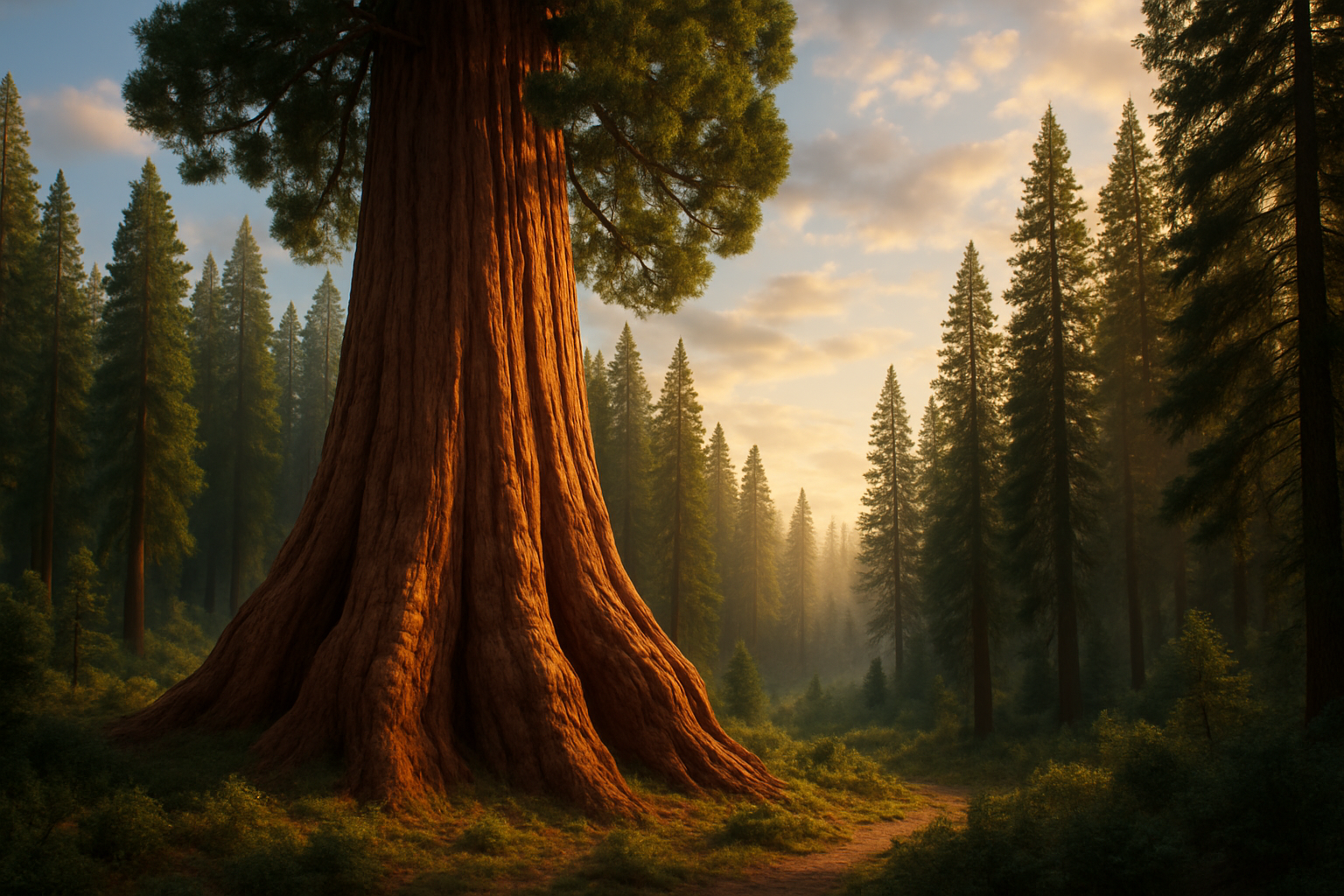
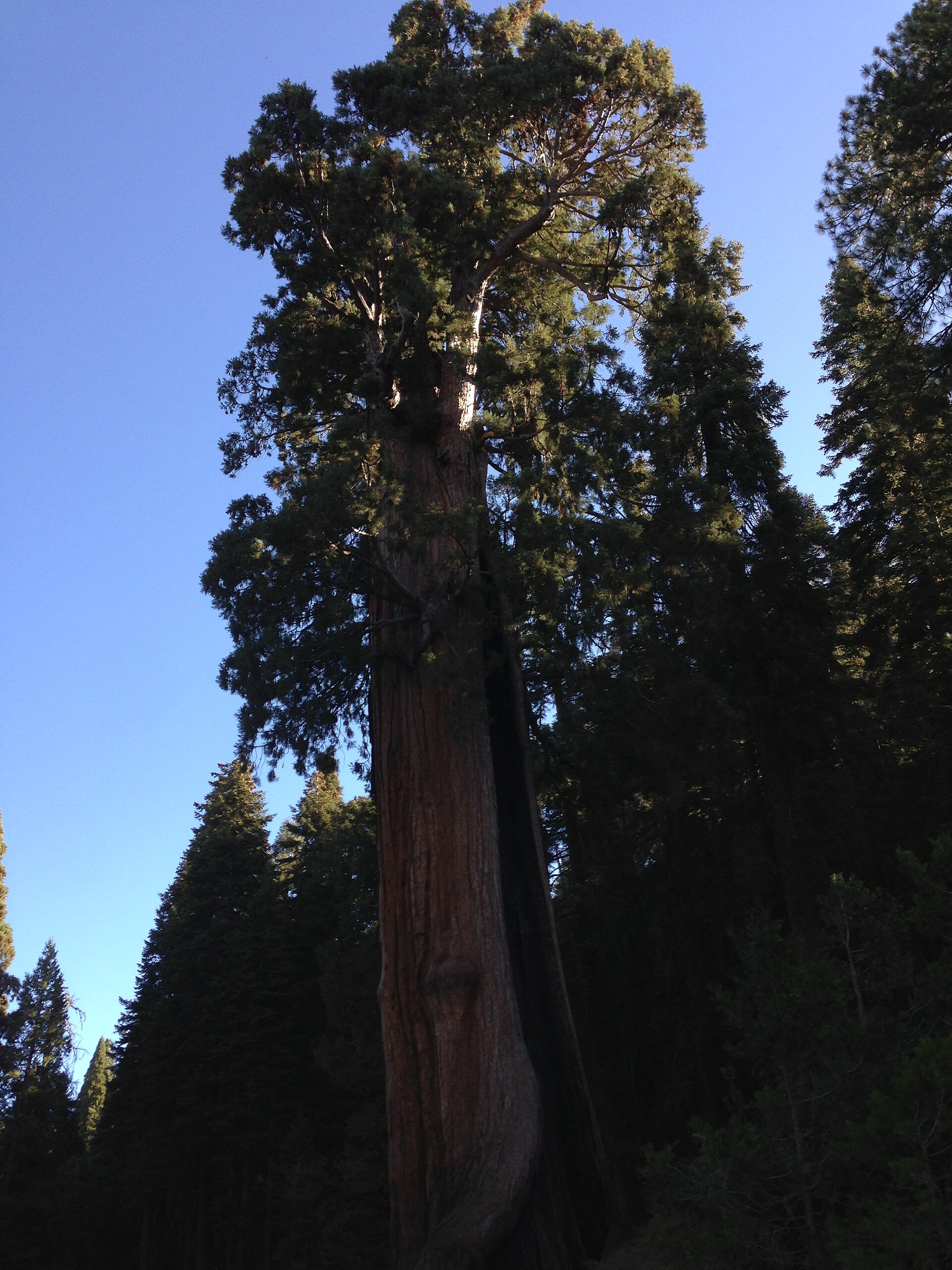
High on the western slopes of California’s Sierra Nevada range, between 1,500 and 2,400 meters above sea level, you step into a fragmented belt of mixed conifer forest stretching roughly 400 kilometers [4][5]. Looking up into the canopy, it is easy to assume you are standing beneath the tallest living thing on the planet. However, that height record actually belongs to a close relative, the coast redwood (Sequoia sempervirens), which can reach heights over 116 meters [1, 3, 8]. What you are actually looking at is the Giant Sequoia (Sequoiadendron giganteum)—a tree that may not win the vertical race, but reigns supreme as the single largest living organism on Earth by trunk volume and overall mass [1, 2, 8].
Measuring an Absolute Titan
To understand the sheer scale of Sequoiadendron giganteum, one must examine the famous individual tree known as General Sherman [2]. Located within its native forest habitat, General Sherman holds a total single-trunk volume estimated at approximately 1,487 cubic meters [2][8]. This single main stem contains enough structural mass to earn it recognition as the largest individual living organism currently recorded on Earth [2][8].
However, measuring these forest titans involves a fascinating scientific dispute regarding volume calculation criteria [8][9]. If researchers strictly calculate primary trunk volume, General Sherman ranks first, followed by the General Grant tree in second place and the President tree in third [8][9]. Yet, when botanical studies factor in the combined volume of heavy branches and foliage alongside the main stem, the ranking shifts—moving the President tree into second place overall [8][9].
Built Like an Armor-Plated Fortress
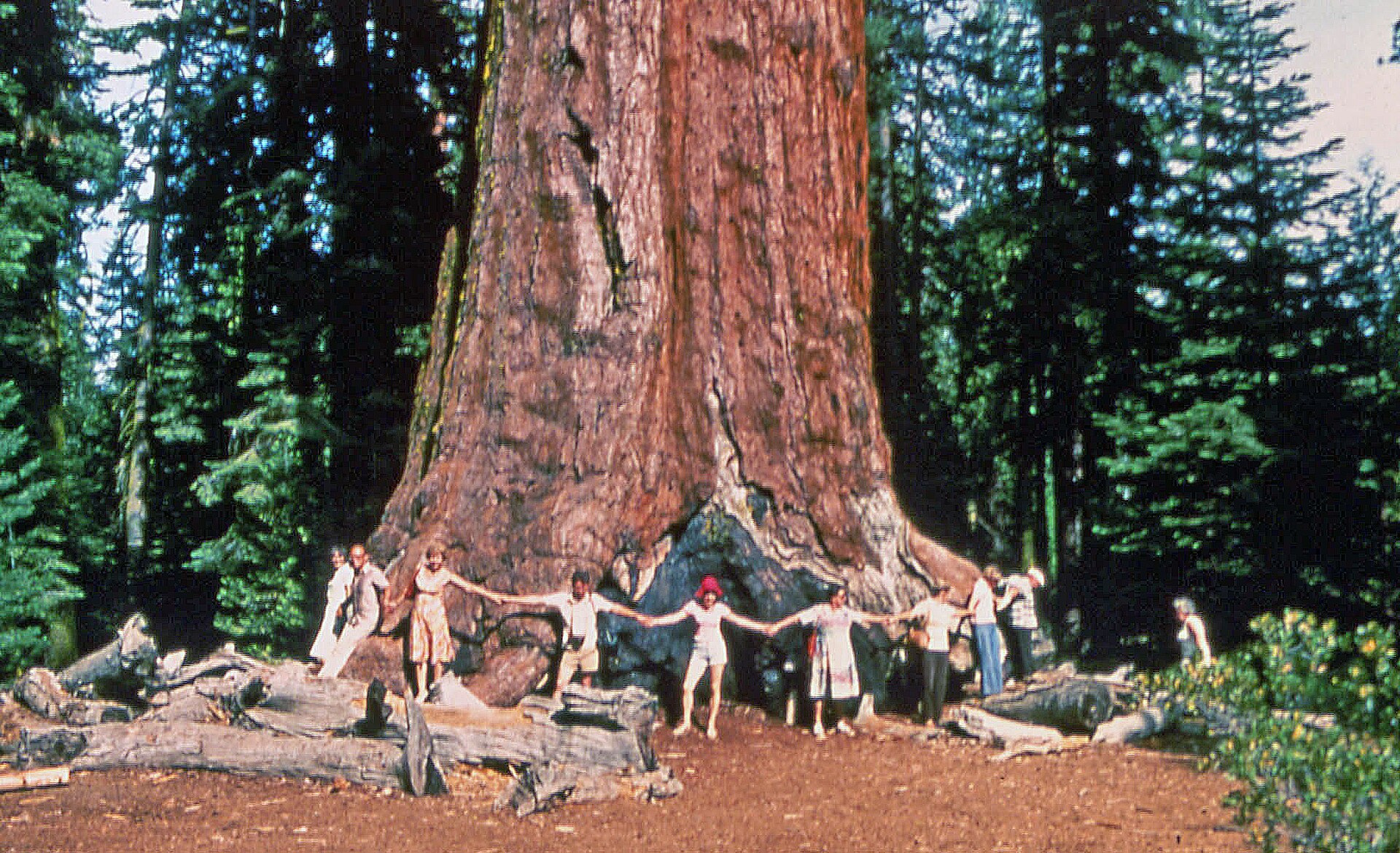
Surviving for thousands of years in the Sierra Nevada requires exceptional physical defenses. The exterior bark of the Giant Sequoia can reach up to 60 centimeters in thickness and consists of a dense, fibrous material containing almost no flammable resin [4][5]. This low-resin structure acts as a thermal shield, preventing external heat from reaching the delicate inner growth layer beneath the bark, known formally as the cambium [4][5].
Because of its immense wood volume, a common myth suggests that early logging operations profited immensely from harvesting these massive trunks [1][4]. In truth, the physical traits of the timber made it commercially poor for building construction [1][4]. When these massive trees were felled, the brittle wood shattered upon hitting the ground, leaving it largely unusable for structural timber [1, 4, 5]. As a result, harvested trunks were primarily reduced to low-value products like fence posts and matchsticks [1, 4, 5].
Born in Fire and Guided by Forest Wildlife
The reproductive cycle of Sequoiadendron giganteum is intimately tied to severe forest conditions. Rather than suffering from routine fires, the species relies directly on heat to complete its life cycle [1][5]. The thermal energy from surface fires dries out the hard seed cones, causing their individual scales to shrink and open so the enclosed seeds can drop to the ground [1][5].
Beyond heat, specific animal vectors facilitate seed release [1][5]. The feeding activities of longhorn beetle larvae and Douglas squirrels physically break open or sever cone scales, allowing seeds to escape [1][5]. Furthermore, low-intensity natural fires clear away thick surface leaf litter, exposing bare mineral soil required for seed germination while removing competing plant species that block essential sunlight [5][6].
Centuries of Growth and Modern Vulnerabilities
Through tree-ring counting research—a scientific method called dendrochronology—botanists have verified that the oldest known Giant Sequoias reach ages exceeding 3,200 years, with individual specimens dated between 3,200 and 3,266 years old [4][5]. Popular claims often suggest that individual trees like General Sherman have reached 4,000 to 5,000 years of age, but modern scientific estimates place General Sherman’s true age between 2,200 and 2,700 years [2][9].
Taxonomically classified within the cypress family, Cupressaceae, this ancient conifer naturally occurs in only about 65 to 75 fragmented groves across its narrow habitat [1, 4, 5]. Despite their ancient survival strategies, mature populations face unprecedented threats from shifting environmental conditions [6][7].
In recent years, high-intensity megafires have bypassed the species’ natural trunk defenses [6][7]. Between 2020 and 2021, destructive high-intensity wildfires burned through the Sierra Nevada, killing an estimated 13% to 20% of the planet’s total mature Giant Sequoia population [6][7]. Due to these severe losses and its narrow range, the species is listed as Endangered on the IUCN Red List [7].
Synthesizing Ancient Adaptations in a Changing Climate
When connecting the tree’s anatomical traits with its reproductive ecology, an important botanical synthesis emerges [4, 5, 6]. The Giant Sequoia’s thick, fibrous bark, low resin content, and heat-activated cone opening evolved in tandem with frequent, low-intensity surface fires [1, 4, 5]. For thousands of years, low-grade fire acted as an essential ecological filter that cleared ground litter, reduced competing vegetation, and triggered mass seed drop onto nutrient-rich mineral soil [5][6].
However, when modern climate conditions turn mild surface burns into unmanageable crown-level megafires, these ancient adaptations are overwhelmed [6][7]. Severe heat reaching high into the canopy destroys reproductive structures and cooks internal cambium tissue despite the thick bark insulator [4][6]. A major scientific limitation remains: long-term monitoring data is still required to determine whether natural forest regeneration or emergency artificial planting will prove effective across severely burned groves.
Returning to the Sierra Nevada Canopy
Standing once more beneath the immense canopy on the Sierra Nevada slopes, the distinction between tree height and structural volume becomes remarkably clear [1, 2, 4]. Sequoiadendron giganteum may not be the tallest organism climbing into the sky, but as a single stem holding nearly 1,500 cubic meters of wood, its mass represents over three millennia of environmental adaptation [2, 4, 5]. As researchers continue to monitor post-fire recovery across these scattered groves, these living giants remain the planet’s ultimate example of volumetric scale and biological endurance [4, 6, 7].
Featured image credit
Created by TaxonGuru · AI-generated featured explanatory reconstruction · not a documentary photograph · generated 2026-09-03
Sources and editorial policy
This feature is based on publicly available scientific and institutional sources listed below. Read our editorial and fact-checking policy and AI use policy. Report a correction: kjhtime@gmail.com
References
- wikipedia.org — en.wikipedia.org, accessed 2026-09-02
- nps.gov — www.nps.gov, accessed 2026-09-02
- wikipedia.org — en.wikipedia.org, accessed 2026-09-02
- savetheredwoods.org — www.savetheredwoods.org, accessed 2026-09-02
- usda.gov — research.fs.usda.gov, accessed 2026-09-02
- boone-crockett.org — www.boone-crockett.org, accessed 2026-09-02
- rbge.org.uk — threatenedconifers.rbge.org.uk, accessed 2026-09-02
- nps.gov — www.nps.gov, accessed 2026-09-02
- nps.gov — www.nps.gov, accessed 2026-09-02