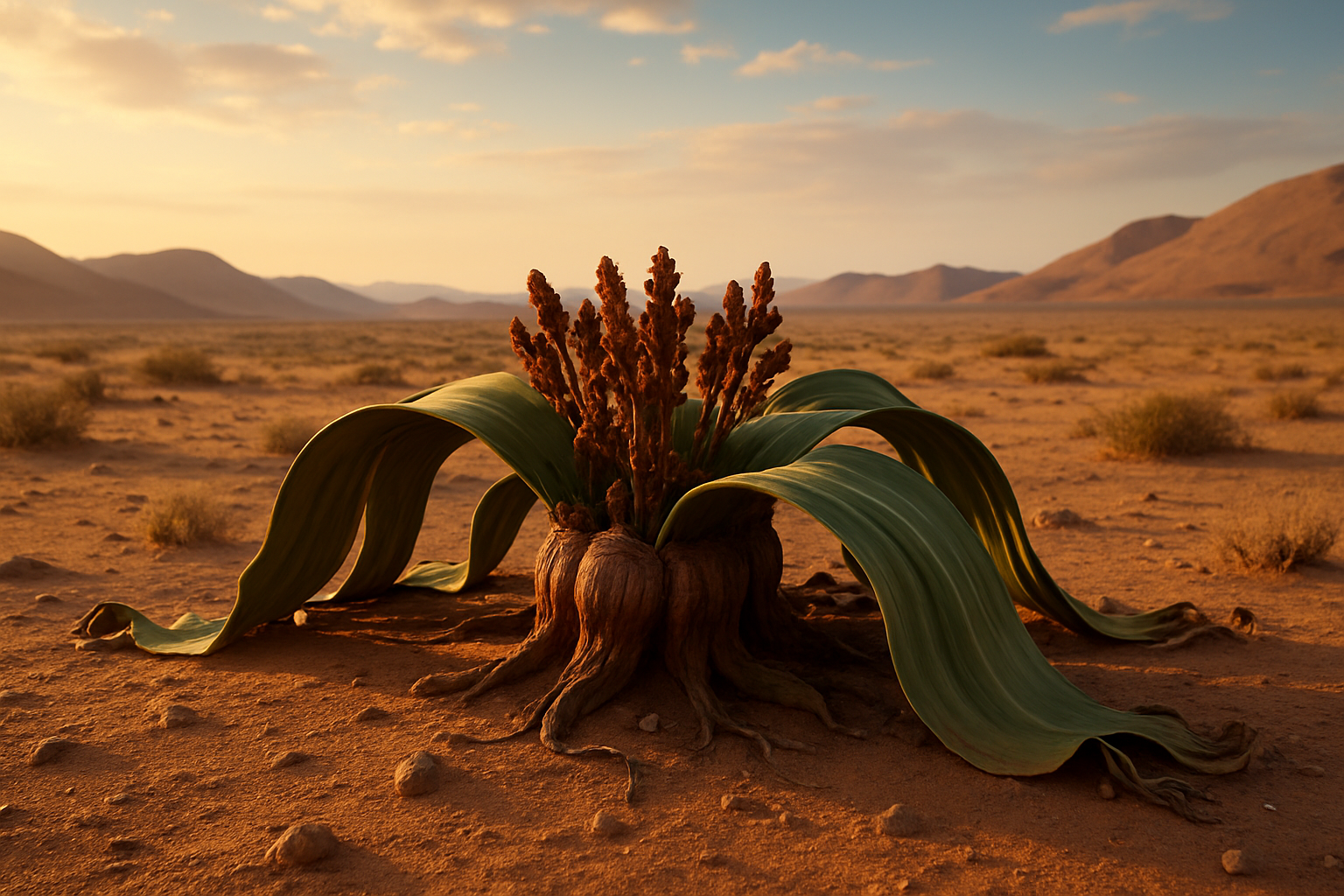
Imagine standing on the gravel plains of the Namib Desert, where hyper-arid winds sweep across landscapes receiving under 100 millimeters of rainfall every year [2, 4, 5]. Scattered across this earth sits what looks like a tangled mound of shredded, frayed ribbons resting in the dust [1, 2, 6]. Yet this eccentric organism is neither a clump of dying stems nor a tangle of separate branches [1, 2, 6]. It is Welwitschia mirabilis, a plant that dominates its environment using a single pair of continuous leaves that keep growing for over a thousand years [1, 2, 3, 6].
The Anatomy of an Eternal Two-Leaf Hairstyle
How can a large plant survive for centuries on just two leaves? The illusion of a dense, multi-leaved crown is simply a trick played by extreme weather [2, 4, 6]. A persistent misconception claims that Welwitschia grows dozens of separate, unkempt leaves over its lifetime [2, 4, 6]. In truth, the plant produces only one true pair of leaves after germination, and it never grows another leaf again [1, 2, 6].
The secret to maintaining this lifelong “hairstyle” lies in an unusual developmental shift [1, 2, 6]. Shortly after germination, the plant’s main growing tip—known formally as the apical meristem—ceases function [1, 2, 6]. Permanent growth transfers entirely to a specialized tissue belt located at the base of each leaf, called the basal meristem [1, 2, 6]. As these continuous leaf belts push outward across the surface, fierce desert winds split and fray them lengthwise, turning two simple leaves into a broad array of ribbon-like strands [1, 2, 6]. Radiocarbon testing on large desert specimens confirms that this uninterrupted growth process can endure for 1,500 to over 2,000 years [2, 3, 6].
Neither Palm nor Flower: Unmasking an Ancient Lineage
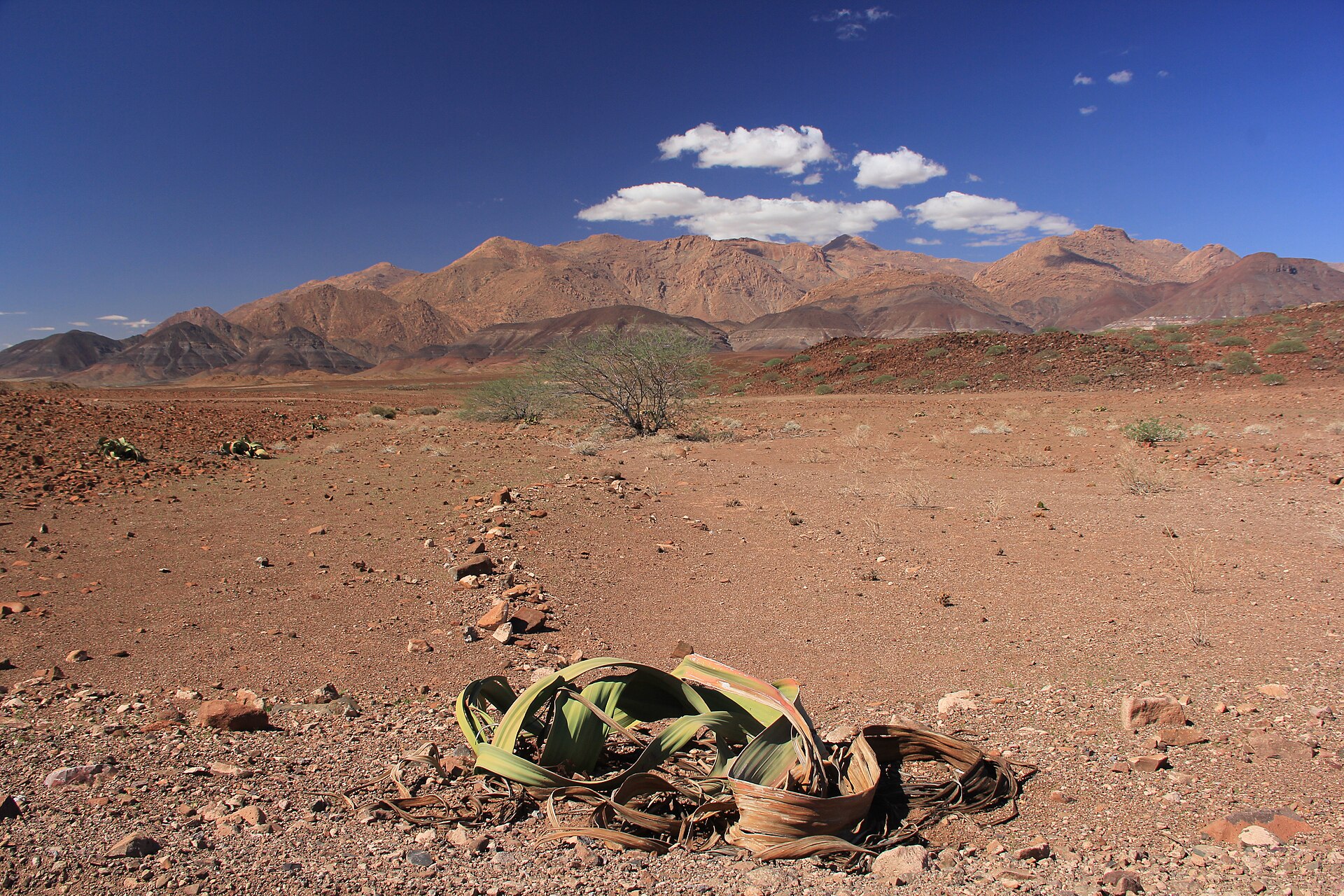
When observers encounter Welwitschia, its unusual shape often causes taxonomic confusion [1, 4, 6]. Popular myths frequently describe it as a desert palm or a weird type of flowering angiosperm [1, 4, 6]. In reality, Welwitschia mirabilis is an ancient non-flowering seed plant—a gymnosperm classified within the class Gnetopsida [1][4].
Within the scientific plant hierarchy, Welwitschia occupies a solitary position [1][4]. It stands as the sole surviving monotypic species in the family Welwitschiaceae and the order Welwitschiales [1][4]. This absolute isolation means it carries structural features seen nowhere else among living plants on Earth [1][4].
While its higher classification is settled, botanists continue to debate its internal taxonomy [1][4]. Some researchers argue for dividing the species into two distinct subspecies—subsp. mirabilis in Angola and subsp. namibiana in Namibia—based on subtle structural projections found on male reproductive structures [1][4]. However, major global botanical databases do not universally adopt this division, leaving scientists split on whether regional variations justify formal subspecies status [1][4].
Sweet Drops and Flying Visitors: A Desert Gymnosperm’s Mating Strategy
Because Welwitschia is a gymnosperm, it produces no true flowers or fleshy fruits [1][4]. Instead, it reproduces using specialized spore-bearing cones, technically termed strobili [1, 2, 4]. The species exhibits dioecy, meaning individual plants are strictly single-sexed, developing exclusively male cones or exclusively female cones [1, 2, 4]. This separation requires pollen to travel across wide desert distances from male individuals to female individuals [1, 2, 4].
This requirement highlights one of the plant’s most unexpected traits [1, 2, 4]. While most cone-bearing gymnosperms rely on the wind to disperse pollen, Welwitschia relies on insect pollinators [1, 2, 4]. Both male and female cones secrete sugary fluid droplets—essentially a rich desert nectar—that attract flies, bees, and true bugs [1, 2, 4]. As these insects move between plants to feed on the sweet droplets, they transfer pollen efficiently, ensuring cross-pollination across sparse desert populations [1, 2, 4].
Rooted Deep: Surviving Hyper-Arid Extremes
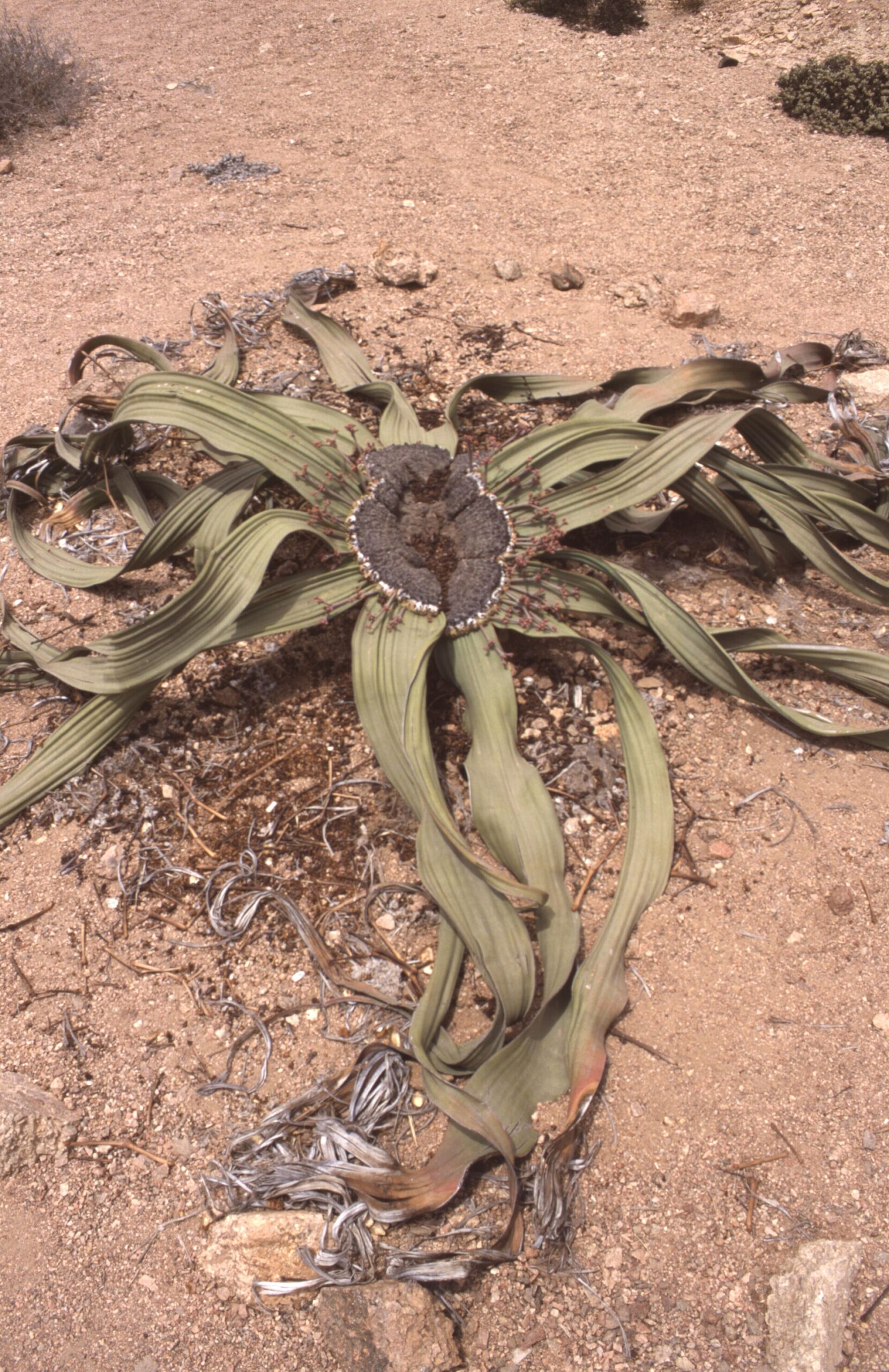
Occupying a 1,000-kilometer strip of the Namib Desert—running from the Kuiseb River in central Namibia up to southwestern coastal Angola—Welwitschia endures harsh heat and dry plains [1, 2, 4]. Annual precipitation in these gravel environments and ephemeral dry riverbeds averages under 100 millimeters [2, 4, 5]. How does a plant nourish large, expanding leaves in such dry earth?
A widespread assumption holds that Welwitschia survives entirely by drinking moisture from coastal fog droplets landing on its leaves [2, 4, 5]. While fog condensation on leaf surfaces provides valuable supplemental water, fog alone cannot sustain the plant through long, severe droughts [2, 4, 5]. For deep survival, the plant relies on a long, straight taproot that descends far underground to tap into deep subterranean water tables [2, 4, 5].
The plant’s photosynthetic mechanism has also sparked scientific debate [5][8]. Researchers long suspected that Welwitschia depended primarily on Crassulacean Acid Metabolism (CAM)—a nighttime water-saving pathway common in desert succulents [5][8]. Early observations showed nighttime carbon dioxide uptake and small acidity shifts, supporting this idea [5][8]. However, direct gas-exchange measurements proved that carbon fixation occurs mainly through standard C3 photosynthesis, with CAM contributing under 4 percent of total carbon uptake [5][8]. Botanists now classify it as a flexible C3-CAM system, using minor CAM pathways as a backup during severe environmental stress [5][8].
Genetic Secrets and Genomic Duplication
The physical toughness of Welwitschia is supported by remarkable features inside its cell nuclei [3][7]. Genome sequencing reveals that approximately 86 million years ago, during an era of intense climate transformation, the ancestral line of Welwitschia underwent a Whole-Genome Duplication event [3][7]. Doubling its entire genetic code provided extra gene copies, giving the plant evolutionary material to adapt to severe ecological stress [3][7].
Maintaining a doubled genome in a dry, sun-baked landscape comes with energetic challenges, especially when non-coding “jumping genes”—known as retrotransposons—threaten to mutate active sequences [3][7]. To protect its DNA, Welwitschia evolved a powerful chemical silencing process known as DNA methylation [3][7]. By attaching methyl groups directly to DNA strands, the plant silences retrotransposons, keeping its genome stable and efficient under high temperatures and strong ultraviolet radiation [3][7].
A Keystone Anchor in the Namib Ecosystem
Connecting these structural, metabolic, and genetic traits reveals why Welwitschia mirabilis is vital to its home region [2, 3, 4, 7]. By combining continuous leaf growth from a basal meristem, a deep taproot reaching buried water, and a tightly controlled, duplicated genome, the plant acts as a crucial keystone species on the Namib plains [2, 3, 4, 7]. Its sprawling leaf ribbons cover large areas of ground, casting shade that creates cool microclimates on the hot desert surface [2][4].
These sheltered zones underneath the leaves provide shelter, shade, and humidity for soil micro-organisms, desert insects, reptiles, and visiting animals [2][4]. Additionally, its nectar droplets and tough foliage offer vital liquid and nutrition to native wildlife in a landscape where free-standing water is almost non-existent [1, 2, 4].
Despite its ecological importance and ancient history, Welwitschia mirabilis has not been formally assigned an evaluation grade on the global IUCN Red List [1, 2, 4]. Even so, domestic laws in Namibia and Angola strictly protect wild populations [2][4]. On the international stage, it is listed under CITES Appendix II, strictly regulating the export and trade of wild specimens and seeds to preserve wild stocks [2][4].
Looking out across the Namib gravel plains, that eccentric, wind-torn silhouette resting in the sand is far from a dying remnant [1, 2, 6]. Fueled by a basal meristem that continuously produces leaf tissue, sustained by deep underground water tables, and safeguarded by ancient genomic adaptations, Welwitschia mirabilis keeps growing its original two leaves century after century [1, 2, 3, 6, 7]. What looks like a messy, 2,000-year-old desert hairstyle is, in fact, one of the most remarkable and enduring survival strategies in the history of plant life [1, 2, 3, 6].
Featured image credit
Created by TaxonGuru · AI-generated featured explanatory reconstruction · not a documentary photograph · generated 2026-09-16
Sources and editorial policy
This feature is based on publicly available scientific and institutional sources listed below. Read our editorial and fact-checking policy and AI use policy. Report a correction: kjhtime@gmail.com
References
- conifers.org — www.conifers.org, accessed 2026-09-16
- sanbi.org — pza.sanbi.org, accessed 2026-09-16
- diagnosticdetectives.com — diagnosticdetectives.com, accessed 2026-09-16
- wikipedia.org — en.wikipedia.org, accessed 2026-09-16
- researchgate.net — www.researchgate.net, accessed 2026-09-16
- ucdavis.edu — conservatory.ucdavis.edu, accessed 2026-09-16
- datadryad.org — datadryad.org, accessed 2026-09-16
- uchicago.edu — www.journals.uchicago.edu, accessed 2026-09-16