Deep beneath the surface of the East Pacific Ocean, between 1,500 and 3,000 meters down, lies a world of total darkness and crushing water pressure [1][3]. In this lightless abyss, active hydrothermal vents spout mineral-rich fluids from the sea floor into freezing ocean water [3][4]. Anchored near these underwater geysers are dense colonies of Riftia pachyptila, commonly known as the giant tubeworm [1][3]. These marine creatures present a profound biological puzzle: how does a large, rapidly growing animal survive its entire adult life without a mouth, a stomach, or an anus [1, 3, 4]?
Unlike almost every other animal on Earth, the adult giant tubeworm cannot eat solid food, chew, or excrete solid waste [1, 3, 4]. It does not hunt prey, graze on detritus, or filter organic particles from the surrounding water [1][3]. Instead, this ringed worm—classified scientifically as a polychaete annelid within the family Siboglinidae—relies entirely on an internal chemical processing strategy to power its existence [1, 2, 4]. Solving the problem of survival in a dark, toxic environment requires abandoning traditional animal biology altogether [1, 2, 5].
The Thermal Tightrope of the Deep Abyss
A common misconception suggests that giant tubeworms live directly inside scalding hydrothermal vent fluids, which erupt from the sea floor at temperatures exceeding 300 degrees Celsius [3][4]. In reality, direct contact with such intense heat would destroy animal tissues instantly [3][4]. Riftia pachyptila survives by settling in a delicate thermal mixing zone where superheated vent fluids mingle with cold oceanic water hovering near 2 degrees Celsius [3][4].
By anchoring where these opposing thermal currents collide, colonies of giant tubeworms maintain an environment ranging between 2 degrees and 30 degrees Celsius [3][4]. This precise habitat choice allows them to colonize active hydrothermal zones across the East Pacific Rise, the Galapagos Rift, and the Guaymas Basin in the Gulf of California [1, 2, 4]. Living in this turbulent interface gives the worms continuous access to geothermal chemicals without exposing them to lethal thermal extremes [3][4].
Life Without an Entrance or an Exit
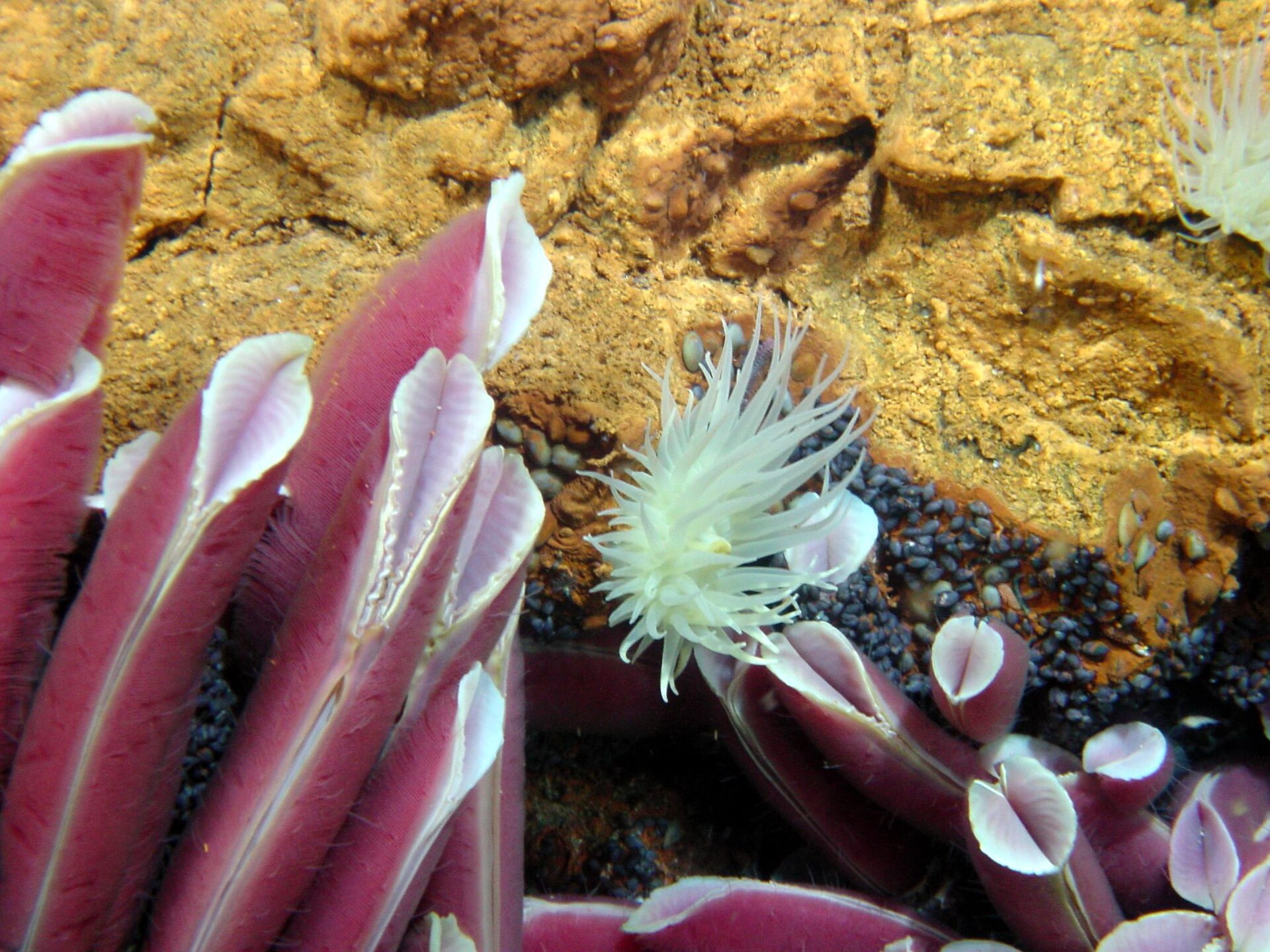
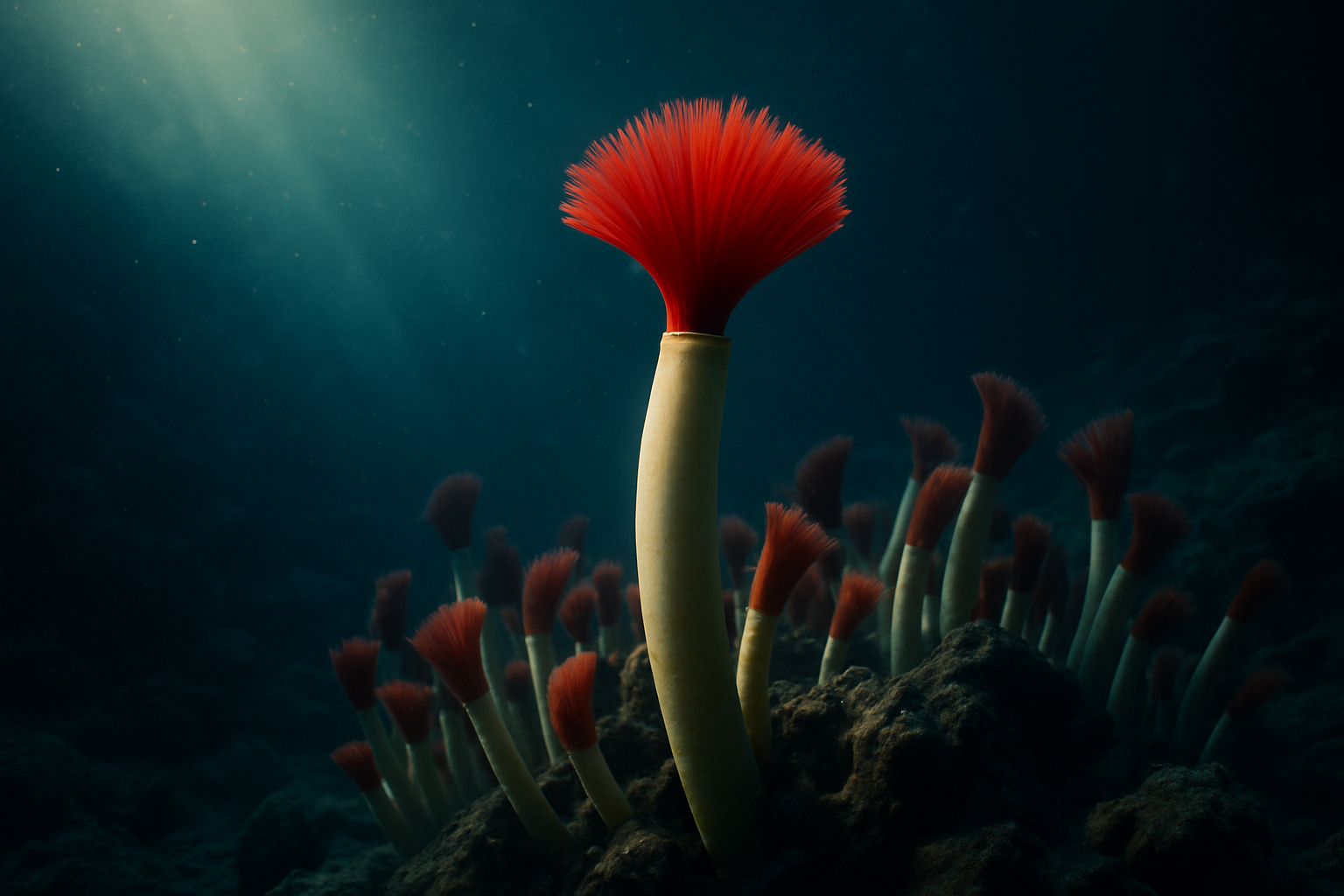
The physical structure of Riftia pachyptila is uniquely adapted to its immobile, non-feeding lifestyle [1][3]. Each individual worm secretes a long, protective outer tube composed of tough chitin, an organic structural material that anchors and shields the soft body within [1][4]. Extending from the top opening of this chitinous tube is a vivid red, feather-like structure known as a plume [1][3].
This red plume is saturated with blood and functions as the primary exchange interface, absorbing dissolved gases and chemicals directly from the surrounding water column [1][2]. Exposing such a critical organ in the open ocean brings potential risks from physical hazards or passing predators [1][3]. When the tubeworm detects mechanical vibrations or physical contact, it rapidly retracts its red plume entirely into the safety of its hard chitinous tube [1, 3, 4].
The Chemical Engine and Its Microscopic Workers
Because adult giant tubeworms lack any functional digestive tract, they depend completely on internal partners for nutrition [1, 3, 4]. Inside the worm’s body cavity lies a specialized internal organ called a trophosome [1, 2, 5]. This organ is packed with billions of symbiotic bacteria, identified by researchers as Candidatus Endoriftia persephone [2][5].
These resident microbes generate biological energy through chemical energy conversion, a process known as chemosynthesis [1, 2, 5]. The bacteria oxidize hydrogen sulfide drawn from vent fluids, using that released energy to convert inorganic carbon into organic compounds that feed the host worm [1, 2, 5]. This chemical partnership is remarkably efficient, enabling Riftia pachyptila to rank among the fastest-growing marine invertebrates, reaching lengths of up to 1.5 meters in under two years under optimal vent flow conditions [3][4].
Toxic Transport: A Dual-Purpose Blood Protein
To sustain its internal bacterial engine, Riftia pachyptila must collect two chemical fuels simultaneously: oxygen from cold sea water and toxic hydrogen sulfide from hydrothermal fluids [2][5]. For most animals, hydrogen sulfide is extremely poisonous because it shuts down cellular energy production [2][5]. The giant tubeworm solves this deadly challenge using a specialized blood protein—a multi-subunit extracellular hemoglobin dissolved directly in its blood plasma [2][5].
This specialized extracellular hemoglobin features separate, independent binding sites for oxygen and hydrogen sulfide [2][5]. By binding both molecules at the same time without allowing them to interfere with one another, the blood neutralizes sulfide toxicity while transporting both compounds directly to the trophosome [2][5]. This molecular adaptation allows the worm to thrive in an environment that would prove fatal to almost any other organism [2][5].
From Free-Swimming Larva to Intimate Partnership
How does a giant tubeworm establish this lifelong chemical partnership? Another widespread myth claims that adult tubeworms swallow their bacterial partners during feeding, but adults possess no mouth to take in food or microbes [1][2]. The acquisition process actually occurs during the animal’s earliest life stages [1][2].
Riftia pachyptila begins life as a floating, free-swimming larva known as a trochophore [1][2]. During this brief larval stage, the young worm briefly possesses a temporary mouth and functional digestive tract [1][2]. However, it does not ingest the bacteria; instead, Candidatus Endoriftia persephone infects the larva horizontally through its outer skin, penetrating the epidermis [1][2]. Once the bacteria establish themselves inside and form the trophosome, the larval mouth and digestive tract completely degenerate and disappear permanently [1][2].
Post-Mortem Escape and Biological Significance
While the lifelong cooperation between the worm and its internal bacteria is well established, the fate of the bacteria after the host dies has generated scientific debate [2][5]. Historically, researchers assumed that Candidatus Endoriftia persephone was bound to an obligate host-dependent death, perishing inside the decaying tubeworm [2][5]. However, recent high-pressure laboratory experiments have revealed that when host worms die and decompose, viable symbiotic bacteria escape from the decaying trophosome into the surrounding environment, contributing to a free-living bacterial pool [2][5]. While this laboratory evidence confirms post-mortem escape, ongoing studies continue to investigate the exact mechanisms of bacterial dispersal in natural vent ecosystems [2][5].
Synthesizing these biological discoveries highlights why Riftia pachyptila matters to modern ocean science: it demonstrates that complex animal ecosystems can flourish in complete darkness, driven entirely by chemical energy rather than solar photosynthesis [1, 2, 5]. By combining a complete loss of adult digestive organs, specialized toxic-gas-binding hemoglobin, epidermal bacterial infection, and rapid growth rates, this species rewrites the rules of animal survival [1, 2, 3, 4, 5]. Currently classified as Not Evaluated on global conservation lists, its long-term future relies on the natural stability of these remote hydrothermal ecosystems [1].
Returning to that pitch-black hydrothermal mixing zone 3,000 meters beneath the ocean surface, the giant tubeworm resolves the mystery of its strange existence [1][3]. By trading its mouth and gut for a thrive-in-the-dark chemical engine, Riftia pachyptila shows how life can abandon every familiar biological rule and still conquer the most hostile frontiers on Earth [1, 2, 4].
Featured image credit
Created by TaxonGuru · AI-generated featured explanatory reconstruction · not a documentary photograph · generated 2026-09-19
Sources and editorial policy
This feature is based on publicly available scientific and institutional sources listed below. Read our editorial and fact-checking policy and AI use policy. Report a correction: kjhtime@gmail.com
References
- wikipedia.org — en.wikipedia.org, accessed 2026-09-19
- schmidtocean.org — schmidtocean.org, accessed 2026-09-19
- deepoceaneducation.org — deepoceaneducation.org, accessed 2026-09-19
- noaa.gov — repository.library.noaa.gov, accessed 2026-09-19
- scispace.com — scispace.com, accessed 2026-09-19