Did an ancient fish hundreds of millions of years ago simply decide to drag itself out of the water and walk onto dry land? Popular stories often depict Tiktaalik roseae as an organism taking humanity’s very first steps on shore. But when scientists evaluate this famous fossil against source-backed evidence, a far more nuanced science-detective story emerges. The physical evidence reveals an organism that lived approximately 375 million years ago during the Late Devonian period, inhabiting shallow freshwater streams, delta channels, and densely vegetated wetlands [2][3]. Far from marching confidently onto dry ground, it spent its existence perfectly tailored to the murky boundary between water and land.
The Arctic Discovery of a “Fishapod”
In 2004, paleontologists conducting field research in the Fram Formation on Ellesmere Island in Nunavut, Canada, uncovered remarkable fossils that were officially described in scientific literature in 2006 [2, 3, 4]. While Ellesmere Island is today an icy Arctic territory, during the Late Devonian period it formed part of the continent of Laurentia, situated near the equator with a warm, subtropical climate [1][2].
The newly identified creature belonged to Sarcopterygii, a class of lobe-finned fish—meaning fish whose fins contain internal bones and muscle rather than simple flexible rays [1][2]. Yet this creature defied simple classification. It retained fish scales and fin rays, but it also possessed a flattened head, sturdy ribs, and a mobile neck. Researchers categorized it as an early relative near the base of the four-limbed animal family tree, formally known as a stem tetrapod, and informally called it a “fishapod” because it sits directly between traditional fish and land-dwelling tetrapods [1, 2, 4].
Fin or Foot? Dissecting the Front Limbs
To test whether this creature was capable of creeping onto shore, scientists examined the internal skeletal architecture of its pectoral fins—the fins located on the sides of the chest [2][4]. What they uncovered inside the fin was remarkably similar to the forelimb of a land vertebrate. Instead of thin, simple fin bones, the interior contained a humerus (upper arm bone), a radius and ulna (forearm bones), and a distinct, functional wrist joint [2, 4, 6].
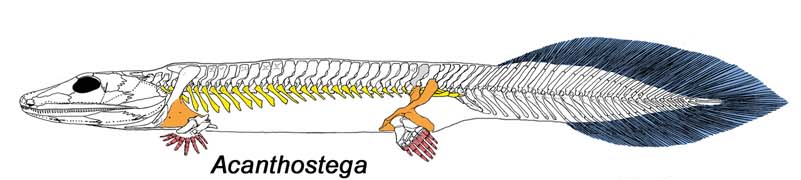
This internal skeleton allowed the pectoral fin to flex and bear weight [2][6]. By bending at its wrist joint, the animal could prop its body up off the substrate or push itself through thick aquatic vegetation [1][6]. However, this structure did not evolve so the creature could go for walks across dry earth. Instead, these fin structures were aquatic adaptations that allowed the animal to maneuver through weed-choked shallows, stabilize itself in moving currents, and raise its eyes above the water line [1][6].
Unshackling the Head: The Invention of a Neck
In standard fish, the skull is rigid and bound directly to the shoulder girdle by opercular bones—the broad bones that cover and protect the gills [2][7]. Because of this solid connection, a typical fish cannot turn its head without shifting its entire torso. Tiktaalik roseae broke this anatomical constraint by losing its opercular bones entirely [2][7].
The loss of these gill cover bones created a true neck joint, allowing the animal to rotate its head independently of its shoulders [2][7]. Combined with a flattened skull and eyes located on top of its head, this mobile neck provided a distinct advantage in shallow wetlands [1][2]. It enabled the animal to scan its surroundings and target prey in shallow water without disturbing the rest of its body.
Surviving in shallow, choked habitats required versatile respiratory and feeding strategies [2][3]. The creature possessed a dual breathing mechanism: functional gills for aquatic breathing and primitive lungs to gulp air at the surface when swamp water ran low on oxygen [2][3]. Furthermore, its skull possessed lateral joint flexibility, allowing it to maintain suction underwater while using strong jaws and upper skull bracing to bite prey in shallow water—a true hybrid feeding system [1][6].
Four-Wheel Drive in the Devonian Swamps
For a long time, evolutionary biologists assumed that early transitional forms relied almost exclusively on their front fins for locomotion, leaving their hind fins small and weak. That assumption was disproven when research on the animal’s pelvic skeleton was published [5, 8, 9].
The pelvic girdle was surprisingly large and robust, capable of supporting wide hind fins that generated significant propulsive force [5, 8, 9]. This demonstrated that a “four-wheel drive” system of propulsion originated in shallow water long before any land transition took place [5][8].
Could this pelvic strength carry the animal across open dry land? Structural limitations suggest otherwise. The animal lacked sacral ribs—the specialized ribs that physically link the pelvic girdle directly to the spine [1][5]. Without this crucial rigid attachment, the spinal column could not support the full weight of the body against gravity outside of water [1][5]. While it could push off the bottom or prop itself up in mud, true terrestrial walking was anatomically out of reach [1][5].
Direct Ancestor or Parallel Cousin?
Another popular misconception is that Tiktaalik roseae represents the single direct ancestral species of all modern land animals and humans [1][2]. While it serves as a crucial anatomical model for the transition, evolutionary history is rarely a single straight line. Paleontologists view it as a stem tetrapod or sister group that illustrates how transitional traits evolved [1][2].
This raises an intriguing question: Was it actually the first animal to venture toward land? Fossil discoveries in Zachełmie, Poland, present a temporal puzzle [1][2]. Trackways found there date to roughly 390 to 395 million years ago in the Middle Devonian—about 18 million years older than Tiktaalik [1][2]. If those tracks were left by true four-limbed tetrapods, then Tiktaalik may be a late-surviving relic maintaining ancient transitional structures, rather than the direct lineage that first moved toward land [1][2].
Why the “Fishapod” Matters to Science
Synthesizing these discoveries reveals why this organism remains so central to evolutionary biology. By combining a flexible neck [2][7], weight-bearing wrist bones [2, 4, 6], pelvic propulsion [5, 8, 9], dual breathing [2][3], and a hybrid feeding strategy [1][6], it demonstrates how complex anatomy evolves in response to immediate ecological pressures.
None of these features developed as a forward-looking plan to invade dry land [1][6]. Instead, every single structural shift—from wrist joints to air-breathing lungs—was an active adaptation for surviving in warm, choked, shallow equatorial waters [1, 2, 6]. The story of this creature proves that major evolutionary shifts are driven by immediate local survival, transforming underwater dwellers long before their descendants ever set foot on dry ground.
So, did this remarkable creature succeed in walking onto dry land? The evidence indicates that Tiktaalik roseae never left the water behind. It was not an incomplete land walker, but a master of the Devonian wetlands [1][2]. Its wrist joints, mobile neck, and powerful pelvis were built to push through tangled aquatic vegetation, prop its head above oxygen-starved water, and capture prey in the mud [1, 2, 6]. Rather than taking a bold leap onto dry ground, it flourished right at the water’s edge, leaving a permanent record of life in transition.
Featured image credit
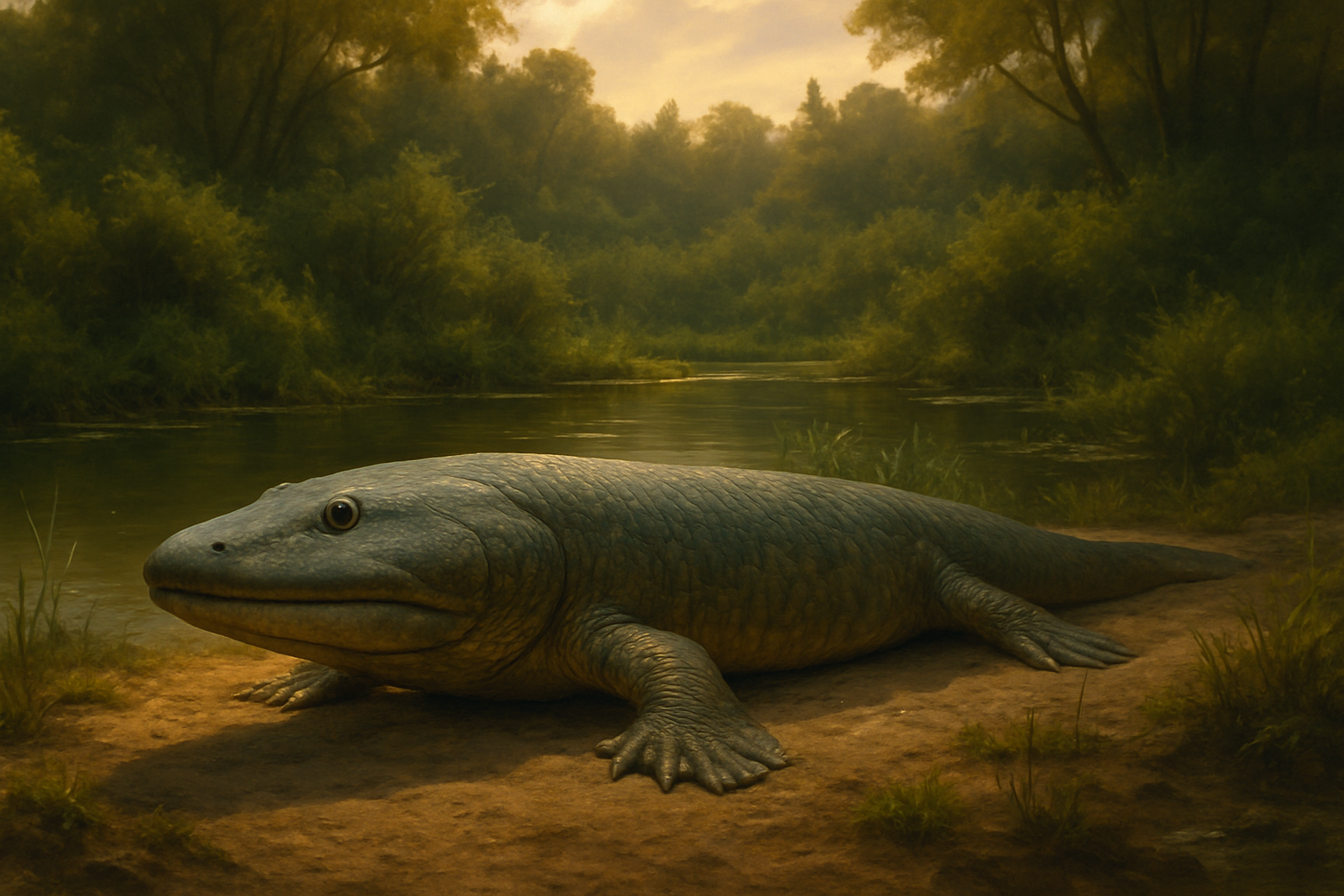
Created by TaxonGuru · AI-generated featured explanatory reconstruction · not a documentary photograph · generated 2026-09-05
Sources and editorial policy
This feature is based on publicly available scientific and institutional sources listed below. Read our editorial and fact-checking policy and AI use policy. Report a correction: kjhtime@gmail.com
References
- wikipedia.org — en.wikipedia.org, accessed 2026-09-04
- britannica.com — www.britannica.com, accessed 2026-09-04
- nasa.gov — science.nasa.gov, accessed 2026-09-04
- harvard.edu — news.harvard.edu, accessed 2026-09-04
- nih.gov — pmc.ncbi.nlm.nih.gov, accessed 2026-09-04
- uchicago.edu — shubinlab.uchicago.edu, accessed 2026-09-04
- sciencenews.org — www.sciencenews.org, accessed 2026-09-04
- uchicago.edu — news.uchicago.edu, accessed 2026-09-04
- nih.gov — pubmed.ncbi.nlm.nih.gov, accessed 2026-09-04