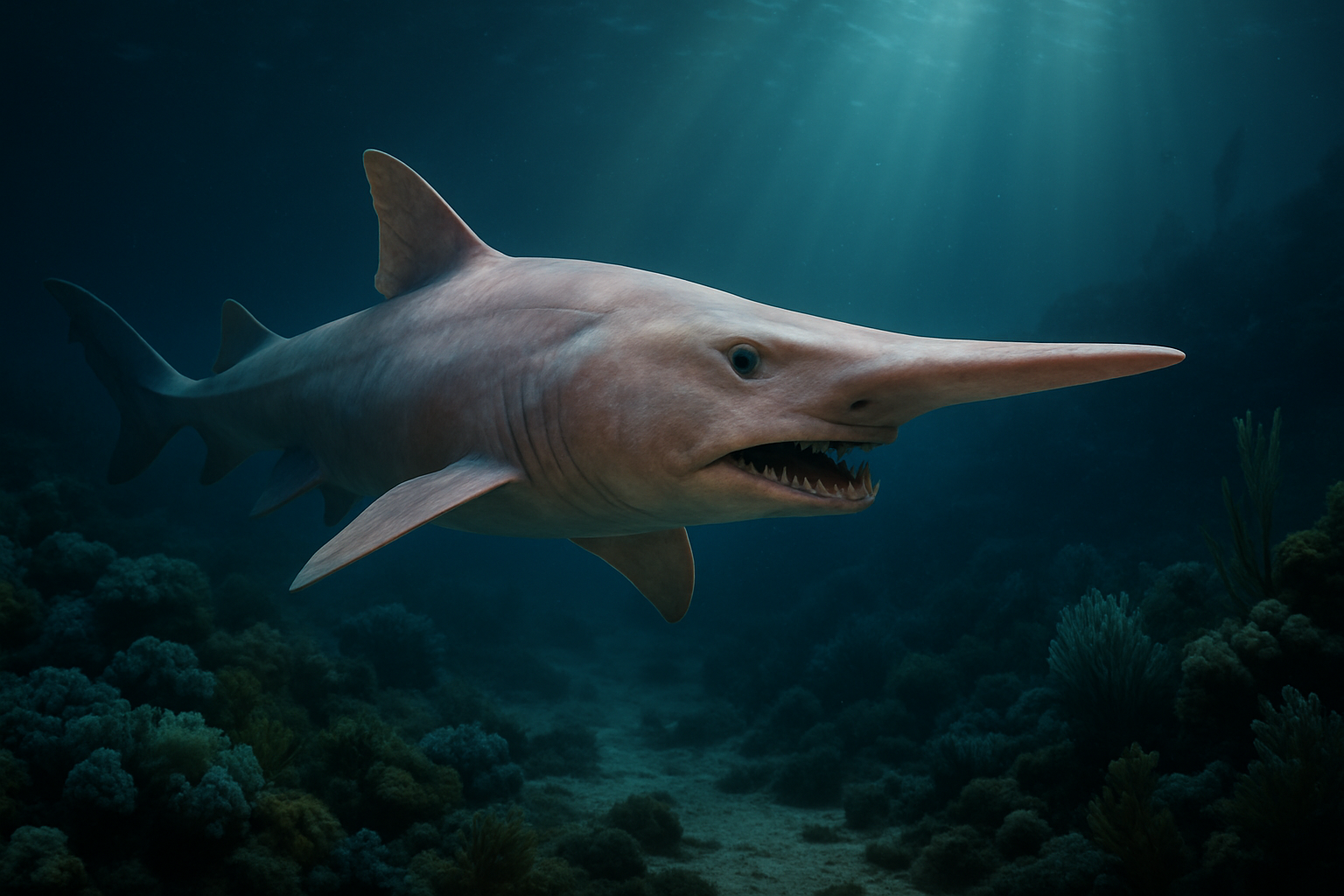
Imagine descending into the pitch-black ocean depths where sunlight dies away completely. In the faint illumination of an underwater research lander, a pale, elongated silhouette drifts into view. It features a strange, blade-like snout extending over its head, translucent skin tinted with a flush of blood-vessel pink, and a jaw tucked beneath its skull like a spring-loaded trap. Pop culture often frames this deep-sea creature—the goblin shark (Mitsukurina owstoni)—as a grotesque alien monster, an ancient beast that roams the dark ocean with its terrifying jaws permanently thrust open to gore unsuspecting prey.
How much of this dramatic visual shock is grounded in scientific reality, and how much is simple myth? When marine scientists test these popular claims against physical specimens and deep-sea camera footage, a fascinating picture emerges. The goblin shark is not an unearthly monster or an aggressive hunter armed with a lethal spear, but a remarkable evolutionary survivor perfectly tailored for life thousands of meters below the surface.
A Cretaceous Lineage in the Modern Ocean
To understand the place of Mitsukurina owstoni in nature, one must look back approximately 125 million years to the Early Cretaceous epoch [1][2]. While iconic land-dwelling dinosaurs evolved, diversified, and eventually disappeared, the ancestral lineage belonging to the shark family Mitsukurinidae quietly persisted in the world’s oceans [1][3]. Today, the goblin shark stands as the sole surviving species of this ancient family line, making it a unique living representative of a distant epoch [1, 2, 3].
The formal scientific record for this species began in 1898, when ichthyologist David Starr Jordan officially described the shark under the binomial name Mitsukurina owstoni [1, 3, 7]. Belonging to the cartilaginous fish class Elasmobranchii and the mackerel shark order Lamniformes, this species retains primitive anatomical characteristics that have largely vanished in other modern sharks [1, 2, 3]. Because its lineage has endured for tens of millions of years with relatively little structural change, researchers frequently describe it as a “living fossil” [1][2].
Myth Versus Reality: The Flattened Snout and Translucent Skin
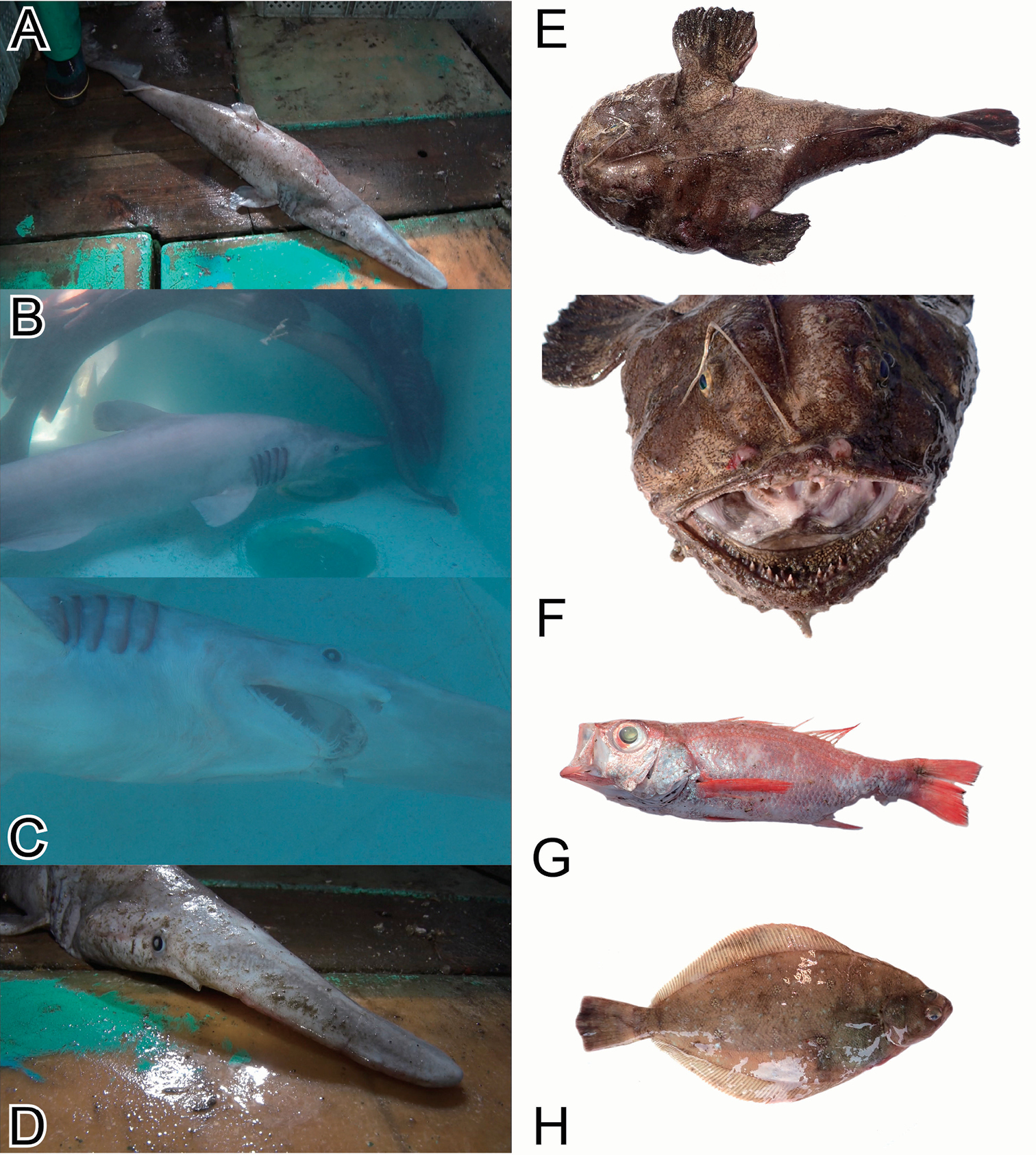
Popular illustrations and dramatic television features frequently suggest that the shark’s long, flattened snout—known scientifically as the rostrum—functions as an offensive spear used to stab or slash prey in the dark. However, physical specimens reveal a completely different structure. The elongated rostrum is composed of flexible cartilage and soft tissue, making it far too delicate to serve as a impact weapon [2].
Rather than a spear, the rostrum functions as an advanced sensory dashboard. Packed within its soft internal tissue are dense networks of electroreceptors known as the Ampullae of Lorenzini [2]. These specialized sensory organs detect tiny bio-electric fields generated by the muscular movements and nervous systems of organisms hiding in total darkness [2].
Another widespread misconception involves the shark’s unusual pink appearance. Popular media often assumes the creature possesses vivid pink skin pigments. In reality, Mitsukurina owstoni lacks significant melanin pigment in its skin [2]. Its thin skin is translucent, allowing the dense network of tiny blood vessels beneath the surface to show through as a pale pinkish tone [2]. When a goblin shark dies and is brought to the surface, its skin loses this translucency, quickly dulling to a muted greyish-brown color [2].
How the Catapult Jaws Actually Work
Museum taxidermy mounts and classic biological drawings almost universally depict the goblin shark with its jaws protruding wildly forward from its head. This persistent imagery leads many to believe that the shark swims through the ocean with an eternally distended, nightmare-inducing mouth.
In life, the shark swims with its jaws folded neatly underneath the base of its skull [2]. The dramatic jaw extension occurs exclusively during prey capture [2]. Utilizing specialized elastic ligaments and jaw muscle structures, the goblin shark catapults its protruding jaws forward like a spring-loaded trap to snatch prey before snapping them back into their resting position under the head [2].
Mapping the Deep-Sea Habitat: From Slopes to 2,000 Meters

Where does this primitive predator make its home? *Mitsukurina owstoni* is distributed broadly across the globe, inhabiting deep continental slopes, ocean trenches, and seamounts throughout the Atlantic, Pacific, and Indian Oceans [2, 4, 9]. Documented field records and scientific specimens have been collected from widely distant regions, including the coastal waters of Japan, northern Brazil, and the Colombian Caribbean [4, 7, 9].
For many years, the species was thought to live primarily along upper continental slopes at depths starting around 100 meters. However, recent observations using deep-sea landers—unmanned camera platforms deployed to the ocean floor—have captured verified footage of goblin sharks active at depths down to 2,000 meters [2].
Despite this massive global distribution spanning multiple ocean basins, genetic analysis reveals a surprising trend. Population studies examining mitochondrial DNA—genetic material inherited through maternal lines—show low levels of genetic diversity among goblin shark populations worldwide [5]. This low genetic variation across widely separated geographic areas suggests that deep ocean corridors allow these sharks to maintain broad connectivity across international waters [5].
The Size Controversy: How Large Does the Goblin Shark Grow?
The maximum physical dimensions of Mitsukurina owstoni remain a subject of ongoing scientific discussion and field verification [2][7]. Confirmed scientific records show that typical adult goblin sharks reach average overall lengths between 3 and 4 meters [2][7].
A notable exception occurred in 2000, when a massive individual was captured with reports claiming an overall length of nearly 6 meters [2]. However, precise field measurements for extreme specimens exceeding 5 meters remain exceptionally rare and difficult to verify under standardized scientific protocols [2][7]. While average adult lengths are well documented, determining the absolute maximum ecological limit of body size requires continued deep-sea observation [2][7].
Human Impact and Conservation Status
Given its bizarre visual features and primitive evolutionary status, observers often wonder whether the goblin shark is on the brink of extinction. The International Union for Conservation of Nature (IUCN) Red List officially classifies Mitsukurina owstoni as a species of Least Concern (LC) [6][8].
Because the shark lives in remote, deep-water environments far below normal human activity, its global populations receive natural protection from intensive commercial surface fisheries [6][8]. Nevertheless, human interaction is not non-existent. Goblin sharks are occasionally captured as incidental bycatch in deep-water bottom trawls and deep longline fishing gear [2, 6, 8]. Despite these occasional capture events, their vast oceanic range and deep vertical distribution buffer the overall population against critical threats [6][8].
What the Living Fossil Teaches Us
Connecting these verified scientific facts answers why Mitsukurina owstoni holds such an essential place in marine science. The persistence of a single 125-million-year-old lineage in the deep ocean illustrates how extreme habitat stability allows ancient biological specializations to endure [1, 2, 5]. By combining low mitochondrial genetic diversity, vast ocean distribution down to 2,000 meters, translucent capillary-fed skin, and a electroreceptive hunting rostrum, the goblin shark demonstrates how life adapts to harsh, lightless environments without requiring fundamental anatomical redesigns across geological epochs [1, 2, 5].
When we test popular claims against source-backed evidence, the goblin shark transforms from a terrifying pop-culture alien into an elegant deep-sea specialist. Its long snout is not a spear, its skin is not dyed pink, and its catapult jaws remain safely folded under its head as it glides through the dark [2]. Returning to our opening vision of that strange silhouette gliding past deep-sea camera landers, we see Mitsukurina owstoni not as a freakish visual shock, but as one of the deep ocean’s most successful ancient masterpieces [1][2].
Featured image credit
Created by TaxonGuru · AI-generated featured explanatory reconstruction · not a documentary photograph · generated 2026-09-02
Sources and editorial policy
This feature is based on publicly available scientific and institutional sources listed below. Read our editorial and fact-checking policy and AI use policy. Report a correction: kjhtime@gmail.com
References
- GBIF species record: Mitsukurina owstoni — Global Biodiversity Information Facility (GBIF), accessed 2026-09-01
- Goblin shark — Wikipedia, accessed 2026-09-01
- WoRMS taxon details: Mitsukurina owstoni — World Register of Marine Species (WoRMS), accessed 2026-09-01
- REGISTRO DA OCORRÊNCIA DO TUBARÃO-DUENDE, Mitsukurina owstoni JORDAN, 1898 (LAMNIFORMES: MITSUKURINIDAE) NA REGIÃO NORTE DO BRASIL — Universidade Federal do Ceará (UFC), accessed 2026-09-01
- Low mitochondrial genetic diversity and distribution of the goblin shark ( Mitsukurina owstoni Jordan, 1898) — Universidad Nacional de Costa Rica, accessed 2026-09-01
- Mitsukurina owstoni: Finucci, B. & Duffy, C.A.J. — IUCN, accessed 2026-09-01
- Notes on an adult goblin shark (Mitsukurina owstoni) of Japan — Smithsonian Institution, accessed 2026-09-01
- Mitsukurina owstoni: Duffy, C.A.J., Ebert, D.A. & Stenberg , C. — IUCN, accessed 2026-09-01
- MITSUKURINA OWSTONI JORDAN (CHONDRICHTHYES: MITSUKURINIDAE) RST RECORD FOR THE COLOMBIAN CARIBBEAN — Marine and Coastal Research Institute INVEMAR, accessed 2026-09-01