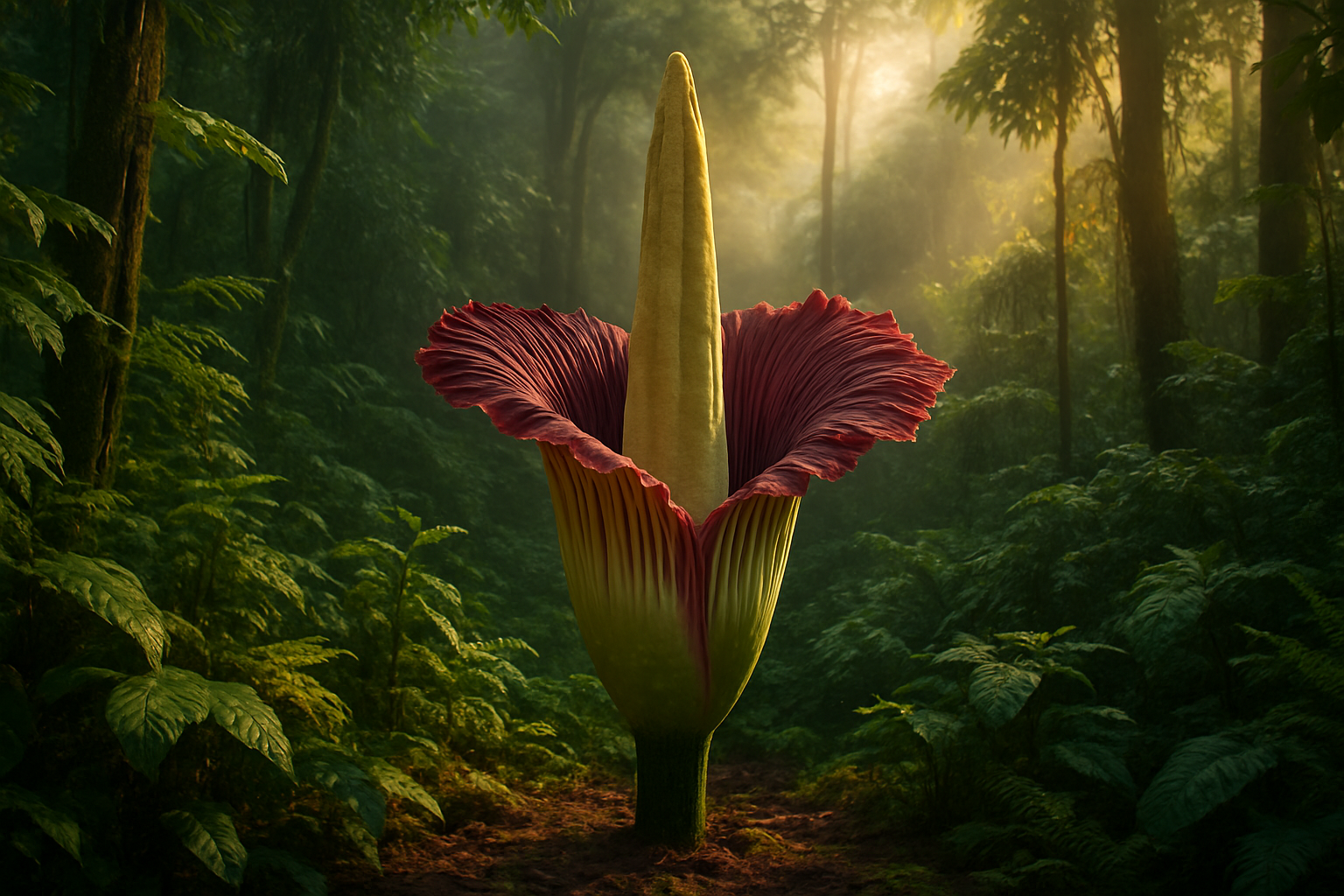
Deep within the shaded, sloping rainforests of western Sumatra, an extraordinary botanical phenomenon emerges from the forest understory [1], [2], [8]. How does a plant that offers no sweet fragrance, no edible fruit, and no conventional visual charm become one of the most celebrated attractions in the natural world? The answer lies in Amorphophallus titanum, a remarkable perennial species commonly known as the Titan Arum or corpse flower [1], [2].
When this plant blooms, it does not subtly blend into the tropical foliage. Instead, it produces a massive structure that can tower over 3 meters in height, broadcasting its presence across the rainforest canopy [1], [2], [6]. Yet, behind its dramatic presentation lies a complex reproductive strategy, a series of persistent botanical misconceptions, and an urgent conservation story unfolding in both native ecosystems and modern research laboratories [4], [8].
Anatomy of a Giant: Inflorescence versus Single Flower
To understand Amorphophallus titanum, one must first examine how its central structure is built. A common mistake among casual observers is calling this towering structure a single, gigantic flower [2], [6]. In formal botanical terms, this claim is entirely incorrect [2], [6].
What appears to be a single immense blossom is actually a massive unbranched flower stalk holding hundreds of tiny individual flowers—a feature formally designated as an unbranched inflorescence [1], [2], [6]. Amorphophallus titanum holds the official biological record for forming the largest unbranched inflorescence in the entire plant kingdom [1], [2], [6].
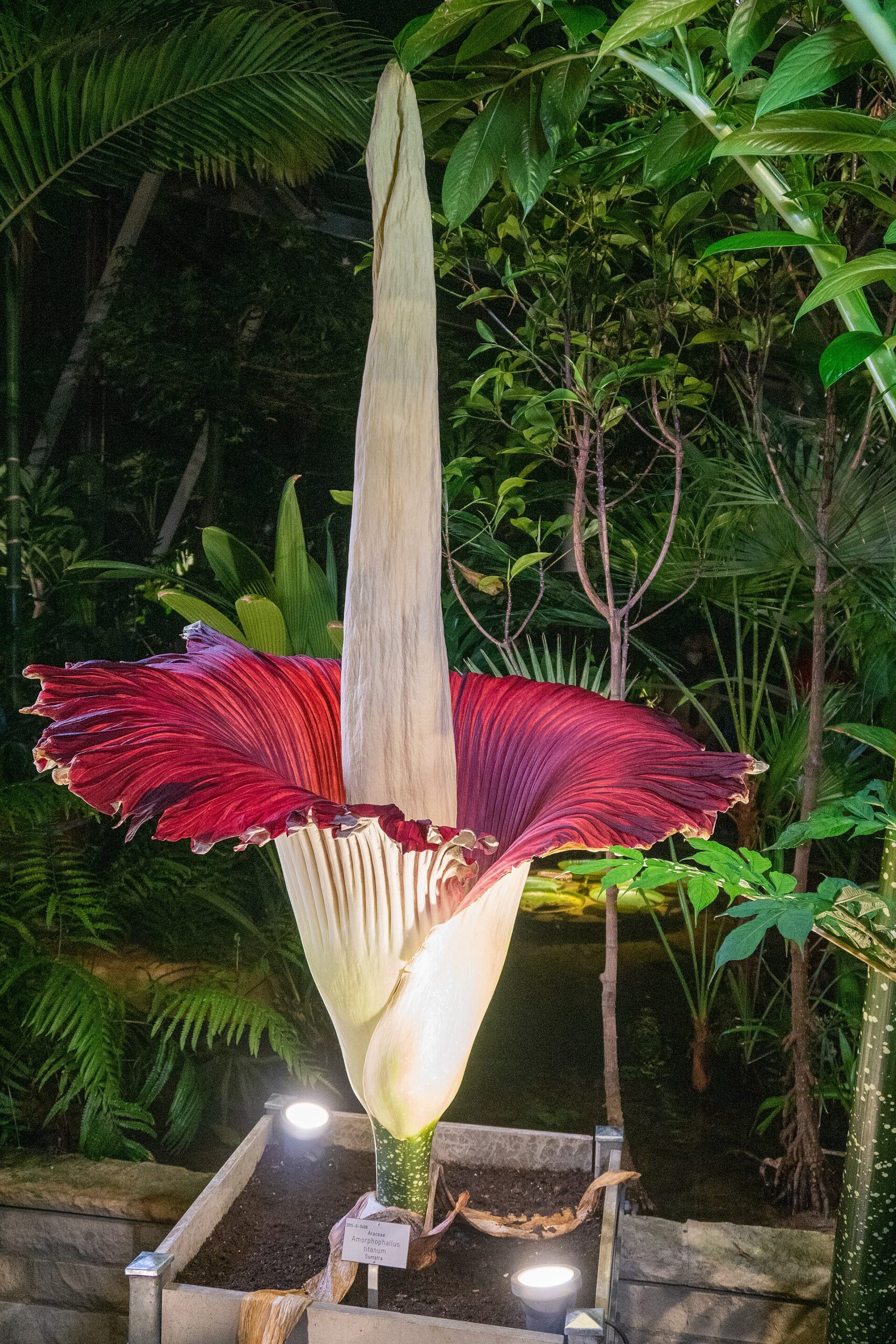
If the corpse flower does not hold the record for the world’s largest single flower, what plant does? That title belongs to Rafflesia arnoldii, another native of Indonesian rainforests, which produces a true individual flower rather than a clustered flower stalk [2], [6]. Distinguishing between a single bloom and an inflorescence is essential for understanding how different plant families solve the challenge of reproduction [2], [6].
Taxonomically, Amorphophallus titanum belongs to the monocot class Liliopsida, within the order Alismatales and the arum family Araceae [1], [3]. Within scientific literature, researchers have also clarified historical naming overlap. Detailed taxonomic studies and formal lectotypification confirmed that Conophallus titanum is an academic synonym for Amorphophallus titanum, resolving past botanical nomenclature disputes [1], [7].
Smell and Heat: Deception Without Digestion
The most famous characteristic of Amorphophallus titanum is undoubtedly its odor. During its brief blooming event, the plant emits a powerful, overpowering stench that closely resembles decaying meat [2], [8]. This pungent aroma can fill an entire greenhouse or travel through the tropical forest understory [2], [8].
Working alongside this stench is a rare biological mechanism known as heat production, or a fever phenomenon [2], [8], [9]. During the blooming phase, the plant actively generates internal heat, elevating its temperature above that of the surrounding ambient air [2], [8], [9]. This thermal phenomenon helps vaporize the odor compounds, sending the foul scent floating higher and farther into the air [2], [8], [9].
This combination of stench and heat frequently gives rise to a widespread myth: is the corpse flower a carnivorous plant? It is easy to assume that a plant mimicking decaying flesh must be luring animals into a trap to consume them [2], [9].
However, Amorphophallus titanum is not carnivorous [2], [9]. It does not capture, digest, or extract nutrients from insects [2], [9]. The rotting meat scent and elevated internal temperature serve a purely reproductive purpose, deceiving specific insects into visiting the tiny flowers hidden inside the inflorescence to transport pollen [2], [8], [9].
The Pollination Puzzle: Greenhouse Observation versus Wild Reality
While the purpose of the plant’s stench is clear, determining precisely which insects carry out pollination reveals an interesting gap between greenhouse observations and wild field evidence [2], [8], [9].
In controlled botanical garden settings, entomologists have observed carrion beetles and flesh flies responding enthusiastically to the heat and stench [2], [8], [9]. These insects, which normally seek out decaying animal carcasses to lay their eggs, are deceived into crawling across the flower stalk, effectively picking up and transferring pollen grains [2], [8], [9].
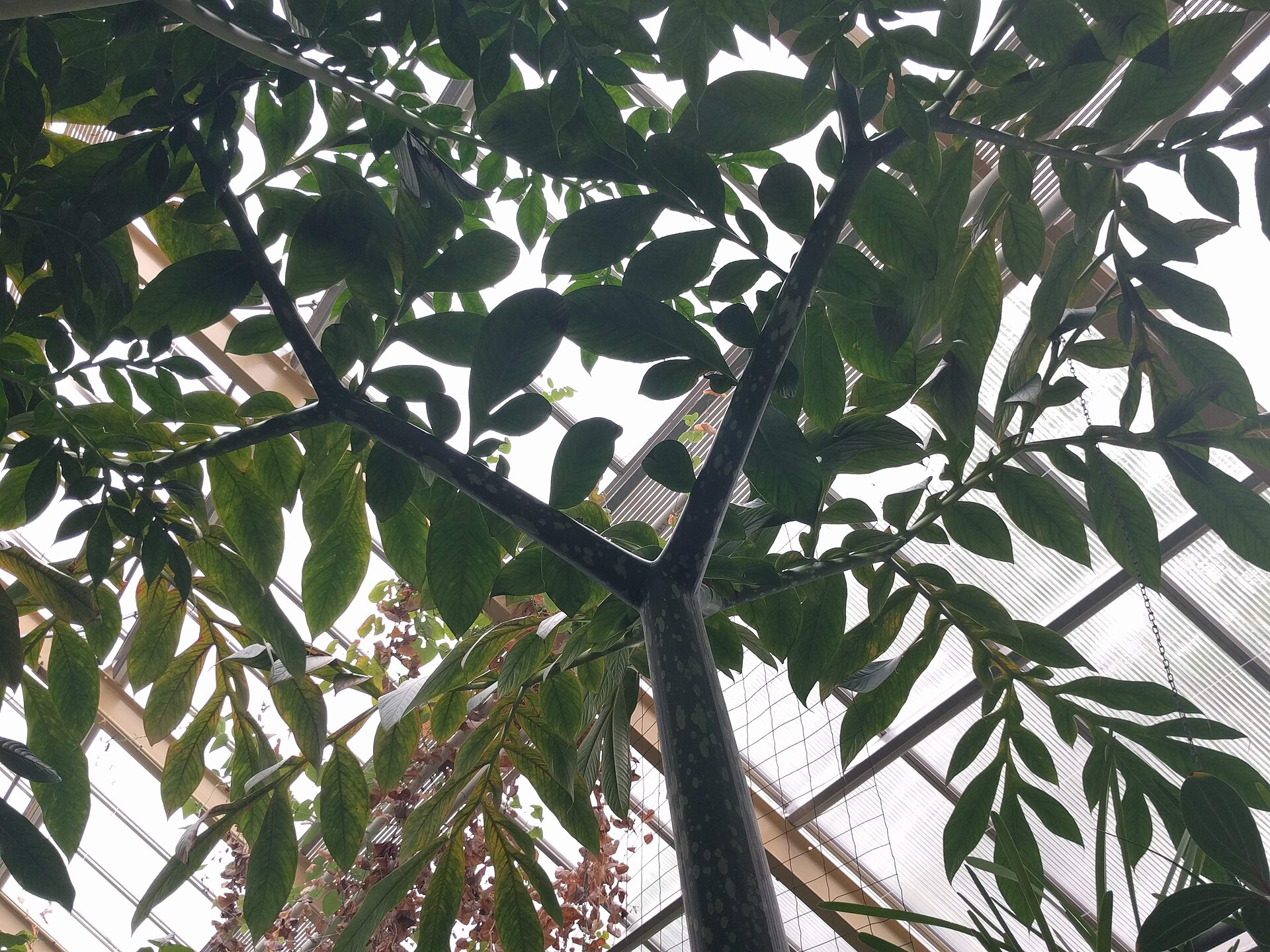
However, scientific rigor requires distinguishing between what occurs in a greenhouse and what is fully proven in the wild. In the dense, remote, and sloping rainforest terrain of western Sumatra, documenting every natural pollinator is extraordinarily difficult [1], [2], [8].
Because of logistical constraints in these rugged microhabitats, a complete inventory of wild pollinator species across all native populations remains unverified [2], [8], [9]. While carrion beetles and flesh flies are confirmed functional pollinators in cultivation, field researchers acknowledge that additional wild insect interactions require ongoing ecological study [2], [8], [9].
Endangered Status and Laboratory Micropropagation
Beyond its extraordinary biology, Amorphophallus titanum faces a perilous environmental reality. The species is endemic exclusively to the tropical rainforests of western Sumatra, Indonesia, where it relies on shaded, sloping ground to survive [1], [2], [8].
Because its native habitat is increasingly threatened by deforestation and land conversion, Amorphophallus titanum is officially classified as Endangered (EN) on the IUCN Red List of Threatened Species [8]. Wild populations have experienced significant declines as primary rainforest cover continues to shrink [8].
It is important to note how population figures are evaluated. Current assessments suggesting that fewer than 1,000 individual plants remain in the wild are not based on a direct, complete census of every stem in the jungle [8]. Instead, these numbers are derived from habitat loss modeling and spatial distribution assessments [8].
To prevent the loss of this remarkable species, scientists are turning to modern laboratory conservation techniques [4], [5]. Researchers have successfully developed protocols for lab-based tissue growth—known formally as in vitro propagation—using tissue induction procedures termed callus induction [4], [5]. These tissue culture methods allow botanists to propagate healthy specimens without removing remaining vulnerable plants from their native habitat, offering a vital safety net for species preservation [4], [5].
Botanical Strategy and Evolutionary Survival
Why does Amorphophallus titanum invest such immense biological resources into a single, massive blooming event? Connecting its verified biological traits answers this fundamental question [1], [2], [6], [8], [9].
Living on the dimly lit floor of a tropical rainforest presents severe ecological challenges [1], [2], [8]. Flowers situated under a dense forest canopy struggle to attract airborne pollinators using visual cues alone [2], [8]. By constructing an unbranched inflorescence reaching over 3 meters in height, generating metabolic heat, and releasing an intense olfactory signal, Amorphophallus titanum solves the problem of visibility in a crowded ecosystem [1], [2], [6], [8], [9].
The elevated stalk acts as a broadcasting tower, while the heat carries volatile compounds far above the forest floor to reach specialized insects like carrion beetles [2], [6], [8], [9]. What appears to humans as an unbearable stench is, in reality, a masterful evolutionary solution for surviving in a competitive environment [2], [8], [9].
Yet, the very specialization that allowed this species to conquer the rainforest floor now makes it fragile in the modern world [8]. Severe habitat fragmentation directly interrupts its delicate pollination network [8]. This reality highlights why laboratory tissue culture research and habitat conservation must work hand in hand to secure the future of the species [4], [5], [8].
Returning to our opening question: how does a plant that smells like rotting meat capture the imagination of the world? It succeeds because it represents the extreme outer limits of botanical adaptation [1], [2], [6], [8]. Deep in the shaded slopes of Sumatra, Amorphophallus titanum continues its ancient strategy, standing tall as a testament to the strange, complex, and magnificent ways life survives on Earth [1], [2], [8].
Featured image credit
Created by TaxonGuru · AI-generated featured explanatory reconstruction · not a documentary photograph · generated 2026-09-10
Sources and editorial policy
This feature is based on publicly available scientific and institutional sources listed below. Read our editorial and fact-checking policy and AI use policy. Report a correction: kjhtime@gmail.com
References
- GBIF species record: Amorphophallus titanum — Global Biodiversity Information Facility (GBIF), accessed 2026-09-09
- Amorphophallus titanum — Wikipedia, accessed 2026-09-09
- NCBI Taxonomy: Amorphophallus titanum — National Center for Biotechnology Information, accessed 2026-09-09
- Induksi Kalus Amorphophallus titanum (Becc.) Becc. Melalui Kultur In Vitro — Institut Pertanian Bogor, accessed 2026-09-09
- IN VITRO PROPAGATION OF AMORPHOPHALLUS TITANUM BECC. AND AMORPHOPHALLUS RIVIERI DURIEU — International Society for Horticultural Science (ISHS), accessed 2026-09-09
- Amorphophallus Titanum: The biggest flower in the world — Oxford University Press (OUP), accessed 2026-09-09
- Lectotypification of Conophallus titanum (≡ Amorphophallus titanum ) ( Araceae ) — Wiley, accessed 2026-09-09
- Amorphophallus titanum: Yuzammi, Hadiah, J.T. — IUCN, accessed 2026-09-09
- Amorphophallus Titanum — JSTOR, accessed 2026-09-09