Can a creature written off as extinct for 66 million years suddenly reappear on a fishing trawler? For decades, paleontology textbooks recorded that the ancient lineage of coelacanths vanished at the end of the Cretaceous period alongside the non-avian dinosaurs [1][3]. That scientific certainty shattered in December 1938 off the coast of South Africa, initiating one of the most intriguing cold-case investigations in modern marine biology [3][5].
A Cold Case Reopened off the South African Coast
The detective story began in December 1938 near the mouth of the Chalumna River in South Africa [3][5]. A local fishing trawler brought in an unusual catch, prompting museum curator Marjorie Courtenay-Latimer to inspect the haul [5][6]. Recognizing that the creature possessed anatomical features unlike any modern fish she had encountered, she saved the specimen and alerted ichthyologist Professor J.L.B. Smith [5][6].
In 1939, following detailed examination, Professor Smith formally announced to the scientific community that the specimen was indeed a living coelacanth—a group previously known strictly from ancient fossil formations [3][6]. The species was officially assigned the scientific name Latimeria chalumnae, commonly referred to today as the West Indian Ocean coelacanth [1].
This single specimen instantly shifted the presumed extinction boundary of the order Coelacanthiformes forward by tens of millions of years [1][4]. Biologists realized that an ancient lineage within the animal kingdom (Kingdom Animalia) and phylum Chordata had quietly survived in deep maritime environments while entire geological epochs passed [1][4].
Is it Really a “Frozen” Living Fossil?
Following its discovery, popular media outlets frequently categorized Latimeria chalumnae as a “living fossil” [1][4]. This label led to a widespread misconception that the creature had experienced zero genetic or structural changes over hundreds of millions of years, remaining entirely frozen in time [1][7]. Did evolution truly grind to a halt in the deep ocean?
Comparative anatomical and genomic studies paint a far more dynamic picture [1][4]. While the West Indian Ocean coelacanth maintains the general structural body plan of its prehistoric relatives, researchers have confirmed that its internal skeleton and genetic profile continued to evolve [1][7]. Subtle changes in bone structure and ongoing genetic divergence demonstrate that its lineage never stopped adapting [1][4].
Rather than an unchanged relic, Latimeria chalumnae is a modern organism [1]. It retains ancient baseline traits while accumulating distinct genetic variations across millions of generations in its specialized marine environment [1][7].
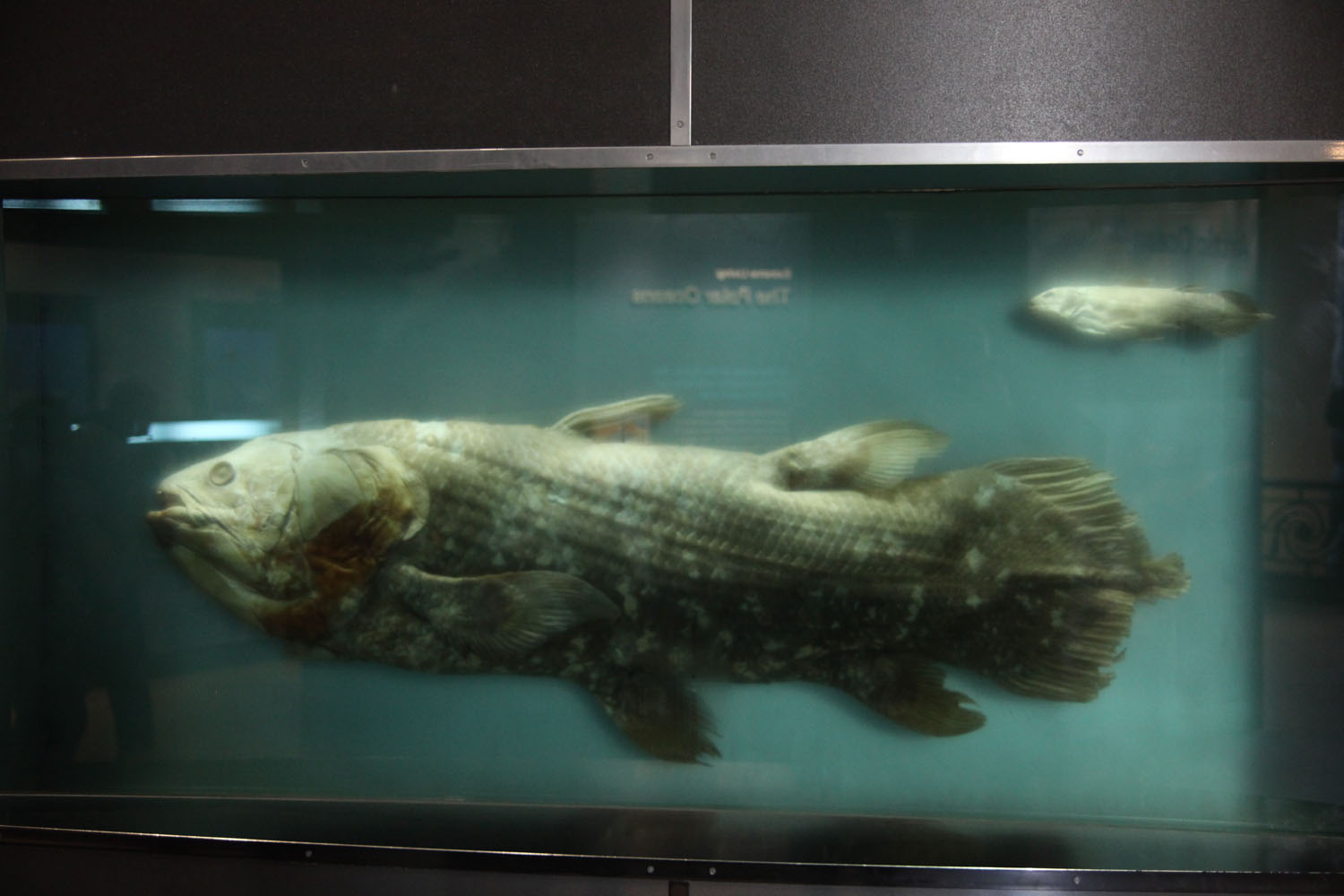
Inside a Deep-Sea Hunter: A Two-Part Skull and a Fatty Brain
To understand how Latimeria chalumnae operates as an underwater predator, scientists examined its skull architecture [7][9]. They identified a mechanical feature unseen in other living backboned animals: a hinge dividing the skull into distinct front and back sections [7][9].
Known formally as an intracranial joint, this specialized skull partition allows the front half of the fish’s head to flex upward when opening its jaw [7][9]. By lifting the front part of its skull, the coelacanth expands its mouth cavity dramatically, creating powerful suction to draw in unsuspecting prey [7][9].
Intriguingly, this elaborate cranial machinery houses a surprisingly tiny brain [9]. Anatomical dissections reveal that actual brain tissue occupies less than 1 percent of the interior skull cavity [9]. The remaining 99 percent of the space is packed with dense fatty tissue [9].
Walking Fin Movements and an Electric Snout
The locomotion of Latimeria chalumnae sets it apart from typical ray-finned fishes [4][7]. As a member of the lobe-finned fish class, known formally as Sarcopterygii, its thick, muscular fins contain internal bone structures that closely resemble the limb bones of land animals [1][4].
When swimming through deep water, the coelacanth moves its fins in an alternating, diagonal sequence [4][7]. It coordinates its right pectoral fin with its left pelvic fin, moving them in tandem like a four-legged animal walking across dry ground [4][7]. It is also known to tilt into a headstand posture, hovering upside down near the seafloor to inspect deep rock crevices [4][7].
To pinpoint prey in pitch-black environments, the fish relies on an electro-sensory organ embedded in its snout [2][7]. Termed the rostral organ, this specialized sensory apparatus detects faint electrical fields emitted by organisms hiding in darkness or inside rocky gaps [2][7].
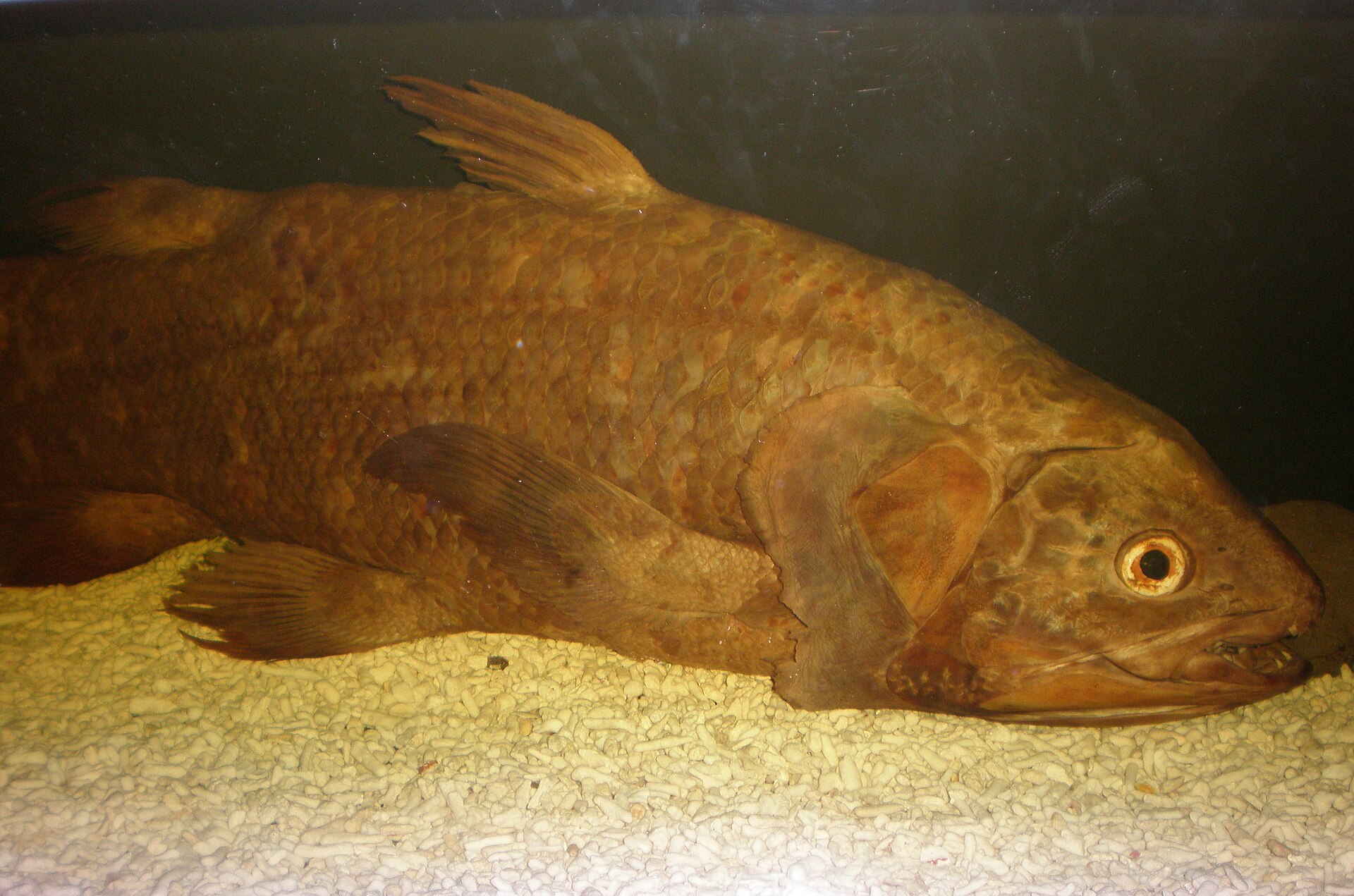
Extreme Slow Motion: A Century-Long Lifespan
The pace at which Latimeria chalumnae grows, reproduces, and ages has been a topic of intense scientific investigation and debate [2][8]. Early studies examining scale growth lines estimated that these fish lived relatively brief lives of roughly 20 years [2][8].
That timeline was fundamentally re-evaluated in a 2021 study led by researcher Kélian Mahé and colleagues [2][8]. By employing microscopic analysis with polarized light filters—a technique known as polarized light microscopy—the team re-examined scale structures and discovered that scale growth lines form at much slower intervals than previously recognized [2][8].
The revised data indicates that Latimeria chalumnae is one of the slowest-growing vertebrates in the ocean [2][8]. Key findings from this research include:
- Delayed Maturity: Individuals reach sexual maturity at an estimated age of 40 to 69 years [2][8].
- Extended Pregnancy: Females carry developing young for an astonishing gestation period of approximately 5 years [2][8].
- Remarkable Longevity: Maximum lifespans are estimated to reach up to 100 years [2][8].
While polarized light analysis strongly supports the 100-year lifespan model, researchers emphasize that direct long-term monitoring of wild populations in deep waters remains difficult, leaving some debate open regarding exact age determination standards [2][8].
An Evolutionary Cousin, Not a Direct Ancestor
Given its limb-like fin bones and ancient lineage, a popular misconception persists that the coelacanth is the direct linear ancestor of all four-legged land vertebrates, known as tetrapods [1][4]. Does Latimeria chalumnae sit directly on the evolutionary branch that crawled out of the sea? [1][4]
Genetic sequencing resolved this question by analyzing the relationship between surviving lobe-finned lineages [1][4]. While coelacanths belong to the order Coelacanthiformes within the family Latimeriidae and genus Latimeria, genetic data demonstrates that air-breathing lungfish are actually the closer sister group to terrestrial tetrapods [1][4].
Consequently, the West Indian Ocean coelacanth is best understood as a close evolutionary relative rather than a direct parent of land-dwelling animals [1][4]. It represents a parallel branch of lobe-finned vertebrates that perfected deep-water survival [1][4].
Editorial Synthesis: Why the Coelacanth Matters Today
Connecting these verified discoveries reveals why Latimeria chalumnae is central to modern evolutionary biology. By combining a hinged intracranial skull joint [7][9], limb-like alternating fin locomotion [4][7], electro-receptive rostral organs [2][7], and an extraordinarily slow life history [2][8], this species demonstrates how complex structural traits can be conserved and refined over tens of millions of years to thrive in stable ecological niches [1][4].
Today, the West Indian Ocean coelacanth inhabits steep reef slopes and underwater lava caves at depths ranging from 100 to 500 meters, occasionally venturing down to 700 meters [1][2]. Its known range spans the western Indian Ocean, including waters off the Comoros Islands, South Africa, Mozambique, Madagascar, and Tanzania [1][2].
Because its life cycle is so exceptionally slow—requiring decades to mature and five years for a single pregnancy—the species cannot recover quickly from population losses [2][8]. Field surveys face natural limitations because the fish lives in deep, nocturnal cave habitats, making precise wild population estimates challenging [1][2]. As a result of these vulnerabilities, *Latimeria chalumnae* is officially classified as Critically Endangered on the IUCN Red List and receives strict international trade protection under CITES Appendix I [1][2].
Decoding the Ancient Secrets of the Deep
The detective story that re-opened in December 1938 transformed our understanding of living vertebrate diversity [3][5]. What was once categorized as a fossil cold case turned out to be an active deep-sea predator navigating volcanic caves using walking fin mechanics, an electro-sensory snout, and a two-part hinged skull [2, 7, 9].
As marine scientists continue to study *Latimeria chalumnae* using modern technology, this resilient survivor stands as a powerful reminder that missing evolutionary links and unexpected deep-sea discoveries may still be hiding in the dark waters of our planet [1][4].
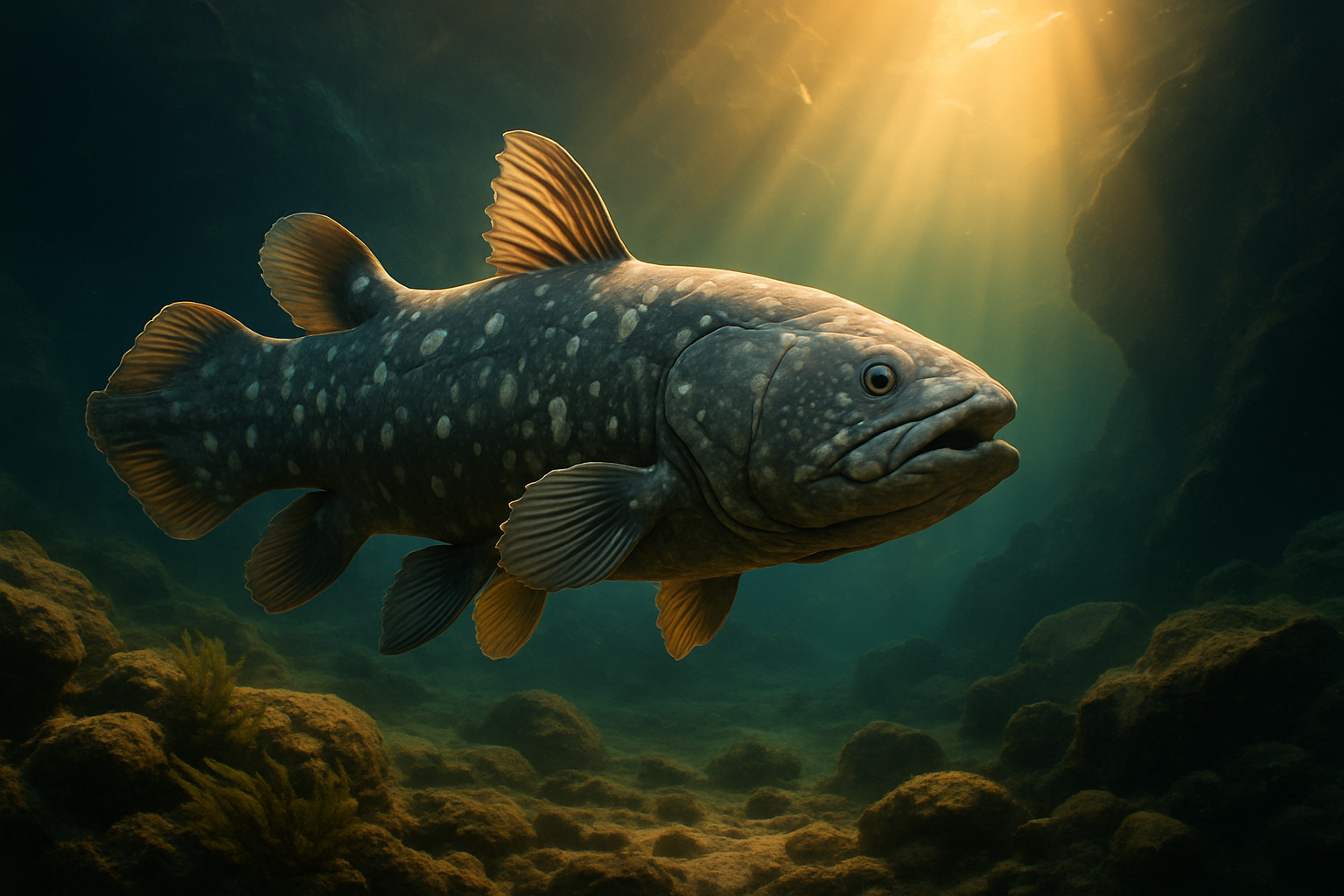
Featured image credit
Created by TaxonGuru · AI-generated featured explanatory reconstruction · not a documentary photograph · generated 2026-09-18
Sources and editorial policy
This feature is based on publicly available scientific and institutional sources listed below. Read our editorial and fact-checking policy and AI use policy. Report a correction: kjhtime@gmail.com
References
- wikipedia.org — en.wikipedia.org, accessed 2026-09-18
- wildlifeconnect.com — www.wildlifeconnect.com, accessed 2026-09-18
- historytoday.com — www.historytoday.com, accessed 2026-09-18
- wikipedia.org — en.wikipedia.org, accessed 2026-09-18
- smithsonianmag.com — www.smithsonianmag.com, accessed 2026-09-18
- knysnamuseums.co.za — www.knysnamuseums.co.za, accessed 2026-09-18
- worldanimalrescuenetwork.org — worldanimalrescuenetwork.org, accessed 2026-09-18
- sci.news — www.sci.news, accessed 2026-09-18
- esrf.fr — www.esrf.fr, accessed 2026-09-18