Could you step onto a floating lily pad, roll out a yoga mat, and balance on one foot without sinking into the river? It is a tempting daydream when staring at the massive, dish-like leaves of Victoria amazonica, commonly known as the Amazon Giant Water Lily [1][3]. Floating serenely across slow-moving tropical waters, these aquatic giants look less like delicate pond flora and more like buoyant green armor plates resting on the water’s surface [1][3]. Yet, behind this calm appearance lies a dynamic story of structural engineering, nighttime biological heat, and formidable defense mechanisms forged in the flooded river basins of South America [1, 2, 4].
Floating Fortresses of the Amazon Basin
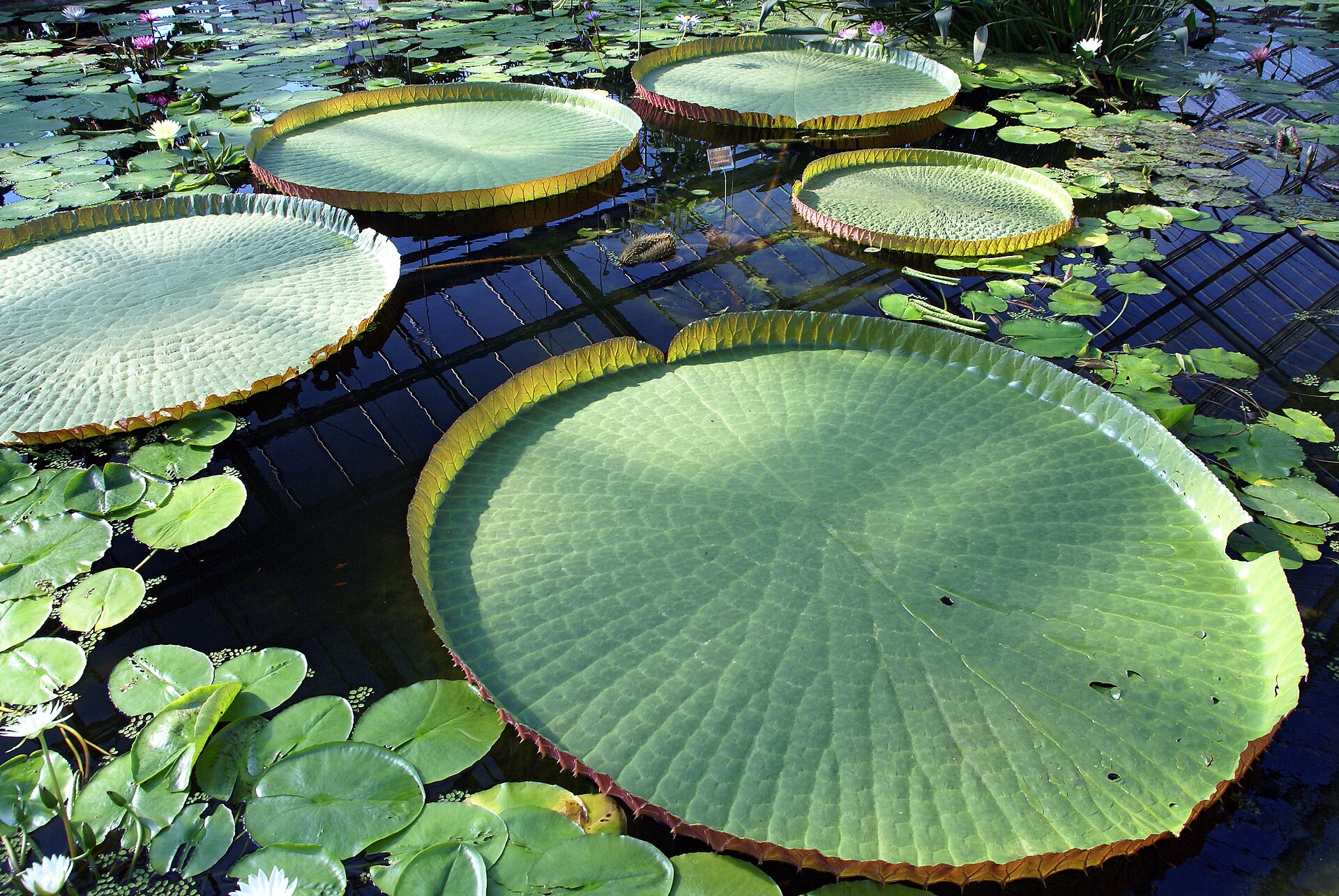
In the warm, sluggish waters of the Amazon River basin and the Guiana region—stretching across Brazil, Guyana, Bolivia, Colombia, and Peru—Victoria amazonica makes its native home [1]. Classified within the plant family Nymphaeaceae under the order Nymphaeales, this grand member of the genus Victoria thrives in oxbow lakes, river channels, and seasonally flooded forests known as várzea [1]. In these sheltered aquatic environments, the plant produces vast circular leaves that stretch between 2.5 and 3 meters in diameter [1][3].
These expansive leaves spread across the river’s surface to capture every available ray of sunlight in nutrient-rich tropical waters [1]. As seasonal floods alter river levels, the plant adapts to fluctuating aquatic depths while continuously expanding its floating canopy [1]. While the International Union for Conservation of Nature (IUCN) Red List has not formally assessed the wild conservation status of Victoria amazonica, botanists closely monitor how changing river ecosystems impact its native habitats [1].
The Myth of Barefoot Yoga on Water
Can a person truly stand or hold a yoga pose directly on top of a Victoria amazonica leaf? Popular stories and online imagery frequently suggest that anyone can step directly onto these floating green platters [5, 7, 8]. However, attempting to stand barefoot on an uncovered leaf will quickly result in a splash [5][7]. Concentrated pressure from a human heel or foot point instantly tears the delicate leaf surface, causing the pad to rupture and submerge [5, 7, 8].
To support significant weight, that physical force must be distributed evenly across the leaf’s entire surface area [5][7]. Botanists demonstrate this weight-bearing principle in public garden tests by placing a flat, rigid board—such as acrylic or plywood—directly onto the pad [5, 7, 8]. Beneath the leaf, a complex network of hollow, air-trapping ribs provides exceptional rigidity and strong buoyancy [3, 5, 7]. When load is properly spread using a board, a single leaf can readily support the full weight of a child or an adult weighing over 100 kilograms [3, 5, 7, 8].
Spines, Pores, and Rain Channels
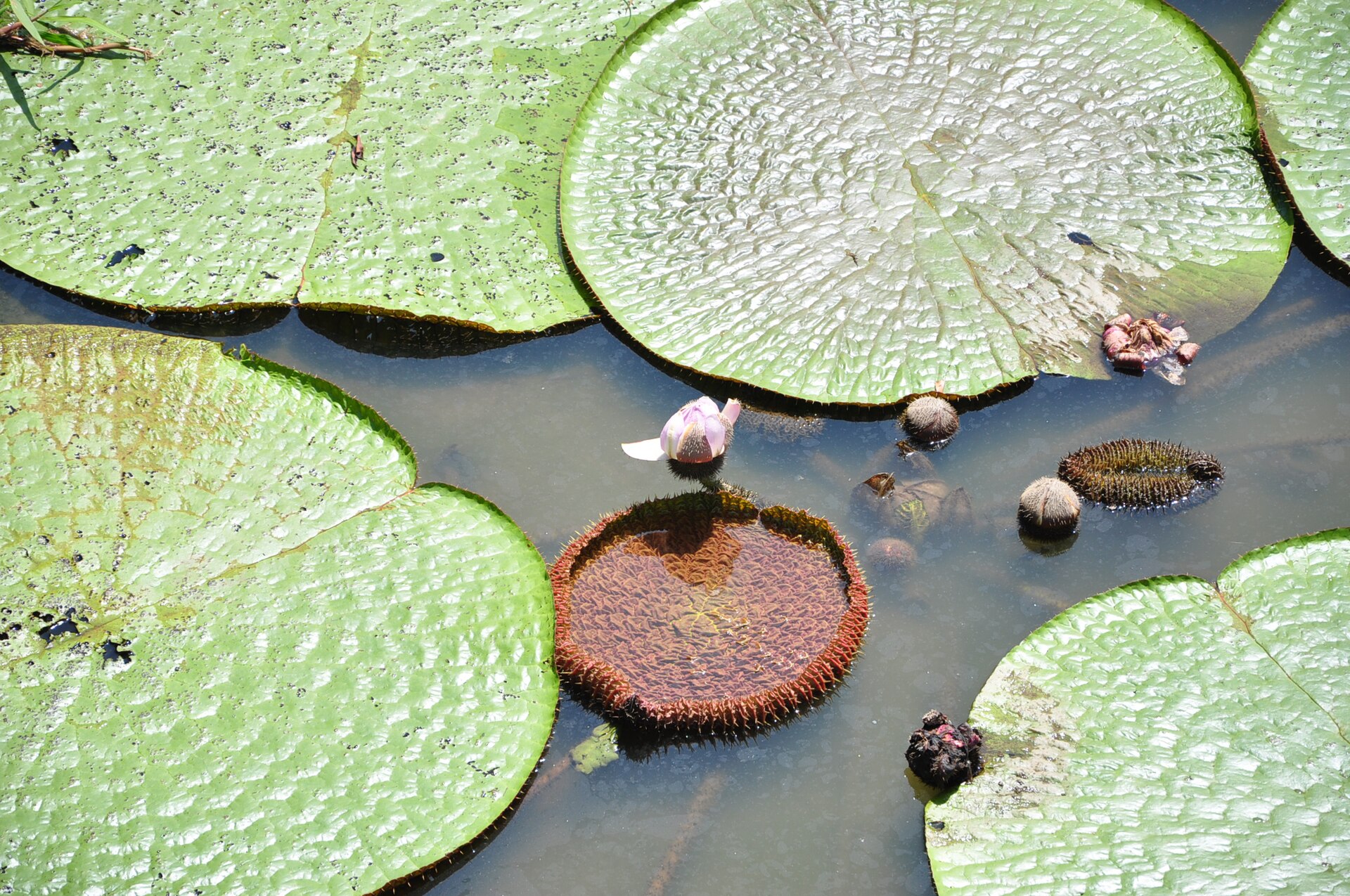
Living in a crowded tropical ecosystem requires an aggressive defense strategy [1][4]. The entire underside of each leaf, along with its long leaf stalks—known as petioles—and unopened flower buds, is covered in a dense coating of sharp spines [1, 3, 4]. These formidable hard spines prevent underwater herbivorous animals from grazing on the plant’s structural tissues or consuming its developing flowers [1, 3, 4].
The upper surface of the leaf encounters a completely different structural obstacle: heavy equatorial rainstorms [1][3]. If rainwater accumulated inside the vast floating dish, the sheer weight of trapped water could submerge the leaf [1][3]. To prevent drowning, Victoria amazonica utilizes specialized microscopic drainage pores called stomatodes scattered across the leaf surface [1][3]. Additionally, the upturned outer rim features small notched cutouts that allow trapped rainwater to drain rapidly back into the river [1][3].
A Two-Night Trap: Heat, Fragrance, and Beetles
The reproductive strategy of Victoria amazonica is a carefully timed, two-night biological drama [2, 3, 9]. On the first night, a white flower unfolds at the water’s surface [2, 3, 9]. To attract pollinators in the dark, the blossom initiates thermogenesis—a biological self-heating process that raises the flower’s internal temperature up to approximately 10°C above the surrounding ambient air [2, 3, 9]. This intense heating vaporizes a sweet, fruity scent reminiscent of pineapple, which wafts across the water to attract night-active Cyclocephala beetles [2, 3, 9].
As the night-active beetles crawl into the warm blossom, the flower slowly closes, trapping the insects inside for a full day [2, 3, 9]. During their day-long captivity, the beetles move around the interior chamber, feeding and becoming thoroughly covered in pollen [2][3]. On the second night, the flower reopens, revealing a striking transformation: the blossom has changed color from white to pink or red [1, 2, 3]. The pollen-coated beetles fly out to locate newly opened white flowers elsewhere, successfully completing the cross-pollination cycle [2][3]. Once pollination concludes, the flower contracts and sinks beneath the water surface to mature its seeds in safety [1, 2, 3].
Architectural Inspiration and the Great Size Reassessment
The structural geometry of Victoria amazonica has influenced human design far beyond tropical river systems [1, 2, 3]. In the nineteenth century, English architect Joseph Paxton studied the leaf’s underside framework of radiating hollow ribs and cross-bracing supports [1, 2, 3]. Inspired by the plant’s natural strength-to-weight efficiency, Paxton applied these structural principles to design the iron-and-glass framework of London’s famous Crystal Palace for the Great Exhibition of 1851 [1, 2, 3].
For nearly two centuries following its scientific description in 1837, Victoria amazonica was widely regarded as the largest water lily species in the world [1, 2, 6]. However, a detailed taxonomic reassessment published in 2022 revised this long-standing record [1][6]. Researchers formally described a distinct new species, Victoria boliviana, whose leaves can exceed 3.2 meters in width [1][6]. This classification established Victoria boliviana as the largest water lily species, placing Victoria amazonica as the second-largest species in the genus Victoria [1][6].
Linking Architecture, Defense, and Survival
Why does the biology of Victoria amazonica matter beyond its impressive size? Synthesizing these verified facts reveals a unified evolutionary package tailored for survival in competitive, flooded environments [1, 2, 3, 4]. The same hollow rib network that inspired nineteenth-century human architecture acts as a buoyant solar collector, holding space against rival aquatic plants [1, 2, 3, 5]. Meanwhile, sharp defensive spines protect this structural investment from aquatic grazers below, and microscopic stomatodes shed heavy downpours above [1, 3, 4]. When combined with thermogenic flowers that manipulate temperature and insect behavior to secure pollination, every anatomical detail functions together to maintain the plant’s dominance in slow-moving Amazonian waterways [1, 2, 3, 9].
Returning to the River’s Edge
So, could you really roll out a yoga mat and hold a pose on a giant Amazon water lily? If you step directly onto the floating leaf barefoot, point pressure will instantly tear the surface tissue, sending you straight into the water [5, 7, 8]. But place a flat, rigid board across that intricate grid of hollow, air-trapping ribs, and the leaf’s natural engineering can easily hold an adult floating above the stream [3, 5, 7, 8]. From its heat-generating, beetle-trapping blossoms to the spiky underside that reshaped modern architecture, Victoria amazonica remains one of nature’s most brilliant floating fortresses [1, 2, 3, 9].
Featured image credit
Image: Sèrgio Valle Duarte .mw-parser-output .messagebox{margin:4px 0;width:auto;border-collapse:collapse;border:2px solid var(–border-color-progressive,#6485d1);background-color:var(–background-color-neutral-subtle,#fbfcff);color:var(–color-base,#202122);box-sizing:border-box;border-inline-start-width:8px}.mw-parser-output .messagebox.mbox-small{font-size:88%;line-height:1.25em}.mw-parser-output .mbox-warning,.mw-parser-output .mbox-speedy{border:2px solid var(–border-color-error,#b22222);background:var(–background-color-error-subtle,#ffdbdb);border-inline-start-width:8px}.mw-parser-output .mbox-serious,.mw-parser-output .mbox-delete,.mw-parser-output .mbox-stop{border:2px solid var(–border-color-error,#b22222);border-inline-start-width:8px}.mw-parser-output .mbox-issue,.mw-parser-output .mbox-content{border:2px solid #f28500;background:var(–background-color-warning-subtle,#ffe);border-inline-start-width:8px}.mw-parser-output .mbox-query,.mw-parser-output .mbox-style{border:2px solid #f4c430;background:var(–background-color-warning-subtle,#ffe);border-inline-start-width:8px}.mw-parser-output .mbox-shit{border:2px solid #960;border-inline-start-width:8px}.mw-parser-output .mbox-license{border:2px solid #88a;border-inline-start-width:initial}.mw-parser-output .mbox-legal{border:2px solid var(–border-color-notice,#666);background:var(–background-color-base,#fff);border-inline-start-width:8px}.mw-parser-output .mbox-honor{border:2px solid #ca3;background:var(–background-color-warning-subtle,#fcf4db);border-inline-start-width:8px}.mw-parser-output .mbox-growth{border:2px solid #8d4;background:var(–background-color-success-subtle,#d5fdf4);border-inline-start-width:8px}.mw-parser-output .mbox-move{border:2px solid #93c;border-inline-start-width:8px}.mw-parser-output .mbox-protection,.mw-parser-output .mbox-message{border:2px solid var(–border-color-base,#aaa);border-inline-start-width:8px}.mw-parser-output .messagebox .mbox-text{border:none;padding:0.25em 0.9em;width:100%}.mw-parser-output .messagebox .mbox-image{border:none;padding-top:2px;padding-bottom:2px;padding-inline-start:0.9em;padding-inline-end:0;text-align:center}.mw-parser-output .messagebox .mbox-imageright{border:none;padding-top:2px;padding-bottom:2px;padding-inline-start:0;padding-inline-end:0.9em;text-align:center}.mw-parser-output .messagebox .mbox-empty-cell{border:none;padding:0;width:1px}.mw-parser-output .messagebox .mbox-invalid-type{text-align:center}@media(min-width:720px){.mw-parser-output .messagebox{margin:4px 10%}.mw-parser-output .messagebox.mbox-small{clear:right;float:right;margin:4px 0 4px 1em;width:238px}}body.skin–responsive .mw-parser-output table.messagebox img{max-width:none!important} Wikidata has entry Sergio Valle Duarte (Q16269994) with data related to this item. · Wikimedia Commons · CC BY 3.0 · original file
Sources and editorial policy
This feature is based on publicly available scientific and institutional sources listed below. Read our editorial and fact-checking policy and AI use policy. Report a correction: kjhtime@gmail.com
References
- wikipedia.org — en.wikipedia.org, accessed 2026-09-20
- nih.gov — pmc.ncbi.nlm.nih.gov, accessed 2026-09-20
- uada.edu — www.uaex.uada.edu, accessed 2026-09-20
- amazonriverlodge.com — www.amazonriverlodge.com, accessed 2026-09-20
- facebook.com — www.facebook.com, accessed 2026-09-20
- wikipedia.org — en.wikipedia.org, accessed 2026-09-20
- facebook.com — www.facebook.com, accessed 2026-09-20
- facebook.com — www.facebook.com, accessed 2026-09-20
- facebook.com — www.facebook.com, accessed 2026-09-20