

Imagine walking along a sunlit roadside in tropical America and spotting a sprawling, low-growing plant with delicate leaves [1][3]. Curiosity takes over, so you reach down and lightly touch a single tiny leaflet. In less than two seconds, the entire leaf branch folds inward and slumps downward toward the stem as if it has vanished into thin air [1][4]. Does this botanical performer understand your presence, shrink away out of shyness, or play dead to survive?
For centuries, onlookers have wondered whether this curious plant possesses a mind of its own [1][4]. Yet behind this dramatic display lies no emotion or human-like sensitivity, but rather a remarkable marvel of biological engineering [1][4]. By inspecting its habitat, hydraulic mechanism, and reproductive power, we uncover the true survival strategies of one of the world’s most dynamic plants [1, 2, 3, 4].
A Highway Edge Encounter in the Tropics
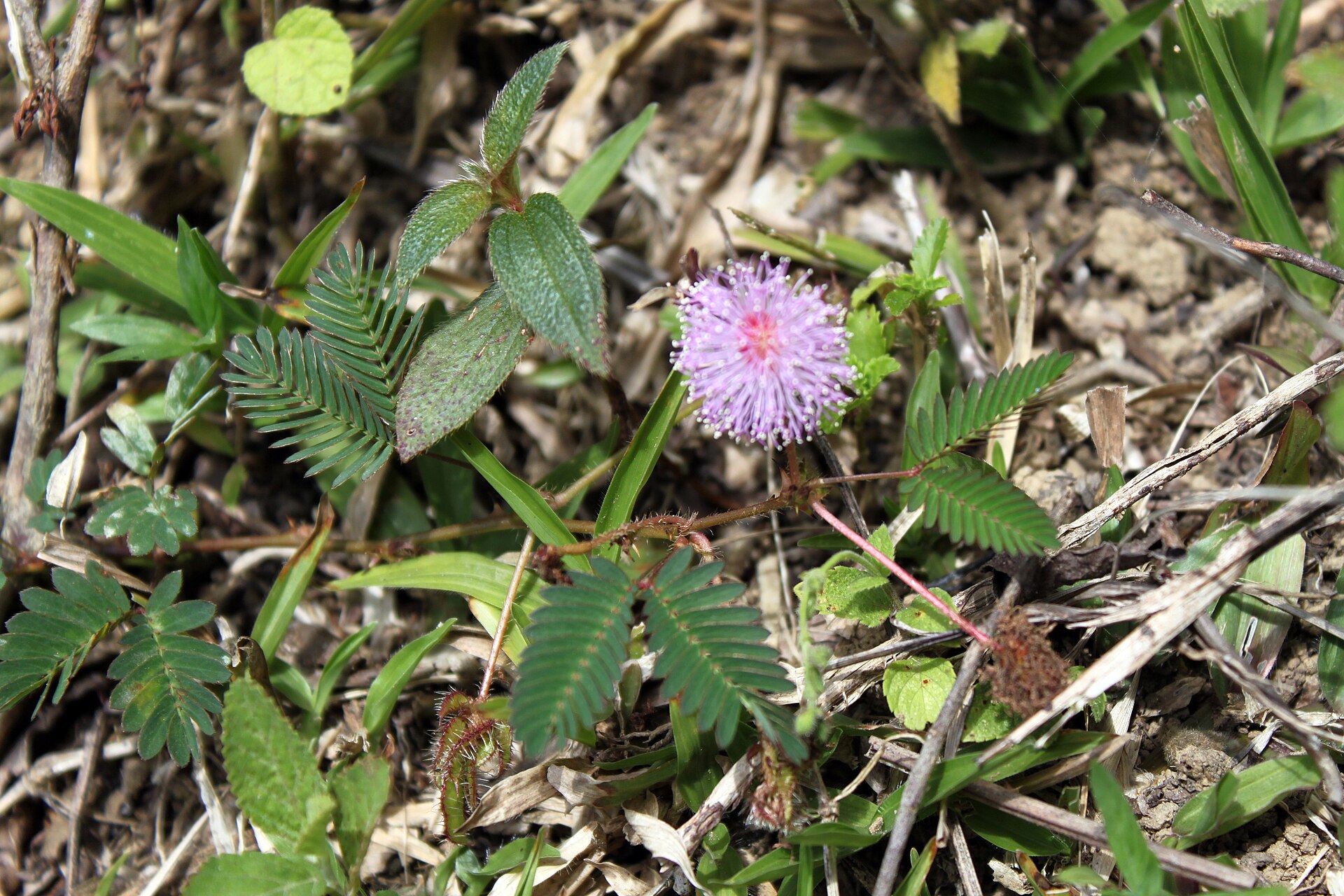
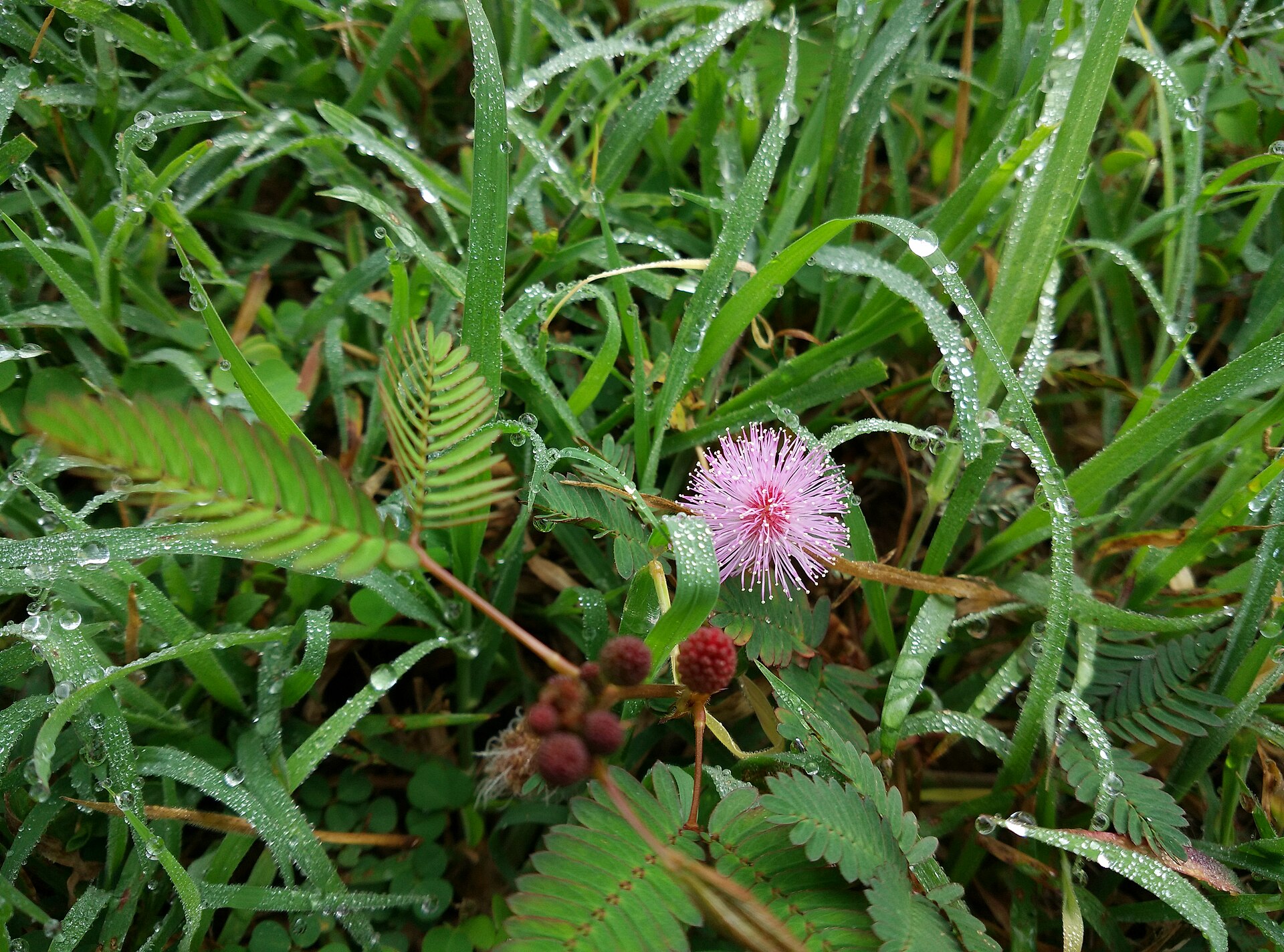
The subject of this touch-sensitive display is Mimosa pudica, a creeping herb or prostrate, drooping shrub belonging to the legume family, Fabaceae [1]. Native to Central America, South America, and the Caribbean, it thrives in environments that receive abundant sunlight [1][3]. It frequently colonizes disturbed habitats, including sunny road edges, open pastures, and forest margins [1][3].
Thanks to its extraordinary adaptability, Mimosa pudica has traveled far beyond its native range [1][3]. Today, it is widely established across tropical and subtropical regions in Asia, Africa, Australia, and various Pacific Islands [1][3]. On the Global Conservation Scale, the International Union for Conservation of Nature (IUCN) categorizes Mimosa pudica as a species of Least Concern [3]. However, in many introduced territories, its rapid spread has led agricultural authorities to classify it as an aggressive alien weed and ecological threat [1][3].
The Hydraulic Architecture of Rapid Motion
When an insect lands on Mimosa pudica or a human finger brushes its surface, the plant reacts almost instantly without possessing a single muscle cell [1][4]. Physical contact generates an internal electrical signal, known as an action potential, which travels rapidly through the plant tissue [1][4].
This electrical signal quickly reaches a specialized, swollen pad at the base of each leaf stalk called the pulvinus [1][4]. The pulvinus acts as a biological hinge, filled with specialized motor cells [1][4]. Upon receiving the electrical signal, these motor cells immediately flush out potassium and chloride ions [1][4].
This sudden movement of dissolved ions alters the cell’s osmotic pressure, driving water to exit the motor cells rapidly via osmosis [1][4]. As fluid drains out, the cells lose their internal fluid pressure—formally known as turgor pressure—causing the pulvinus to collapse and the leaves to fold tightly together [1][4]. Botanists classify this rapid, contact-triggered movement as a seismonastic movement [1][4].
Daily Rhythm and the 1729 Discovery
In addition to collapsing upon touch, Mimosa pudica responds continuously to light changes throughout the day and night [1][4]. As evening arrives and ambient light fades, the leaflets fold neatly together and remain closed until dawn [1][4]. In the morning, light signals cause the motor cells to regain turgor pressure, unfolding the leaves once more [1][4].
This light-dependent sleep movement is known as nyctinastic movement [1][4]. In 1729, French astronomer Jean-Jacques d’Ortous de Mairan conducted a foundational study on this exact behavior [1][4]. He placed the plant in a completely dark room and observed that it continued to open and close its leaves in synch with the natural day-night cycle [1][4]. This demonstrated for the first time that plant movements are governed by internal circadian rhythms rather than passive reactions to sunlight alone [1][4].
A Calculated Defense, Not Shy Behavior
Popular folklore often suggests that Mimosa pudica feels shy, gets tired, or even responds to human voices and emotions [1][4]. Myth-busting botanical evidence shows that the plant cannot comprehend human speech or feel social shyness [1][4]. When a plant closes after someone speaks near it, it is responding strictly to sound wave vibrations or physical movement hitting its mechanical receptors [1][4].
Similarly, folding up is not an act of pretending to sleep out of fatigue, but an active, calculated survival mechanism [1][4]. By folding its leaves within seconds, Mimosa pudica reduces its visible leaf surface area and makes itself look wilted, unappealing, and small to hungry herbivores [1][4].
Furthermore, as the foliage collapses, it exposes sharp thorns hidden along its stems, creating an immediate physical barrier against grazing animals and leaf-eating insects [1][4]. Closing the leaves during sudden storms also protects delicate plant structures from heavy rainfall and extreme thermal heat stress [1][4].
The Invasive Powerhouse: Nitrogen and Seeds
Understanding why Mimosa pudica thrives as a globally successful invader requires connecting its rapid motion defenses with its hidden underground biology [1, 2, 3, 4]. Defensive touch movements protect the foliage above ground, but the plant’s true ecological dominance relies on its root system and massive seed output [1, 2, 3].
As a member of the legume family, Mimosa pudica forms a symbiotic partnership with specialized root nodule bacteria, known as Rhizobium [1][2]. These bacteria absorb atmospheric nitrogen and convert it into accessible soil nutrients [1][2]. This biological nitrogen fixation allows Mimosa pudica to flourish in nitrogen-poor, barren, or heavily disturbed soils where native plants struggle to survive [1, 2, 3].
At the same time, a single individual plant can produce over 600 seeds every year [1][3]. Encased in tough, durable seed coats, these seeds can lie dormant in soil seed banks for decades while retaining their viability [1][3]. When combined with rapid hydraulic leaf defense, nitrogen fixation and long-lived seed banks transform this simple weed into a formidable pioneer species capable of outcompeting local flora across worldwide tropical zones [1, 2, 3, 4].
Plant Intelligence or Cellular Fatigue?
Because Mimosa pudica displays such fast physical responses, researchers have long debated whether it possesses basic learning capabilities [1][4]. A widely discussed 2014 experiment led by Monica Gagliano investigated this question by repeatedly dropping potted plants from a set height onto a soft surface [1][4]. Initially, the plants folded their leaves tightly upon impact [1][4]. However, after multiple drops caused no physical harm, the plants stopped folding their leaves, suggesting they had learned that the dropping force was non-threatening [1][4].
Despite these intriguing results, plant physiologists express strong skepticism regarding claims of plant intelligence or brain-like memory [1][4]. Critical researchers point out that the lack of folding can be fully explained by physiological habituation, cellular fatigue, temporary depletion of cellular energy stores like adenosine triphosphate (ATP), or adaptation in sensory receptors [1][4].
While consensus confirms that Mimosa pudica demonstrates genuine physiological habituation to repeated mechanical stimulation, mainstream science maintains that interpreting this as conscious learning or memory remains completely unsupported by physical evidence [1][4].
Confronting the Botanical Survivor
Returning to that sunlit roadside, reaching out to touch Mimosa pudica reveals something far more impressive than a timid herb playing dead [1, 3, 4]. The sudden collapse of its leaves is not driven by fear, human emotion, or physical exhaustion [1][4].
Instead, it is an exquisite hydraulic reaction powered by ion movements, turgor pressure shifts, and millions of years of evolutionary refinement [1][4]. Supported by nitrogen-fixing roots, protective stem thorns, and durable seed banks, Mimosa pudica stands as a masterclass in plant survival [1, 2, 3, 4]. The next time you watch its leaves fold shut, you are witnessing one of nature’s most effective defense systems in motion [1][4].
Featured image credit
Created by TaxonGuru · AI-generated featured explanatory reconstruction · not a documentary photograph · generated 2026-09-05
Sources and editorial policy
This feature is based on publicly available scientific and institutional sources listed below. Read our editorial and fact-checking policy and AI use policy. Report a correction: kjhtime@gmail.com
References
- wikipedia.org — en.wikipedia.org, accessed 2026-09-05
- pfaf.org — pfaf.org, accessed 2026-09-05
- iucngisd.org — www.iucngisd.org, accessed 2026-09-05
- nih.gov — pmc.ncbi.nlm.nih.gov, accessed 2026-09-05